Disinfectant Cleaning Products: A Practical Guide for Homes
You're standing in the kitchen in Dallas, the coffee's brewing, a dog is waiting for dropped toast, and the spray bottle under the sink suddenly looks more complicated than it should. That's the moment a lot of people realize disinfectant cleaning products aren't really about “clean” versus “dirty,” they're about using the right product the right way, so you're not trading a shiny counter for extra fumes, residue, or guesswork.
In homes across Dallas, Plano, and Lakewood, the central question isn't whether a bottle says disinfectant. It's whether that bottle fits the job, the surface, and the people who live there. Healthy cleaning starts with choosing less when less is enough, and choosing disinfection only when it's justified.
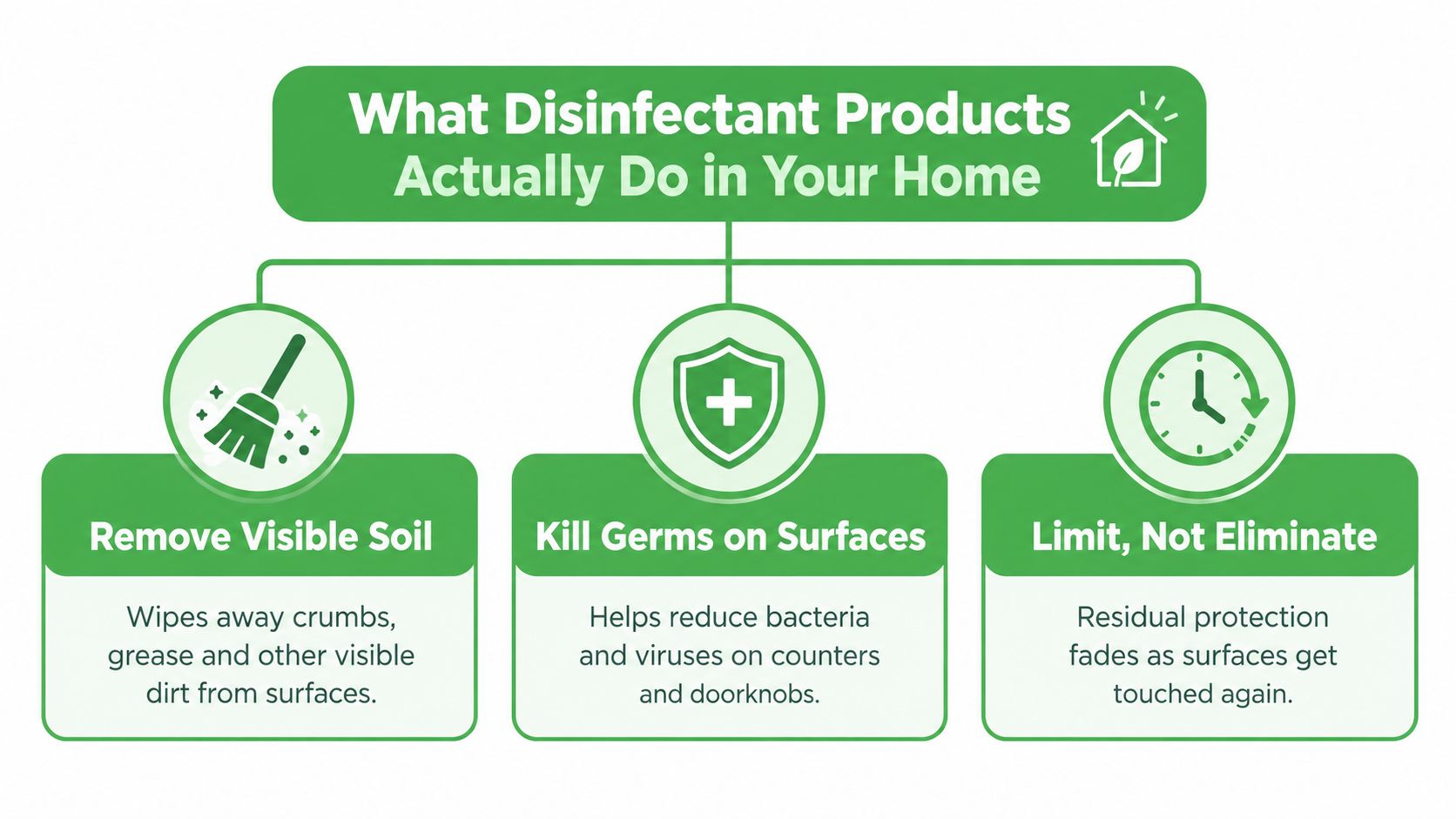
Table of Contents
What These Products Actually Do in Your Home
A disinfectant bottle can make a kitchen look like it has all the answers, but the product can only do its job if the surface, the timing, and the use match the label. That matters in Dallas homes where breakfast crumbs, pet paws, and AC-season dust all end up on the same countertops.
A useful way to think about disinfectant cleaning products is that they sit between routine tidying and heavier-duty microbial control. They are not magic, and they're not meant for every wipe-down. They're tools for specific situations, especially when someone is sick, a surface is shared often, or a high-touch area needs more than soap and water.
Practical rule: if a surface is visibly dirty, clean it first. A disinfectant works better on a surface that isn't coated in grease, dust, or food residue.
What changes in a real home
In a busy Dallas kitchen, one spray bottle might get used for three different jobs. Wiping flour off the island, cleaning a sticky fridge handle, and treating a bathroom touchpoint after illness are not the same task, even if they look similar from across the room. That's where confusion starts.
For families in Highland Park, Plano, or Lakewood, the goal is not to stock every possible cleaner. The goal is to understand what each bottle does, so you don't overuse stronger chemistry in places where ordinary cleaning is enough. That also helps keep fumes and residue down around babies who crawl, pets who nap on floors, and adults who are sensitive to fragrance or harsh odors.
A disinfectant should be chosen because the situation calls for it, not because the label sounds more serious. When you start from that mindset, the rest gets simpler, safer, and more intentional.
Cleaning, Sanitizing, and Disinfecting Explained
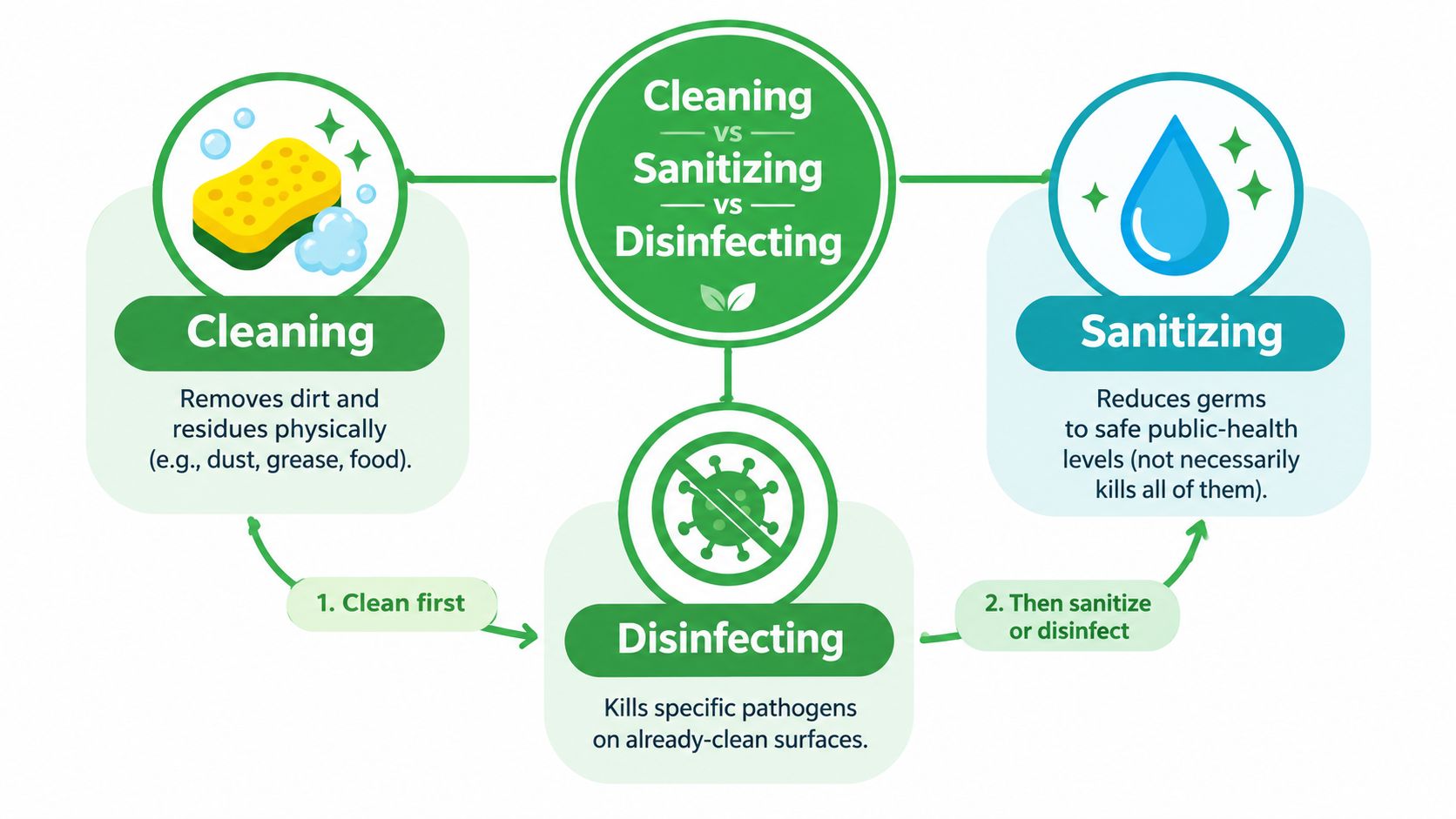
These three words get mixed up all the time, but they don't mean the same thing. Cleaning removes dirt and residue. Sanitizing lowers germs to a safer level on certain surfaces. Disinfecting is the strongest step, used to kill specific pathogens on already-clean surfaces.
The simplest way to tell them apart
Cleaning is what you do when you wipe a sticky counter with soap and water. The mess comes off because you're physically lifting it away, not because the product is trying to kill every microorganism in the room. That's why cleaning is the default move for most everyday surfaces in Dallas homes.
Sanitizing sits in the middle. It's common on food-contact areas and other places where lowering germ counts matters, but where full disinfection isn't necessary. Disinfecting goes further, and that's exactly why it should be reserved for the right moments, like a shared bathroom after illness or a high-touch surface that needs label-based treatment.
On a normal Tuesday, a clean surface is often enough. On a sick day, the question changes.
Why the sequence matters
A sticky stove knob and a dusty doorknob are not good candidates for the same shortcut. Soil can block coverage and reduce how well a product works, which is why the clean first, then sanitize or disinfect approach keeps showing up in label science and public guidance. It's also why a “stronger” spray is not automatically a smarter one.
In households with toddlers, cats, or someone who gets headaches from strong scents, that distinction matters even more. A home in Dallas doesn't need to smell like a chemical aisle to be genuinely clean. It needs the right process in the right order, with the right product for the job.
Active Ingredients Worth Knowing
If you've ever compared two bottles side by side in a Dallas store and felt like you were reading a different language, the active ingredient line is the part worth slowing down for. That line tells you what's doing the actual work. The rest of the label tells you how to use it safely and legally.
What the ingredient usually signals
Hydrogen peroxide is an oxidizer, so it works by breaking down microbial structures and then turning into water and oxygen after use. That makes it a common fit for people who want less lingering residue than harsher formulas can leave behind. Citric acid and lactic acid are acid-based options, often used in products that need antimicrobial action with a different surface profile than bleach-heavy sprays.
Thymol is plant-derived and shows up in some botanical formulations. Quaternary ammonium compounds, often shortened to quats, are widely used in disinfectants and can leave a residual film on surfaces. That can be useful in some settings, but it's not ideal for every household, especially when people are sensitive to lingering product feel or indoor air.
Why bleach and ammonia deserve extra caution
Bleach and ammonia are effective at certain jobs, but they're not casual ingredients. Mixing bleach with ammonia or other cleaners can create dangerous vapors, and that risk matters in closed Dallas homes where AC systems keep air circulating for long stretches. For kids, pets, and anyone with respiratory sensitivities, fumes and residues aren't abstract concerns, they're part of the daily decision.
Good label reading beats product hype: the ingredient list tells you what's in the bottle, but the directions tell you whether it's appropriate for your surface, your air, and your household.
If you're comparing non-toxic routines for pets as well as people, a good starting point is pet-safe cleaning products. For Dallas homes trying to keep things calmer around crawl spaces, pet beds, and baseboards, ingredient choice matters more than scent strength.
How EPA Registration Actually Works
A disinfectant can carry an EPA registration and still be the wrong fit for your job. Registration means the product's claims and directions were reviewed together, so the label is more than marketing. That matters in Dallas homes and offices, where people often want clear answers about what is safe, what is effective, and what is just extra chemical load.
The older EPA records show why the label deserves attention. In a published EPA report, the agency described about 5,000 registered antimicrobial pesticide products containing one or more of 256 active ingredients, and it said the antimicrobial registration backlog fell from 388 cases in December 1996 to 90 by June 30, 1997, a 77% decrease (EPA report). In a later EPA assessment, published in 2010, the agency said it had tested 379 of 6,566 active hospital disinfectants, which left more than 40% untested under the cited efficacy program, and more than one-third of the tested hospital-disinfectant products had failed efficacy tests on average (EPA report). These figures are dated, but they explain the basic point. Registration is a review step, not a blanket promise that every bottle performs equally in every situation.
What to check on the label
Start with the EPA registration number, then look at the active ingredient, the organism claim, and the directions for use. Those details tell you whether the product belongs on a hard nonporous surface, a soft surface, or a food-contact area, and they tell you how long the surface has to stay wet.
Fragrance claims deserve the same attention. EPA's Safer Choice program uses a specific fragrance-free label for products that meet its standard, and that is different from a product that merely smells lighter after spraying. For Dallas families comparing products in Frisco or Highland Park, the label matters more than the front-of-package promise.
Bottom line: EPA registration supports the claim, but the label tells you whether the product fits the task.
When Disinfecting Helps and When Soap and Water Is Enough
A lot of homes disinfect too much. The cleaner the bottle sounds, the easier it is to assume more use equals better protection, but CDC guidance is more selective than that. Household disinfection is generally not needed unless someone is sick or has recently visited while sick (CDC home guidance).
That changes the decision in ordinary Dallas life. A kitchen counter after making sandwiches is usually a cleaning job. A bathroom after a sick visitor, or a high-touch area during a household illness, is where disinfection starts to make sense. The question isn't “How often can I spray?” It's “What situation am I responding to?”
Think in situations, not in fear
A high chair after a normal meal needs soap and water. A high chair after illness in the home might need a disinfecting step if the product label matches the surface and the contact time. A doorknob on an ordinary week can often be handled with cleaning, while a shared bathroom after a sick grandchild visits from Southlake may warrant a different approach.
For pet-related cleanups, it helps to use resources built for the specific problem. A useful overview of surface-level pet cleanup is antiseptic wipes for dogs, especially when you're trying to keep the approach targeted instead of turning every corner of the house into a disinfecting project.
The same principle shows up in commercial spaces too. A small office in Dallas doesn't need the same treatment on every desk every day, but it does benefit from a plan that separates routine cleaning from targeted sanitizing or disinfecting where it belongs. If you're mapping that out, a focused option like office disinfecting and sanitizing in Dallas can fit into a broader maintenance routine.
Safe Use Practices Every Household Should Follow
The most common mistake with disinfectant cleaning products is simple. People spray, wait a second, and wipe. If the label says the surface needs to stay wet for longer, that shortcut can undo the point of the product.
The wet contact time rule
Contact time is the period the surface must remain visibly wet for the product to work as labeled. Some products are designed around shorter times, while others need much longer. A 30-second claim isn't the same as a 10-minute claim, and a surface that dries too early may need another application.
That's why timers help. In a Dallas kitchen, a small bottle can be part of a good system, but the system has to follow the label rather than the clock in your head. On high-touch surfaces, wet coverage is the job, not a quick pass.
The rest of the safety routine
Clean first, then disinfect if the situation calls for it. Open a window when you can, run the bathroom fan, and don't mix products to “make them stronger.” Bleach and ammonia are a dangerous combination, and that isn't a theory, it's a real poisoning risk.
- Ventilate the space: Open windows or use exhaust fans so fumes don't build up in recirculated indoor air.
- Store products carefully: Keep bottles out of reach of children and pets, especially in homes with curious toddlers or new puppies.
- Use gloves when directed: If the label calls for protective gear, treat that as part of the product, not optional add-on advice.
- Use one product at a time: Never combine cleaners in the same container or on the same surface unless the label explicitly says to do it.
Practical rule: if the instructions are vague, the product is not ready for a guess.
For Dallas homes running AC for much of the year, fragrance-free and lower-fume choices are easier to live with than sprays that linger in the air. That matters in a baby's room, a pet area, or a bathroom that doesn't clear out quickly.
| Situation | Best Approach | Product Type to Reach For | Watch For |
|---|---|---|---|
| Everyday kitchen mess | Clean only | Soap and water or a mild all-purpose cleaner | Soil removal first |
| Sick-day bathroom | Clean, then disinfect | EPA-registered disinfectant with the right label claim | Wet contact time |
| Food prep after normal use | Clean, sometimes sanitize | Sanitizing cleaner or soap and water | Surface compatibility |
| Shared high-touch area | Targeted disinfecting | Labeled disinfectant, used exactly as directed | Ventilation and drying time |
Conventional Disinfectants and Non-Toxic Alternatives Compared
A Dallas household does not usually need the harshest product on the shelf. It needs the right match for the job, the surface, and the people living with the result. That is why side-by-side comparison helps. Once you compare label claims, scent, residue, and contact time, the trade-offs become much easier to see.
How the main options differ
Bleach-based and ammonia-based products can be effective in the right setting, but they are also the ones most likely to leave strong fumes or noticeable residue. That can matter in homes with children, pets, pregnancy concerns, asthma, or fragrance sensitivity. The label tells you where those products belong, and where they do not. Use them only for the specific job the directions describe.
Non-toxic alternatives usually center on hydrogen peroxide, citric acid, lactic acid, or thymol-based formulas. These often feel easier to live with, but they still need the same careful reading. A milder smell does not automatically mean a product works on every surface or every germ.
A practical approach is to keep routine cleaning fragrance-free and plant- or mineral-based, then bring in EPA-registered disinfectants only when the situation calls for disinfection. Gmaids uses that kind of approach in Dallas, and green cleaning and non-toxic maid service in Dallas shows how that can fit into a household routine without turning the home into a chemistry lab. Non-toxic thinking applies beyond disinfectants too, as shown in the Pestless Inc. roach guide, which follows the same idea of choosing the least harsh method that still handles the problem.
| Product Type | Efficacy Fit | Surface Feel | Fume and Residue Profile | Household Fit | Watch For |
|---|---|---|---|---|---|
| Bleach-based disinfectant | Strong for specific label claims | Can be harsh on some surfaces | Strong odor, residue possible | Best only when the job really calls for it | Never mix with ammonia or other cleaners |
| Ammonia-based cleaner | Useful for certain cleaning tasks | Can cut grease well | Noticeable fumes | Less ideal in sensitive homes | Do not combine with bleach |
| Hydrogen peroxide formula | Broadly useful in many homes | Usually lighter feel | Less lingering than harsher options | Good for families wanting fewer harsh chemicals | Check surface compatibility |
| Citric or lactic acid product | Good for targeted use | Often milder on feel | Usually less offensive indoors | Fits fragrance-conscious households | Read exact surface directions |
| Thymol-based product | Botanical-leaning option | Depends on formula | Can still have a scent | Common in natural-leaning routines | Botanical does not mean risk-free |
Fragrance-free is its own category
Fragrance-free means fragrance has been left out, not hidden under another name. Unscented can still include masking agents or leave a chemical smell after the first note fades. For families in Frisco, Dallas, or Highland Park, that difference matters because what stays in the air and on baseboards can matter just as much as what is in the bottle.
A product can also be fragrance-free without being the right fit for every person or every surface. Ingredient list, surface use, and the setting still need to line up. That is why the comparison has to include both the chemistry and the household, not just one or the other.
Building a Disinfecting Routine That Fits Your Household
The easiest routine to keep is the one that matches real life. In Dallas, that usually means regular cleaning as the backbone, targeted disinfection when illness or shared-contact situations call for it, and a product shelf that doesn't turn into a chemistry experiment. For holiday hosting in Lakewood, post-renovation cleanup in a newer north-suburb home, or a pet incident that needs more than a wipe, the plan should stay simple enough to use under pressure.
A service like Gmaids can fit into that kind of routine with Basic Cleaning, Deep Cleaning, Move-In/Move-Out Cleaning, Post-Construction Cleaning, Recurring Maid Service, Office Cleaning, Commercial Cleaning, and Sanitizing Cleaning. Those services are carried out by Gmaids Certified Cleaning Teams®, who are trained, background-checked, and insured, using non-toxic, fragrance-free products without bleach or ammonia. For households in Dallas, Plano, or Southlake that want fewer harsh chemicals around kids and pets, that makes day-to-day upkeep more predictable.
How the routine usually looks
One practical pattern is to keep weekly or biweekly cleaning focused on soil removal and surface care, then add targeted sanitizing when a bathroom, office, or shared touchpoint needs it. Move-in and move-out work often benefits from deeper attention inside the fridge, oven, cabinets, drawers, and closets, while post-construction jobs need dust control and residue removal before a family settles in. For office settings, the same logic applies, especially around high-touch areas and shared spaces.
That approach also fits what busy families in Dallas are already juggling, from allergy season dust to long AC stretches to pet-friendly households. If you're also trying to keep equipment and shared gear in decent shape, a practical resource like how to maintain gym gear shows the same kind of habit-based thinking.
Gmaids has served Dallas–Fort Worth since 2004, with a 4.8-star Google rating, trust from 7,500+ families, and features in Forbes and on NBC 5 DFW. The company also backs its work with a 24-hour satisfaction policy, so if something isn't right, you can let them know within 24 hours and they'll make it right.
If you want a cleaner Dallas home without guessing at the bottle under your sink, Gmaids can help you build a routine around the right products, the right timing, and the right level of disinfection for each space. Visit Gmaids to get an instant, flat-rate quote online, or call 214-997-6918 to talk through what your home, office, or move actually needs.


Ready for a healthier, cleaner home?