Maid Service Arlington TX: Choosing the Right Plan
You've vacuumed, but there's pet hair along the baseboards again. The bathroom needs attention, guests are coming, and the last cleaner left a perfume smell that lingered longer than you wanted. Choosing a maid service in Arlington, TX, should start with what's happening in your home, not the biggest cleaning package.
A good plan separates a one-time reset from ongoing upkeep, then accounts for pets, pollen, renovation dust, and fragrance-sensitive occupants. You shouldn't have to choose between a clean floor and knowing what's in the spray bottle.
Table of Contents
- Maid Service Options in Arlington at a Glance
- Choosing Weekly, Biweekly or Monthly Service
- Why Fragrance-Free Cleaning Matters at Home
- When Sanitizing Cleaning Makes Sense
- Post-Construction Cleaning After Renovations
- Seasonal Dust and Pollen Plans for North Texas Homes
- Booking Your Arlington Cleaning Visit
Maid Service Options in Arlington at a Glance
| Service | Best for | When to book | What it covers |
|---|---|---|---|
| Basic cleaning | Homes in good condition | Set schedule or one-time | Routine maintenance cleaning |
| Deep cleaning | Built-up grime or a first visit | One-time | Detailed top-to-bottom cleaning |
| Move-in/move-out cleaning | Renters, landlords, buyers and sellers | Before or after a move | Inside fridge, oven, cabinets, drawers and closets |
| Post-construction cleaning | New builds and renovations | After work is finished | Dust, debris and residue removal |
| Recurring maid service | Busy families and pet owners | Weekly, biweekly or monthly | Same team and same day each visit |
| Sanitizing cleaning | High-touch areas | As needed or scheduled | EPA-approved disinfectants, advanced fogging or botanical solutions |
Basic cleaning is the sensible choice when your home is already in good condition. You need the bathrooms, kitchen, floors, and everyday surfaces maintained rather than a major catch-up visit. Choose deep cleaning when bathroom buildup, kitchen grease, and neglected edges need detailed attention before maintenance begins. If the dog has been shedding along the baseboards all spring and no amount of vacuuming keeps up, start with the deep clean and drop to basic from there.
For a move, book around access to the empty property. Move-in/move-out cleaning reaches inside the fridge, oven, cabinets, drawers, and closets, so renters, landlords, and buyers aren't trying to clean around boxes. Post-construction cleaning is a separate job because renovation residue needs a different sequence from ordinary household dirt.
Match the visit to the problem
Recurring maid service handles predictable upkeep, which suits Arlington households where pets, kids, and pollen tracked in from March onward keep floors from staying clean. Sanitizing cleaning addresses selected high-touch surfaces when there's a reason for additional treatment, such as illness in the home or a fragrance-sensitive occupant who needs botanical solutions rather than standard disinfectants. Don't buy sanitizing as a substitute for removing visible grime.
Gmaids has provided non-toxic, green house cleaning in Dallas since 2004. Our Gmaids Certified Cleaning Teams® are trained, background-checked, and insured, and perform one-time services and customized maintenance plans. We also offer office cleaning and commercial cleaning for workplaces, including retail locations and medical practices.
Start with the condition of the home: A maintenance visit shouldn't be expected to absorb an overdue deep clean.
Find the row that describes your home today. Then pick the schedule that keeps it from returning to that same starting point.
Choosing Weekly, Biweekly or Monthly Service
Arlington averaged 2.74 persons per household during 2020–2024, according to the U.S. Census Bureau. That's a useful baseline, but the dog, toddler, cooking habits, and hours spent at home matter more than head count alone.
| Household situation | Suggested frequency | Why it fits |
|---|---|---|
| Pets, allergies or young children | Weekly or biweekly | Hair, dander and floor dirt build up quickly |
| Busy professional family | Biweekly | Steady upkeep without booking every week |
| Tidy household with light upkeep | Monthly | Covers living spaces, floors, bathrooms and kitchens between deeper cleans |
| Frequent hosting or guests | Weekly or biweekly before events | Keeps kitchens and bathrooms ready on short notice |
| Recent move or renovation | One-time clean first, then recurring | Recurring visits start once the home has settled |
Weekly service is my recommendation when floor dirt becomes a problem well before the next visit. It's especially practical when pets shed heavily or children spend much of their time playing on the floor.
For busy professional families, biweekly cleaning is a strong starting point. You'll still handle spills and daily tidying, but you won't spend every free weekend catching up on bathrooms.
When monthly makes sense
Monthly service suits a tidy household that handles light upkeep between appointments. Our monthly recurring service includes all living spaces, dusting, vacuuming and mopping floors, bathroom and kitchen sanitation, trash removal, and surface polishing.
Before holiday hosting, temporarily increase visits rather than expecting one appointment to handle accumulated dirt and event preparation. Following a move or renovation, begin with the appropriate one-time service.
Our recurring plans maintain the same experience and day each visit, with consistent team assignments where possible. Watch the first two visits, then adjust if dust and grime return faster or slower than expected.
Why Fragrance-Free Cleaning Matters at Home
A lemon-scented spray can make a kitchen feel freshly cleaned. It doesn't tell you whether the counter is clean or what you're breathing. The EPA's indoor-air guidance identifies cleaning supplies as sources of volatile organic compounds, or VOCs, and cites studies finding several organic compounds averaged two to five times higher indoors than outdoors.

Read these labels differently:
- Fragrance-free: Synthetic scent is left out entirely, rather than replaced with perfume.
- Unscented: The product may contain masking ingredients that cover its odor.
- Natural or plant-based: These descriptions don't, by themselves, guarantee low emissions or suitability for sensitive occupants.
The EPA's greener-cleaning guidance supports evaluating product attributes and ingredients rather than relying on reassuring marketing language.
Fragrance-free means no synthetic scent was added. Unscented can still mean scent was masked.
Ingredients and application both matter
Our non-toxic, fragrance-free approach uses plant-derived and mineral-based products, with no bleach, ammonia, or synthetic fragrance. It's an approach built around fewer harsh chemicals, better suited to sensitive households, including those with kids, pets, pregnant moms, allergies, asthma, or chemical sensitivities. It isn't a medical guarantee.
Think about residue on floors where babies crawl and pets nap, not just the smell at standing height. Careful cleaning means reading and documenting labels, measuring dilution correctly, closing containers, ventilating where feasible, and avoiding unnecessary spraying or mixing products.
For more label-reading context, BacteriaFAQ.com's resource on choosing safe cleaners for sensitive homes offers another starting point. Our fragrance-free cleaning guide explains the service distinction.
Before your appointment, make these questions part of the conversation: Which products will be used? Can the product list and Safety Data Sheets be shared? Tell us about specific sensitivities before the team arrives.
When Sanitizing Cleaning Makes Sense
Routine cleaning isn't the same as disinfection. The CDC's household guidance says soap and water remove most germs in most situations; household disinfection generally isn't necessary unless someone is sick or someone sick recently visited.
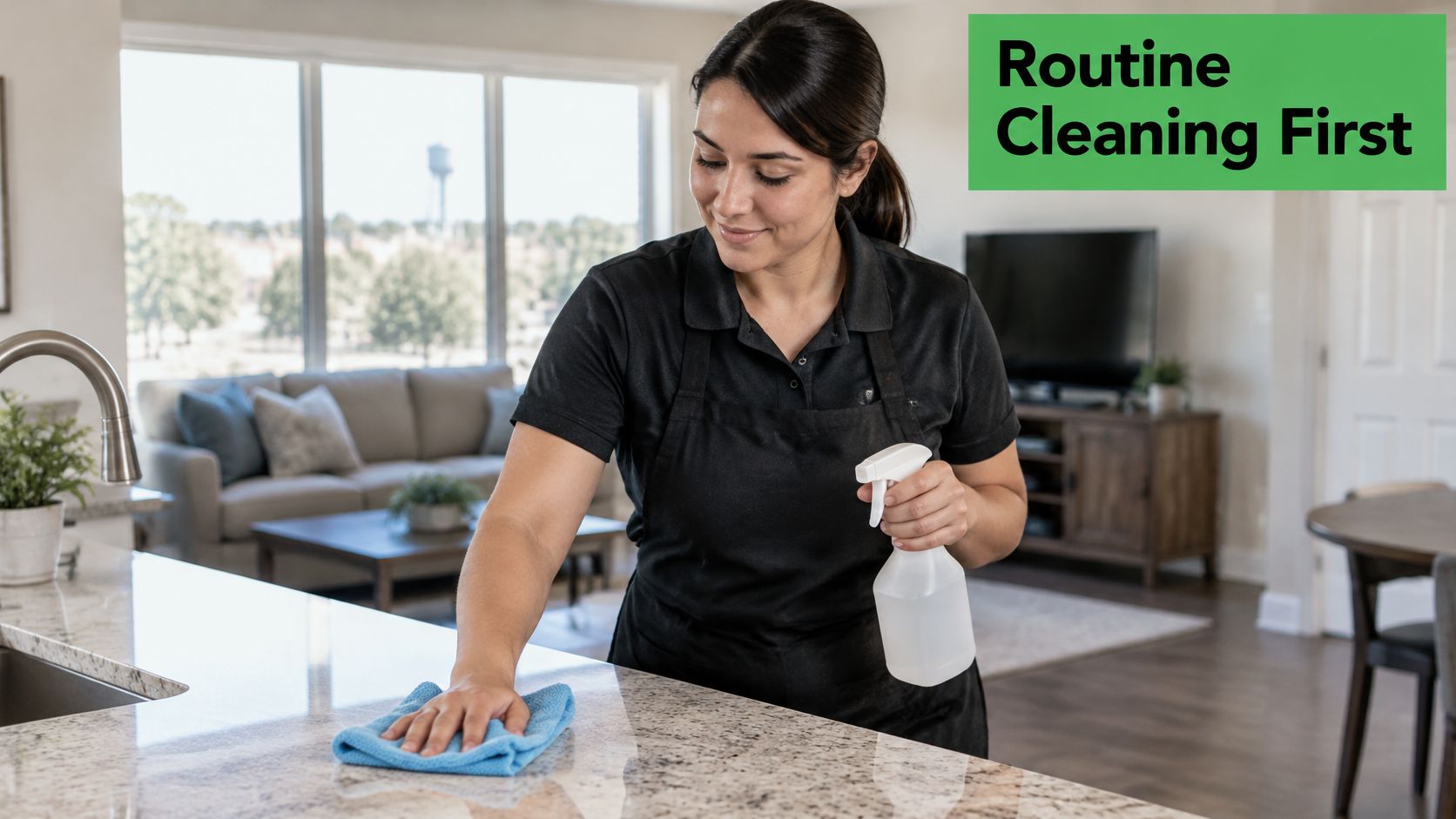
Targeted sanitizing cleaning can make sense for door handles, switches, faucets, remotes, and kitchen counters after illness. Offices, coworking spaces, retail counters, and medical practices need a plan appropriate to their use, not an automatic household checklist.
Follow the full contact-time sequence
- Clean first. Remove dirt and residue so they don't interfere with the disinfectant.
- Apply an EPA-registered product to compatible surfaces exactly as directed.
- Keep the surface visibly wet for its labeled contact time. Don't assume a quick spray is enough.
- Wipe or allow drying only after that interval, following any rinsing instructions, particularly on food-contact surfaces.
CDC guidance on dwell time explains why the uninterrupted interval matters: wiping too early can deny the product the exposure time it needs.
Our sanitizing service uses EPA-approved disinfectants, advanced fogging technology, and non-toxic botanical solutions. Fogging is appropriate only when the product label authorizes the method and conditions; a botanical ingredient doesn't independently establish disinfecting performance.
Use a checklist recording the product, target areas, contact time, and completion. Our cleaning versus sanitizing explanation helps clarify which treatment fits.
Before scheduling, settle three details: which surfaces are covered, how long they must stay wet, and what occupants must do before re-entering.
Post-Construction Cleaning After Renovations
The contractor's departure doesn't mean renovation dust has finished settling. Fine residue can remain on fixtures, vent covers, and door frames, then become noticeable again when you start using the rooms.
For an Arlington renovation, a remodeled Dallas home, or new construction in Plano, Frisco, or Prosper, schedule post-construction cleaning after dust-producing work is complete. Don't squeeze it between sanding and the next contractor visit.
Use a controlled cleanup sequence
- Get the contractor's product information. Identify finishes, adhesives, and surface-care restrictions, then arrange fresh-air ventilation where feasible.
- Remove loose debris and bulk dust before wet cleaning. Otherwise, you'll turn dry residue into a film that takes more work to remove.
- Work from the top down: ceiling fans, vent covers, light fixtures, and door frames. Dust falling from above shouldn't land on finished floors.
- Vacuum floors, baseboards, and window tracks with suitable fine-dust equipment. Avoid spreading construction dust with aggressive dry sweeping.
- Detail interiors. Include cabinets, drawers, and appliances in the agreed scope before belongings go back.
- Wipe compatible surfaces with low-emission products, correctly diluted. Never improvise chemical mixtures to tackle stubborn residue.
- Walk through before handover. Inspect corners, ledges, storage interiors, and floors with the homeowner while access is clear.
The EPA's Care for Your Air guide identifies building materials and remodeling products as potential VOC sources and recommends ventilation, product warnings, and proper storage practices.
Our after-renovation cleaning guide can help you coordinate the handoff. If dust entered the HVAC system, have an HVAC professional assess filters and whether duct service is warranted; it shouldn't be an automatic purchase.
The finish line is a home that's clean and comfortable to live in, not ready for photographs alone.
Seasonal Dust and Pollen Plans for North Texas Homes
| Season | Pollen source | Cleaning focus |
|---|---|---|
| December to February | Mountain cedar | Entryways, rugs, furniture and floors where pollen tracks in |
| February to June | Tree pollen, including oak | More frequent dusting, vacuuming and floor mopping during peak weeks |
Children's Health identifies mountain cedar pollen in Texas commonly from December through February, and tree-pollen season roughly February through June, with oak among the spring sources. Use those periods as planning prompts, not a prediction of exactly when your home will need extra attention.
In winter, focus on the path from the door to the sofa. Shoes and pets can bring outdoor material inside, so entry rugs, furniture surfaces, and nearby floors deserve deliberate attention.
Spring calls for a broader dust-removal pass. Pollen can enter through open windows and air movement, then settle on furnishings and floors; during Texas heat and long AC seasons, coordinate filter care with your HVAC provider rather than treating surface cleaning as whole-home air treatment.
Make a temporary seasonal adjustment
- Increase the cadence: Move a biweekly household to weekly during troublesome peak weeks.
- Specify the details: Request careful dust removal from blinds and accessible upholstery, using surface-appropriate tools.
- Finish hard floors properly: Vacuum loose material, then damp-mop rather than relying on sweeping alone.
- Keep the entry manageable: Clean mats and leave outdoor shoes near the door.
Keep expectations realistic: Cleaning removes accumulated dust. It doesn't eliminate pollen exposure or allergies.
Continue following your own health provider's guidance. Book the extra visit before your usual difficult period, then return to your normal recurring schedule when the additional upkeep is no longer useful.
Booking Your Arlington Cleaning Visit
Booking works best when you decide what the home needs before choosing a date. A dog-owning household near a busy Arlington corridor has different requirements than a townhouse halfway through a kitchen remodel, so name your situation first and let it drive the service type and cadence. Gmaids has served Dallas–Fort Worth since 2004 and is trusted by 7,500+ homeowners, and the steps below reflect how that booking runs.
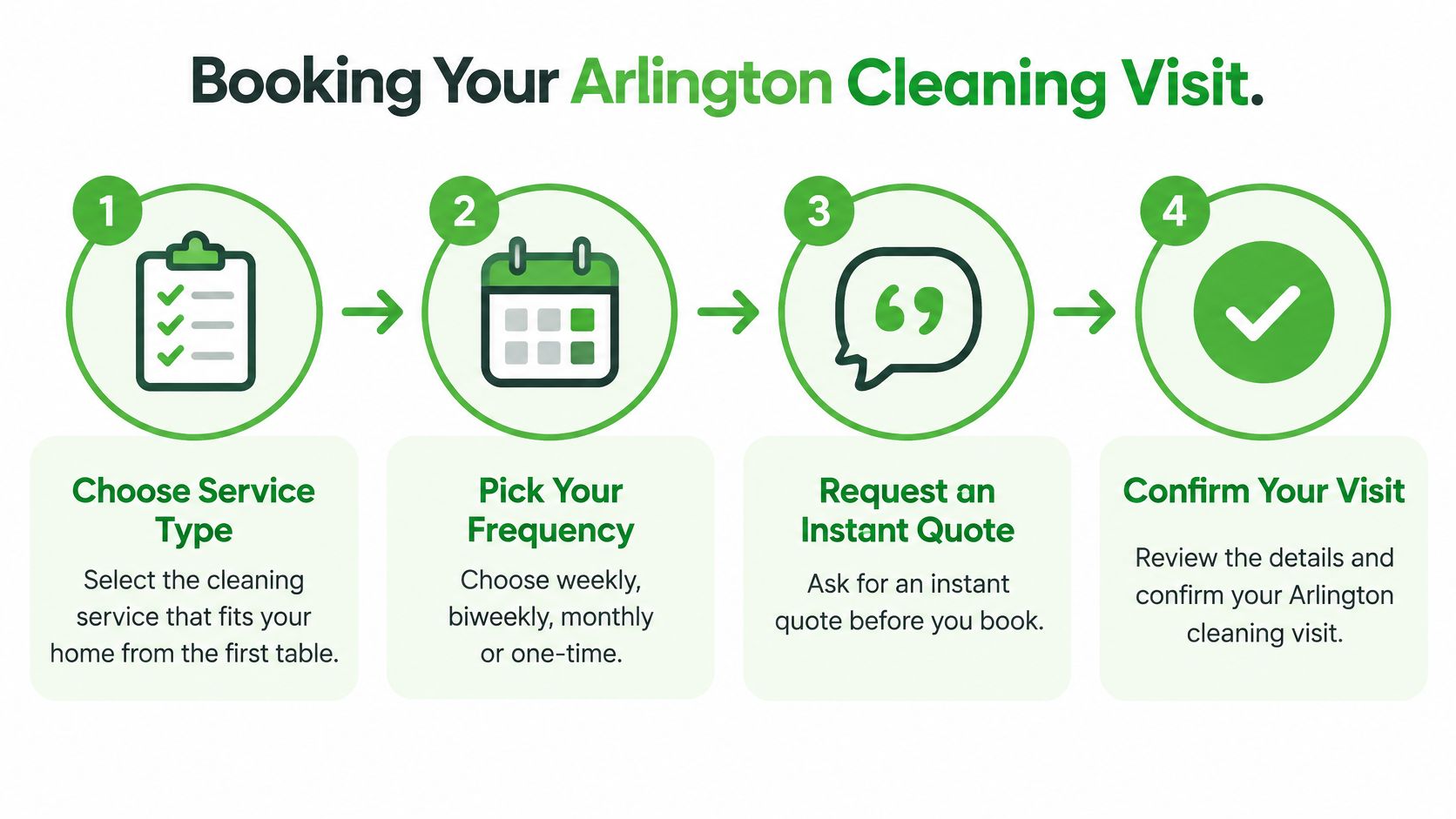
- Choose the service type. Match the visit to the property's real condition: maintenance for a home in good shape, a deep clean for built-up grime, move-in/move-out for a handoff, post-construction for renovation residue, or sanitizing for high-touch concerns.
- Pick weekly, biweekly, monthly, or one-time. Factor in pets, daily occupancy, and guests on the calendar. A home with two shedding dogs and kids usually earns its keep on weekly or biweekly visits.
- Request the instant flat-rate quote. The online tool takes 60 seconds and shows the exact price before you commit to booking.
- Prefer a conversation? Call 214-997-6918 to talk through the scope and confirm the details.
- Choose your visit day. Homes are serviced between 8:00 am and 5:00 pm, and the team strives to arrive within a two-hour window of the estimated arrival time. Request consistent team assignments for recurring appointments so the same crew learns your home.
- Walk through the first visit and note concerns. Technicians work from standardized checklists, so a request you flag once, like extra attention on baseboards or inside the fridge, is easy to repeat on later visits.
- Review after two visits. If dust or pet hair is accumulating faster than the schedule handles, tighten the frequency. If the home stays comfortable between appointments, you picked correctly.
That last check is where the money is saved.
Finish with a household checklist
- Reset or upkeep: Are you removing accumulated grime or maintaining an already-clean home?
- Occupant needs: Does anyone in the household need fragrance-free products or specific arrival arrangements?
- Timing: Is a move, renovation, or gathering on the calendar that should anchor the first visit?
- Access: Have you arranged entry, cleared working surfaces, and settled pets comfortably?
If you run a business and are sorting out appointment handling on your own side, the Expressify AI live chat assistant is built for that separate task. Your cleaning booking itself runs through the quote tool and phone number above.
The brand promise is "Healthy Homes, Families and Souls. We green clean without toxic chemicals." The practical version of that promise is a clearly scoped visit, products that fit your household, and a schedule you can comfortably maintain.
Gmaids offers non-toxic, fragrance-free cleaning for Arlington households, from one-time deep cleans and moves to recurring upkeep for busy families and pet owners. Get an instant, flat-rate quote online at Gmaids or call 214-997-6918 to choose the right service for your home.


Ready for a healthier, cleaner home?