Cleaning vs Sanitizing: Which Your Home Needs
Sanitizing everything, every day, is the advice you'll hear most often. It's also the advice that gets cleaning vs sanitizing backwards.
Cleaning does most of the work in a healthy home. It lifts the grease, dust, pollen, pet hair, and food soil that lets germs linger on a surface. Sanitizing is narrower and more specific. It's a targeted, label-driven step for certain surfaces and situations, not a stronger version of wiping down the whole house.
That distinction matters if you're trying to keep a Dallas home comfortable without filling it with fumes and synthetic fragrance. Babies crawl where mops just passed. Dogs nap on freshly cleaned floors. People with asthma, allergies, or chemical sensitivities notice what stays in the air long after a counter looks shiny.
Once you know what each step does, the choice gets calmer. You'll clean with more purpose, sanitize only where it earns its place, and save disinfecting for illness. You'll also use fewer harsh chemicals without guessing.
Table of Contents
Cleaning, Sanitizing and Disinfecting at a Glance
| Level | What It Does | Where It Fits | When in the Order |
|---|---|---|---|
| Cleaning | Removes dirt, grease, dust and many germs with detergent, water and scrubbing | Everyday upkeep on floors, counters, bathrooms and dusty surfaces | First, every time |
| Sanitizing | Reduces remaining germs to levels considered safe under public-health standards | Food-contact surfaces, infant-feeding items, toys and targeted high-touch spots | After cleaning, following the product label |
| Disinfecting | Uses stronger EPA-registered products to kill remaining germs | Illness in the home, or households with members at elevated risk of infection | After cleaning, for the full label contact time |
These aren't competing options you pick between. They're steps in a sequence, and cleaning always comes first.
What Each Word Really Means
The CDC guidance on cleaning and disinfecting your home defines cleaning as the physical removal of most germs, dirt, and impurities using soap or detergent, water, and scrubbing. It may reduce contamination without necessarily killing microorganisms. Sanitizing follows cleaning and reduces the remaining germs to levels considered safe by public-health codes or regulations.
Disinfecting sits one step beyond that. It uses stronger chemical products to kill remaining germs, and it's especially relevant when someone is sick or at higher risk of infection. Fillaree explains removing dirt versus killing germs in practical terms, which helps if product labels make an all-purpose cleaner and a disinfectant sound interchangeable.
Why Cleaning Comes First in Dallas Homes
Soil and organic residue can shield microorganisms from chemical treatment. That's why sanitizing a visibly dirty surface works less reliably, and why you're not skipping a step when you scrub first.
Think about a normal Dallas-Fort Worth week. Spring oak pollen coats entryways, cedar pollen shows up in winter, and a long summer of closed windows and running AC leaves fine dust on shelves, cabinets, and floors. Kitchens collect cooking grease and crumbs. Bathrooms collect toothpaste, soap film, and skin oils. Those are cleaning jobs first, whether you're in Lakewood, Uptown, or a newer home in Frisco.
Quick test for any room: What's on the surface, who uses it, and does it touch food or mouths?
If the answer is dust, grease, or ordinary grime, start with detergent, water, and a good scrub. If the clean surface will touch food, a baby bottle, or a teething toy, sanitizing may follow. If someone's been sick on the couch for two days, that's when disinfecting enters the conversation.
Which Level Each Room and Situation Needs
| Situation | Level Needed | Practical Note |
|---|---|---|
| Daily kitchen counters and floors | Cleaning | Sanitize the prep zone after handling raw meat |
| Baby bottles, pacifiers and teething toys | Cleaning, then sanitizing | Clean first, then sanitize according to the label |
| Food and water bowls for pets | Cleaning, then sanitizing when needed | Clean daily; sanitize when bowls are shared or soiled |
| A household member is sick | Disinfecting | Focus on bathrooms, bedside surfaces and shared handles; follow label contact time |
| Post-construction dust | Cleaning | Remove dust and debris first; sanitize kitchens and bathrooms afterward |
| Move-in or move-out | Cleaning, then sanitizing | Sanitize kitchen and bathroom after the deep clean |
| Shared office touchpoints | Cleaning daily, sanitizing for high-touch items | Keypads and shared equipment on a schedule that fits business hours |
The table surprises people because cleaning alone covers more of daily life than marketing suggests. Floors, dusty furniture, stovetops, and bathroom sinks usually need soil removed well and consistently.
The CDC fact sheet on cleaning, sanitizing, and disinfecting reflects that balance. In most homes, cleaning with soap or detergent removes most germs, while sanitizing or disinfecting is generally unnecessary unless someone is sick, recently visited while sick, or is at higher risk from a weakened immune system.
Three Triggers Worth Checking
- Food or mouth contact: Counters where you prep raw meat, cutting boards, highchair trays, baby bottles, pacifiers, and toys that go straight into little mouths are the clearest case for sanitizing after cleaning.
- Illness or vulnerability: A sick child, a recovering parent, a newborn, or someone with a weakened immune system changes the calculation for bathrooms, bedside tables, faucet handles, and shared remotes.
- Visible soil: Grease, pollen film, pet mess, and construction dust need removal first. Sanitizing can't do its job through that layer, no matter what the bottle promises.
That last trigger shows up often in Plano and Frisco, where new-construction homes and recent remodels can leave fine dust inside cabinets and on floors. A post-construction cleaning that removes dust and debris comes before anyone talks about sanitizing a kitchen or bathroom. The same logic applies to move-in and move-out cleaning, where inside the fridge, oven, cabinets and drawers, and closets need a thorough clean before targeted sanitizing makes sense.
For fragrance-sensitive households, restraint is a benefit, not a compromise. Extra chemical treatment adds exposure without a matching benefit when nobody's sick and the surface doesn't touch food or mouths. Clean everything, sanitize what touches food or mouths, and disinfect only when illness calls for it.
Why Order, Wet Time and Mistakes Decide Results
Two mechanical rules decide whether sanitizing works at all. Get either one wrong and the surface may look fine while the product never had a fair chance.
Soil Blocks the Product and Time Finishes the Job
Visible soil and organic residue shield microorganisms and use up active ingredients. Spray sanitizer onto a greasy stovetop or a dusty counter, and much of it is spent on the grime instead of reaching the surface underneath. Cleaning first clears that path.
Then the product needs time. The CDC guidance on cleaning and disinfecting with bleach defines contact time as the period during which a disinfectant remains in direct contact with the surface, generally from application until the surface has completely dried. The surface should remain visibly wet for the entire time specified on the product directions.
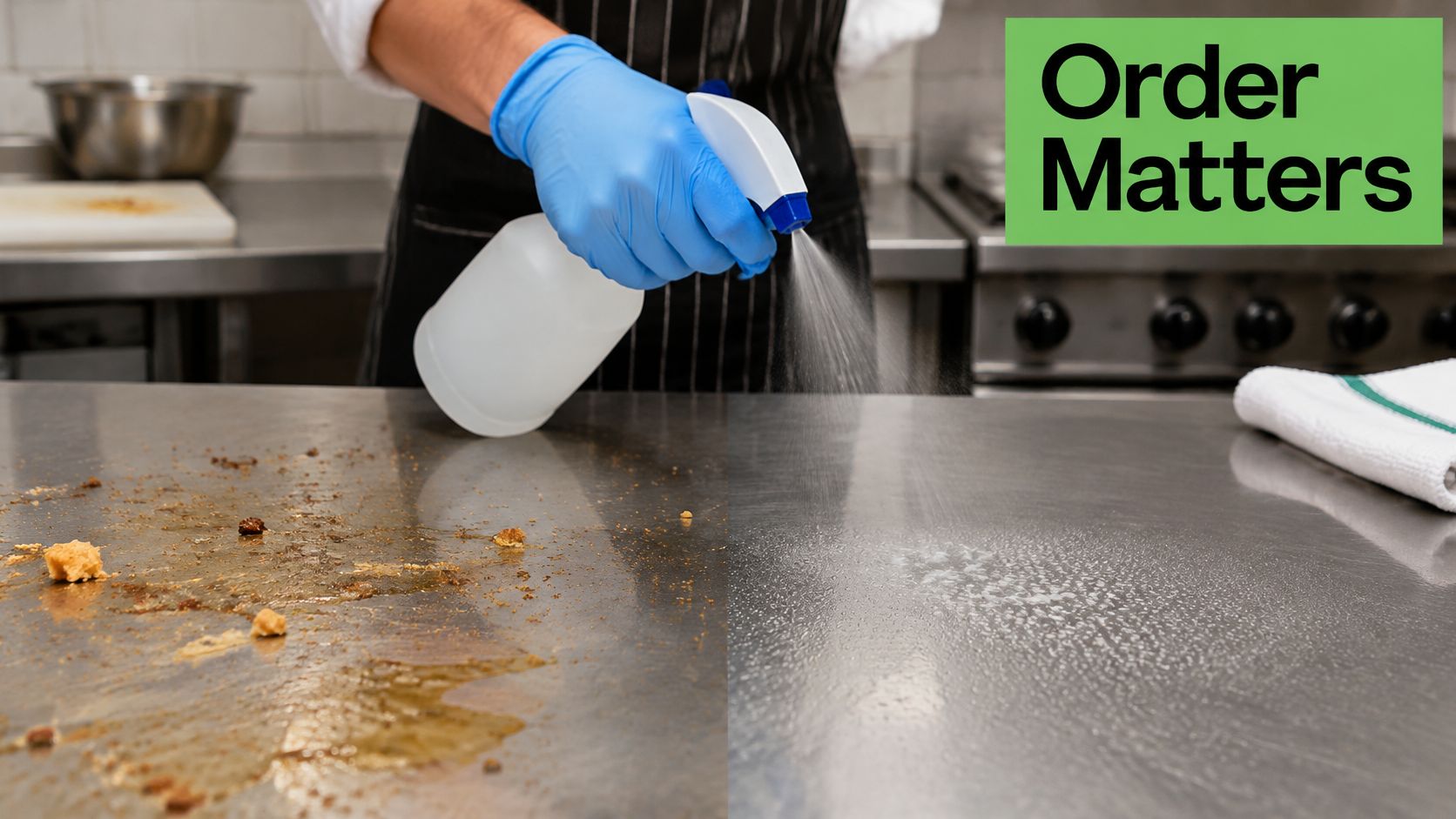
The sequence is simple enough to remember on a busy weeknight:
- Wipe away dust and grease with detergent and water, then rinse away loosened soil.
- Apply the product evenly so the whole surface is covered, not just misted.
- Keep it visibly wet for the labeled time, adding more product if edges dry early.
- Let it air dry, or rinse only if the label tells you to.
A surface that looks clean has not necessarily been sanitized.
Mistakes That Undo Careful Work
Spray and wipe is the most common one. If you wipe a product away seconds after spraying, you've mostly cleaned. You haven't given a sanitizer or disinfectant its contact time, even if the counter shines.
Sanitizing before cleaning is the same problem in reverse. Sanitizing every surface daily creates a different issue. It adds residue and exposure in bedrooms, on floors, and on furniture where targeted cleaning would do. Reserve the extra step for food contact, infant items, and illness.
Never mix products, either. Don't combine cleaners, including bleach or ammonia-based products, because some combinations release harmful fumes. Gmaids avoids that whole category of risk by using no bleach, no ammonia, and no synthetic fragrance, and you can apply the same caution with anything under your sink.
Watch for the scent trap, too. A strong smell often means masking, not cleaning. Fragrance can cover odors while grease and soil stay put. Fragrance-free doesn't mean ineffective. It means synthetic scents are omitted, while efficacy depends on an approved product, correct coverage, and full wet time.
Texas summers make order even more important in Richardson, Irving, and across Dallas. Closed windows and constant AC let dust and cooking residue settle on cabinets and floors. Remove that film first, then decide whether any surface needs the next step.
Reading Product Labels and Botanical Claims
| Product Type | Rated For | What to Check on the Label |
|---|---|---|
| Plain soap or detergent cleaner | Cleaning only | No kill claim; removes soil and many germs by physical action |
| Plant-derived or mineral-based all-purpose cleaner | Cleaning, unless labeled otherwise | Look for a sanitizing or disinfecting claim; without one, it cleans only |
| EPA-registered sanitizer | Sanitizing | Registration number, listed surfaces and wet contact time |
| EPA-registered disinfectant | Disinfecting | Listed target germs, contact time and rinse instructions |
| Botanical product with no registered claim | Cleaning only | Treat as a cleaner unless the label lists a sanitizing or disinfecting claim |
A leaf on the bottle doesn't prove a germ claim. Neither does the word natural, and neither does a fresh scent. The label either supports sanitizing or disinfecting, or you're holding a cleaner.
What the Numbers on a Sanitizer Mean
Sanitizing has a measurable threshold in food-safety regulation. The FDA 2022 Food Code defines sanitization of cleaned food-contact surfaces as treatment sufficient to produce a 5-log reduction, equal to 99.999%, under the conditions used to evaluate efficacy.
In plain language, a 5-log reduction cuts a microbial population by a factor of 100,000. If a test surface started with 100,000 organisms, about one would remain if the treatment hit that benchmark under test conditions. That's impressive, and it's also specific. Efficacy depends on the organism tested, product concentration, temperature, contact time, surface condition, and proper pre-cleaning.
So read 99.999% as a test result tied to labeled directions, not a promise for every counter, toy, and doorknob in your home. Our guide to choosing disinfectant cleaning products walks through those label details if you want to compare bottles side by side.
Three Checks Before You Trust a Claim
- EPA registration number: A sanitizer or disinfectant claim should come with one. Without it, treat the product as a cleaner.
- Listed surfaces and germs: The label names where the product belongs and which organisms it was tested against. A bathroom product isn't automatically right for a cutting board.
- Wet contact time: If you can't keep the surface wet that long, you can't expect the labeled result.
Botanical products deserve an honest description. A plant-derived or mineral-based product can be a gentle, fragrance-free cleaner that's a good fit for kids, pets, pregnant moms, and sensitive noses. It can only be called a sanitizer or disinfectant when its registered label supports that claim for that use.
One last label distinction causes real confusion. Fragrance-free means synthetic scents are left out entirely. Unscented is different, because unscented products can still contain masking chemicals that cover a smell. If fragrance triggers headaches or asthma symptoms in your house, that difference isn't marketing trivia.
How to Clean and Sanitize a Kitchen Step by Step
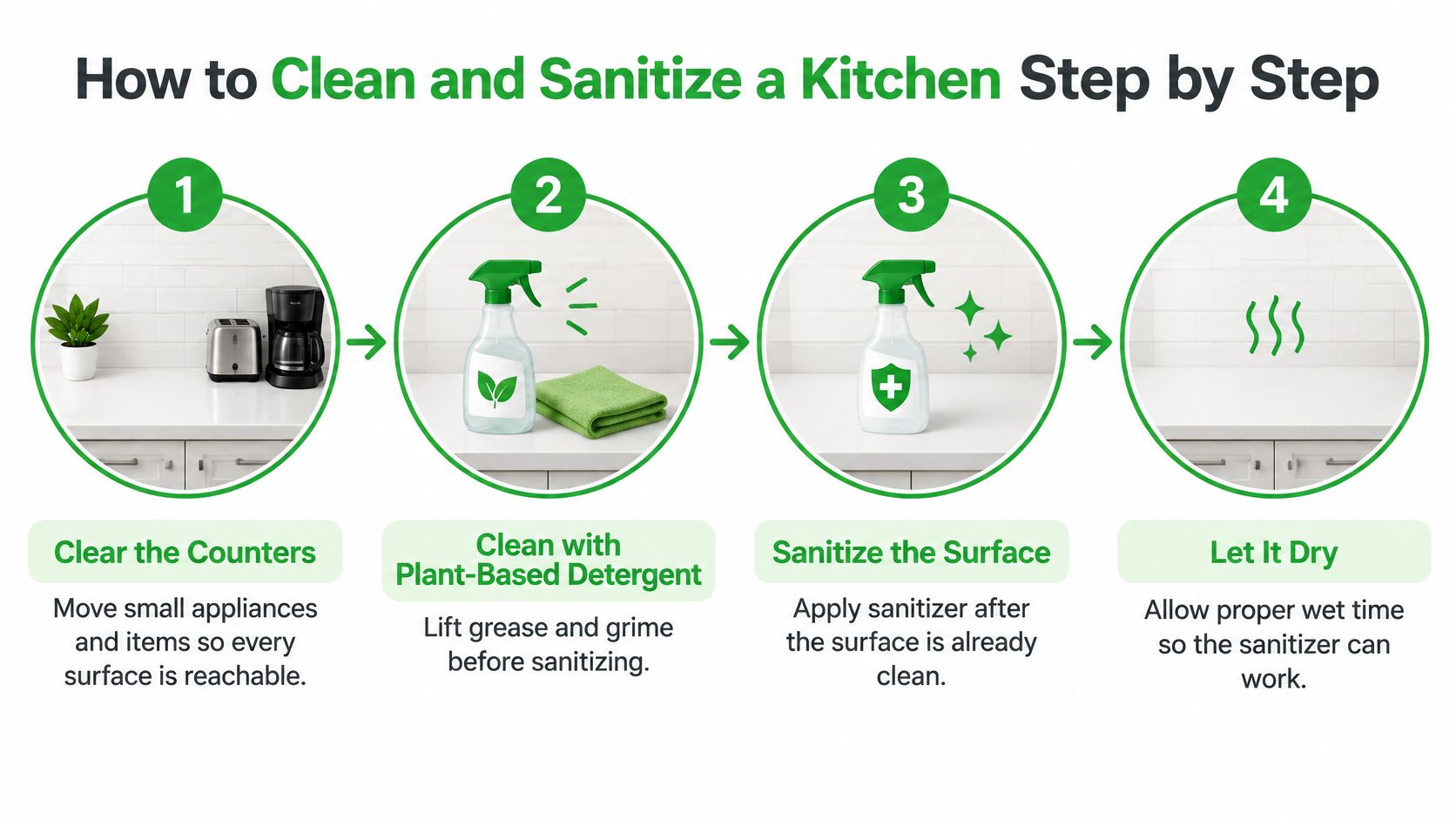
Kitchens are where cleaning vs sanitizing matters most, because the same counter holds mail, groceries, raw chicken, and tomorrow's sandwiches. The order below keeps those jobs separate. It takes a little patience, mainly because you have to let the sanitizer sit instead of wiping it away.
Clean First, Then Sanitize the Prep Zone
- Clear the counters. Move small appliances, fruit bowls, paper piles, and pet treats so every surface is reachable. Sanitizing around clutter leaves untreated shadows.
- Clean with a plant-based detergent. Lift grease, crumbs, and food soil with scrubbing and wiping, then rinse with clean water. Residue left behind shields germs from the sanitizer.
- Dry the surface. Let it air dry or wipe it dry with a clean cloth so leftover rinse water doesn't dilute the sanitizer you're about to apply.
- Apply sanitizer evenly. Cover the prep zone, cutting boards, cabinet pulls, refrigerator handles, and faucet, following the label for dilution and coverage.
- Keep it visibly wet. Leave the surface wet for the full labeled contact time and add product if it starts drying early. This pause is where the sanitizing happens.
- Air dry or rinse as directed. Let it air dry, or rinse only if the label says so. Don't wipe it away early to speed up dinner.
- Launder or replace cloths and sponges. A tired sponge can carry germs right back onto a clean counter. Fresh tools protect the work you just did.
When you're done, the kitchen should look clean, feel dry, and have no sticky residue. If a counter feels filmy, clean and rinse it again rather than adding more sanitizer on top.
Clean the kitchen you can see before you sanitize the germs you can't.
Food-contact surfaces and infant-feeding items follow the same order. Wash bottles, pump parts, pacifiers, and pet bowls to remove milk film or food residue, then sanitize according to the product or item instructions. Everti offers helpful context if you're building kitchen routines to prevent foodborne illness at home, especially around separating cleaning tools for different tasks.
For a full seasonal reset, our deep cleaning kitchen checklist covers the cabinets, appliances, and corners that daily upkeep misses. That's useful before holiday hosting in Highland Park or after a dusty remodel in Allen, when grease and fine debris have built up together.
Every visit follows the same 12-step Cleaning Cycle across three phases, Prep, Purify, and Impress. On sanitizing visits, Gmaids Certified Cleaning Teams follow this same clean-first sequence with no bleach, no ammonia, and no synthetic fragrance, so the prep zone gets attention without scented residue where food lands.
Book a Sanitizing Visit With Gmaids
A sanitizing visit can help when a space needs focused attention, such as between rental stays or around frequently touched surfaces in a shared office. Cleaning removes soil and residue first; sanitizing then targets selected surfaces using products according to their labels.
Gmaids offers Sanitizing Cleaning for homes, offices, retail locations, rental properties, and shared spaces. The service uses EPA-approved disinfectants, advanced fogging technology, and non-toxic botanical solutions. Learn more about Gmaids sanitizing and disinfecting services in Dallas.
For offices, cleaning includes common areas, workstations, and sanitization services. Gmaids also provides office cleaning in Dallas on daily, weekly, or after-hours schedules.
What to Expect When You Book
Gmaids uses non-toxic cleaning products. For sanitizing, the products and methods are chosen for the task and used according to label directions. Tell the team about children, pets, or sensitivities when arranging your visit, and schedule for a time when as few people as possible will be home. Children should stay in other areas during cleaning because equipment and products may not be safe for them.
The online instant quote shows the exact flat-rate price before you commit to booking. It takes about 60 seconds to get a quote. Gmaids serves Dallas and surrounding cities. Share whether the visit is for a home, workplace, rental property, or shared space so you can request the service that fits.
Ready for cleaning first, with sanitizing focused on the surfaces that need it? Gmaids offers Sanitizing Cleaning alongside Basic, Deep, Move-In / Move-Out, Office, Commercial, and Post-Construction Cleaning. Request an instant quote online or call 214-997-6918.


Ready for a healthier, cleaner home?