Deep Cleaning Services Residential: What Your Home Needs
You wiped the counters, ran the vacuum, and lit nothing scented, yet the house still doesn't feel clean. Dust lines the baseboards, the return vent looks gray, and your toddler crawls straight through whatever settled on the floor. That's the gap deep cleaning services residential homeowners book to close. It's not a longer tidy. It's a periodic reset of built-up dust, grime, and the reservoirs routine cleaning leaves behind, done in an order that changes what you breathe afterward.
Table of Contents
What Sets Deep Cleaning Apart From Basic Cleaning
Your kitchen can look fine after a weekly tidy while the sides of the fridge, vent covers, and baseboards haven't been touched in months. Basic cleaning maintains a home that's already in good condition. It includes dusting surfaces and furniture, vacuuming carpets and rugs, sweeping and mopping floors, cleaning kitchen surfaces and appliance exteriors, cleaning and sanitizing bathrooms, cleaning mirrors, removing trash, and tidying rooms.
Deep cleaning does different work. It's a thorough, detailed service that tackles built-up dirt and grime, recommended for first-time cleans, seasonal resets, and homes that haven't been professionally cleaned recently.
Basic cleaning versus deep cleaning at a glance
| Area | Basic cleaning | Deep cleaning |
|---|---|---|
| Best fit | Homes already in good condition that need routine upkeep | First-time cleans, seasonal resets and homes not professionally cleaned recently |
| Dusting | Surfaces and furniture dusted | Built-up dust and grime removed from surfaces |
| Floors and rugs | Carpets and rugs vacuumed, floors swept and mopped | Thorough floor and rug cleaning that removes built-up dirt |
| Appliances | Exteriors wiped | Exteriors cleaned, with interior cleaning optional |
| Bathrooms and kitchens | Cleaned and sanitized as routine | Detailed cleaning to remove buildup and grime |
Most households default to the lighter version, even when they spend real time cleaning. In the 2018 ACI National Cleaning Survey of 1,000 adults, 74% performed light cleaning more often, while only 26% most often performed deep cleaning, defined as thorough cleaning of the entire household, including floors, furniture, and surfaces. Americans spent an average of six hours per week cleaning, and parents averaged seven hours weekly.
That time explains the appeal for Dallas families. You're not paying someone to repeat your Saturday routine more slowly. You're buying back hours and getting the less-frequently cleaned places handled in one visit.
Quick check: Walk through one room and look only at edges, corners, and vertical surfaces. If those tell a different story than your counters, you don't need more basic cleaning. You need a reset.
Compare the table against the last time you cleaned each area, not the last time you tidied it. If several rows have slipped to months ago, start deep. Routine visits hold a baseline well, but they can't create one that's missing.
Room-by-Room Deep Cleaning Tasks and Add-Ons
A cabinet front can look clean while grease remains around its handles. A deep clean addresses those overlooked surfaces, but the exact scope varies by area and service. Use this room-by-room guide to distinguish included work from optional add-ons before booking.
Deep cleaning scope by area and add-on
| Area | Included in deep clean | Add-on or option |
|---|---|---|
| Kitchen | Thorough cleaning of surfaces and appliance exteriors | Interior appliance cleaning is optional |
| Living areas | Detailed cleaning of surfaces, floors, and furniture | Hand-wiping blinds and shutters; interior windows; basic carpet spot treatment |
| Windows | Not included in the listed deep-clean scope | Interior windows as a living-area or whole-home add-on |
| Baseboards | Cleaned as part of move-in/move-out detailing | For an occupied-home deep clean, ask about including them in a customized plan |
| Vents and return grilles | Not listed as a standard deep-clean task | Ask about including them in a customized plan |
| Garage and exterior trash cans | Not included in the listed deep-clean scope | Garage sweeping; detailing exterior trash cans and lids as whole-home add-ons |
Kitchen buildup often gathers where hands and cooking meet: cabinet fronts, handles, and appliance surfaces. The deep cleaning kitchen checklist offers a closer look at kitchen tasks. In living areas, dust can collect on blinds and shutters, while interior windows and carpet spot treatment can be selected as add-ons.
Curtains are a separate fabric-care task, not the same as wiping blinds or shutters. For an example of dedicated curtain care, see professional curtain cleaning in Singapore.
For occupied homes, the listed deep-clean scope includes appliance exteriors, with interior appliance cleaning optional. Move-in/move-out cleaning has a different scope: it includes appliance interior and exterior cleaning, bathroom and kitchen sanitization, floor cleaning and detailing, and cleaning of baseboards and surfaces, as well as the inside of the fridge, oven, cabinets, drawers, and closets. If baseboards or vents matter for your home, include them in your request so the quote reflects the work.
- Choose three areas: Pick spots that have gone the longest without detailed cleaning.
- Mark the scope: Note what is included and which add-ons you want.
- Request a quote: Gmaids includes special requests, such as deep cleaning, in the quote.
Non-Toxic, Fragrance-Free and Disinfecting
What does the bottle promise? Parents and pet owners ask this more than any other question, and the labels don't help, because four different terms get used as if they mean the same thing.
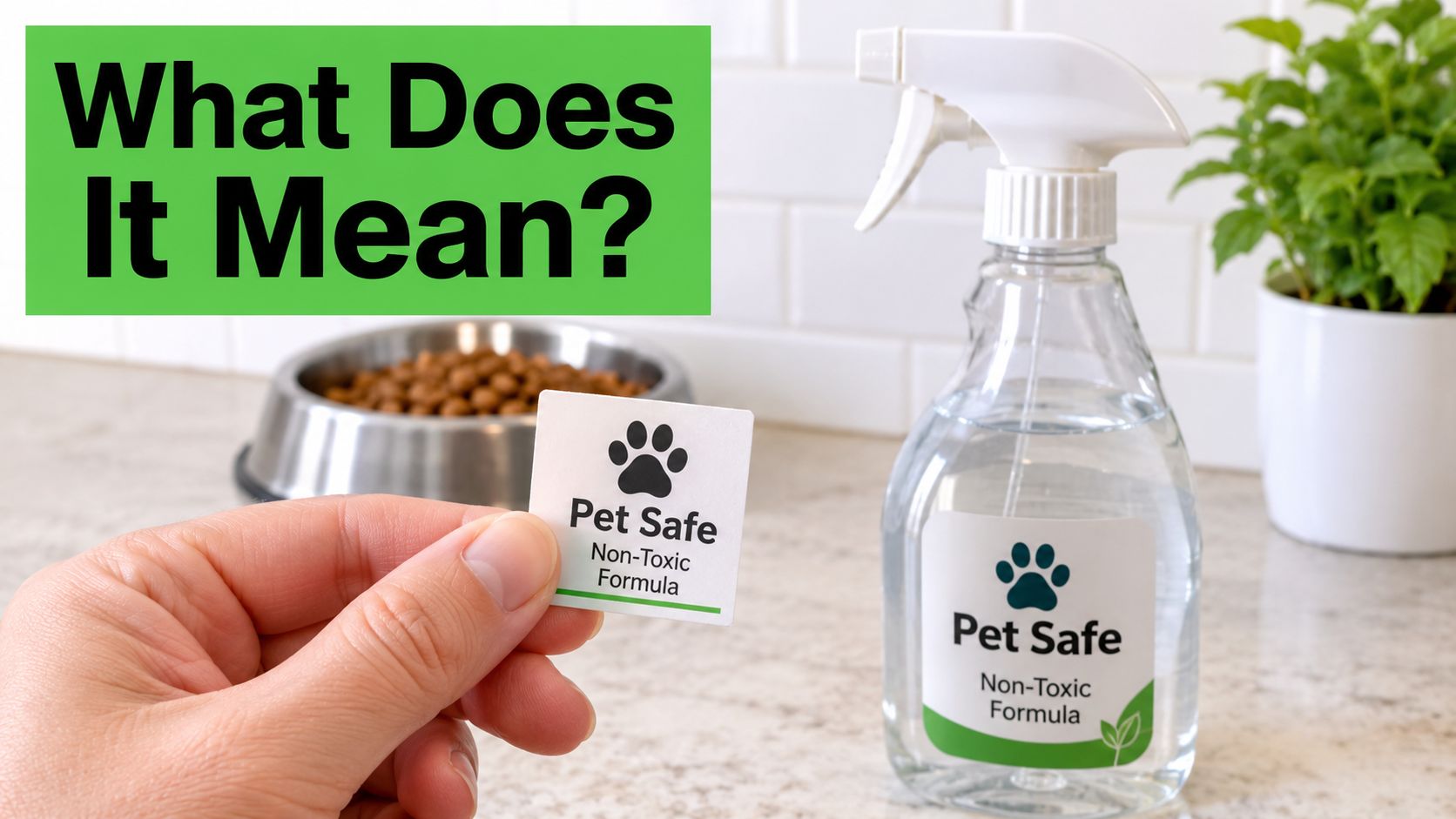
- Non-toxic: A marketing term without a single standard definition. Ask what's left out. We leave out bleach, ammonia, and synthetic fragrance and use plant-derived and mineral-based products.
- Fragrance-free: Synthetic scents are left out entirely. That's not the same as unscented, which can mean a masking fragrance covers the chemical smell. Our fragrance-free cleaning service page explains that distinction in plain terms.
- Low-VOC: Lower volatile emissions, but the level depends on the specific product. Ask for the product name and its data instead of trusting a front-label claim.
- Disinfecting: A regulated claim. A true disinfectant carries an EPA registration number and destroys or irreversibly inactivates bacteria, fungi, and viruses on inanimate surfaces, though not necessarily bacterial spores.
Here's the part that surprises label readers. Reporting on Purdue-led research on scented cleaning products found that both conventional fragranced cleaners and botanical-oil-based products can react with indoor ozone and generate ultrafine nanoparticles ranging from roughly 1 to 30 nanometers. A plant-derived ingredient or pleasant smell isn't proof of cleaner air. It can signal more airborne chemistry.
That finding doesn't mean every botanical product is a problem. It means controls matter more than adjectives.
- Ventilate: Run exhaust fans or open windows during and after service.
- Don't stack scents: Avoid combining several scented products in one session.
- Skip ozone devices: Avoid ozone-generating devices during cleaning.
Gmaids sanitizing cleaning uses EPA-approved disinfectants, advanced fogging technology, and non-toxic botanical solutions on high-touch areas when disinfection is warranted. For everyday pet households, this cleaning guidance for homes with pets from J.G. Carpet Cleaning LLC is a useful companion on choosing gentler products around animals.
Before you book anyone, ask three questions. Which exact products will you use in my home? Which ones carry an EPA registration number? What do you leave out entirely? Clear answers tell you more than the word green ever will.
How a Deep Clean Runs From Top to Bottom
Order changes the result. Clean low surfaces first and everything you dislodge above them lands where you just finished. Disinfect before you remove soil and the product never reaches the surface. A good deep clean follows a sequence for those reasons.
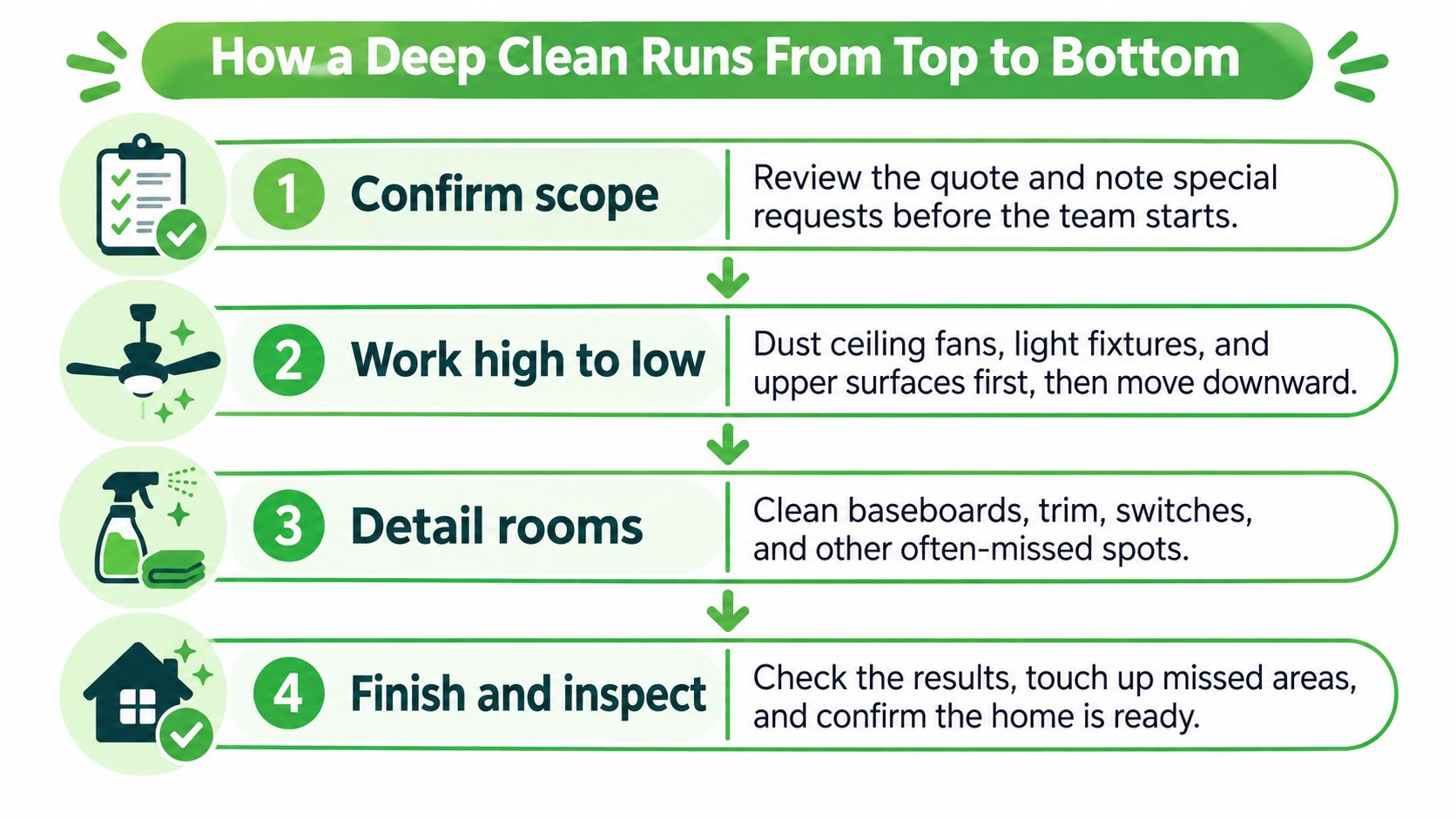
- Confirm scope: Review the quote and note special requests before the team starts. This is when appliance interiors, blinds, and windows get settled, not mid-visit.
- Work high to low: Dust ceiling fans, light fixtures, vent covers, and wall edges first. Falling dust then gets caught by later passes instead of resettling on clean counters.
- Dust damp, not dry: Use damp microfiber on baseboards, furniture, and blinds. Moisture limits settled dust going back into the air. The common slip is dry dusting, which stirs up what you meant to remove.
- Detail kitchens and bathrooms: Remove soil from counters, sinks, cabinet fronts, and fixtures before any disinfecting step. Spraying disinfectant over grime keeps it from reaching germs, so soil removal comes first.
- Disinfect only where warranted: Treat high-touch surfaces such as handles, switches, and counters with an EPA-registered product. The EPA guidance on registered disinfectants states a surface requiring 10 minutes of contact time must stay visibly wet for at least 10 minutes, with reapplication if it dries sooner. Wiping early is the slip that undoes the step.
- Vacuum last: Vacuum floors, rugs, and upholstery after dusting and wet work, using a HEPA-filtered vacuum where possible. The final pass catches what earlier steps loosened.
- Finish and inspect: Walk the home, confirm surfaces are dry, and ventilate with open windows or exhaust fans. Touch up missed spots before anyone settles back in.
What finished actually looks like
A finished room has no streaks, no visible dust on edges, no product residue, and no strong smell. That last point matters. Clean shouldn't announce itself with fragrance where babies crawl and pets nap.
Keep ventilation running until surfaces are dry and any product smell has cleared. That's the re-entry point for pets, kids, and anyone sensitive, not the moment the team packs up.
If you stay home during the visit, you'll notice the team spends its early time on things above eye level. That's deliberate. The floors look done last because, in a proper sequence, they are done last.
When Your Home Needs a Deep Clean
Timing matters more than frequency charts. Certain moments make a deep clean the sensible first step, and booking routine service instead just means paying to maintain buildup.
Start deep when it's your first professional clean. A home that hasn't been professionally cleaned recently needs a baseline before recurring visits can hold it. Weekly, biweekly, and monthly plans work best when they're maintaining a standard that already exists.
Book around the seasons. Dallas households feel spring and winter allergy seasons, when oak and cedar pollen get tracked in and settle indoors. The end of a long Texas AC season is another natural reset point, after months of closed windows and recirculated air. The weeks before holiday hosting count too, since guest traffic raises what floors and bathrooms have to handle.
Trigger events worth acting on
- After construction or renovation: Book once dust has settled, so fine particles on surfaces get removed instead of redistributed. This comes up often in new-construction homes in Plano, Frisco, McKinney, and Prosper.
- Before a move: An empty home lets a team reach inside cabinets, closets, and appliances without working around furniture.
- When routine cleaning stops feeling sufficient: If your weekly effort still leaves the house feeling dusty, the missing work is probably in places weekly cleaning never reaches.
That last point is the logic underneath all of this. A home can be cleaned every week and still leave baseboards, vents, blinds, and appliance fronts untouched for a year. Weekly plans suit busy professional families who want priority scheduling and a consistent routine. Biweekly and monthly plans suit steadier, lower-traffic homes that need occasional professional cleaning. Neither replaces the periodic reset.
Apply one simple test. If you can't remember the last time you cleaned your baseboards, vent covers, or appliance fronts, book a deep clean before setting up recurring service. Memory is a fair measure here. Tasks you do regularly, you remember doing.
Deep Cleaning for Allergies, Asthma and Pet Homes
Dog hair works into the sofa seams. The cat bed sits on the rug, and your toddler crawls across the same floor an hour later. In homes like yours across Lakewood, Highland Park, and Southlake, many triggers aren't floating in the air. They're settled in dust, waiting for movement to stir them up.
The U.S. Environmental Protection Agency guidance on indoor particulate matter recommends frequent cleaning and ventilation, damp dusting because moisture limits settled-dust release, and weekly or more frequent vacuuming of carpets and upholstered furniture. It also recommends considering HEPA-filtered vacuums, because HEPA filtration can reduce the quantity of vacuumed dust escaping back into room air. Indoor particles can carry biological allergens, including mold-related allergens that can trigger asthma symptoms.
Connect that to what you see at home. Oak and cedar pollen arrive on shoes, paws, and coats, then settle on baseboards, vent covers, furniture edges, and upholstery. Texas dust after dry spells does the same. A deep clean that reaches those reservoirs lowers what everyday movement can re-aerosolize. Our guide to pet-safe cleaning products covers what to look for on labels for floors pets and babies use.
What to request for a sensitive household
- Upholstery and pet bedding areas: Dander collects in fabric, not just on hard floors, so ask for methodical vacuuming there.
- Vent covers and furniture edges: These overlooked surfaces hold settled dust that routine passes skip.
- Fragrance-free products: Our Certified Cleaning Teams® use them to reduce irritants for sensitive households, kids, pets, and pregnant moms.
- Room clearance during vacuuming: Keep allergy-sensitive occupants out of the room while vacuuming runs, and let them return after the room ventilates and surfaces dry.
Comparable thinking shows up in drier climates too. These allergen reduction tips for Tucson homeowners from Covenant Aire Solutions pair cleaning with ventilation and source control, which is the same combination that works in Dallas.
Be clear about limits. HEPA filtration is an engineering control, not proof every allergen is gone. Source control, ventilation, and repeated cleaning carry the long-term work. A deep clean reduces settled dust and uses fewer harsh chemicals, which is better for sensitive households. It doesn't replace medical care for asthma or allergies, and no honest service should promise otherwise.
Book Your Deep Clean With a Flat-Rate Quote
Before booking, compare the starting prices and confirm the exact flat rate for your home. Gmaids' instant quote tool takes 60 seconds and shows the price before you commit.
| Service | Starts at | Notes |
|---|---|---|
| One-time deep cleaning | $412.69 | Detailed cleaning to tackle built-up dirt and grime |
| One-time standard house cleaning | $304.44 | Routine cleaning for a home in good condition |
| One-time post-construction cleaning | $548.00 | Cleaning after renovation or new construction |
| Customized cleaning plan | Custom quote | Contact the Gmaids office for pricing |
To get a quote that reflects your needs, share your home's size, bedrooms, and bathrooms, along with how long it has been since its last professional cleaning. Include any special requests, such as deep cleaning or post-construction cleanup, so they can be included in the quote. Deep cleaning covers appliance exteriors; interior appliance cleaning is optional.
A deep clean can reset built-up grime, while weekly, bi-weekly, or monthly service helps maintain the home afterward. Gmaids can also build a custom plan around specific needs, such as focusing on high-traffic areas or detailed cleaning.
Gmaids has served Dallas–Fort Worth since 2004. Its Certified Cleaning Teams® are trained, background-checked, and insured. To schedule, contact Gmaids by phone at 214-997-6918.
Before booking: Mention any household sensitivities or special requests when you ask for a quote. That gives the team a chance to account for them in the cleaning plan.
Gmaids offers deep cleaning across Dallas–Fort Worth, with a flat-rate price available through the instant quote tool. Get a quote online or call 214-997-6918 to schedule.


Ready for a healthier, cleaner home?