Fragrance Free Cleaning Service: A Guide for Dallas Homes

You just finished wiping the kitchen in Dallas, and the room still smells like the bottle. The windows stayed shut because the air conditioner has been running for months. A toddler is about to crawl back across that floor, and the dog will nap on the same rug. The front of the bottle said unscented, so you expected the air to go quiet. It often doesn't.
A fragrance free cleaning service is an operating standard you can verify, not a word to trust on a van. The label, the caddy, and what happens with the windows all have to match. This guide covers the words on the bottle, who usually asks for a quieter clean, what a careful visit looks like, and the questions to ask before you book in Dallas, Plano, or Southlake.
Table of Contents
What Fragrance-Free Really Means on a Label
A cleaner labeled unscented may still contain a masking fragrance. That ingredient hides the product's chemical odor, so the bottle can seem scentless while its formula still includes fragrance.
| Label | Added fragrance | Masking fragrance | Can still release VOCs |
|---|---|---|---|
| Fragrance-free | None | None | Possible, from botanical or residual ingredients |
| Unscented | None listed | Can be used to hide odor | Yes |
| Naturally scented | Essential oils | Sometimes added to mute oil odor | Yes, including terpenes |
| Conventionally scented | Synthetic fragrance | Yes | Yes |
Fragrance-free means no synthetic fragrance or masking scent has been added intentionally. Unscented describes a product that may have no noticeable smell, but a masking ingredient can still be present. Naturally scented cleaners use essential oils, such as citrus or pine; conventionally scented products use synthetic fragrance. Either type can release volatile organic compounds, or VOCs, which evaporate into the air at room temperature.
A lemon-oil spray and a mineral cleaner with no added scent are different choices. Botanical ingredients can release vapors, too, so “natural” is not another way to say fragrance-free. The label is a starting point, not proof of a provider's cleaning standard.
A ten-second label check
Turn the bottle around before it goes in the caddy.
- Fragrance or parfum: Either term in the ingredients means the product is not fragrance-free.
- Front claim: Look for “fragrance-free.” “Unscented” does not make the same promise.
- Essential oils: Lemon, pine, lavender, and tea tree are scented ingredients, even when described as botanical.
Floors deserve a closer look because babies crawl on them and pets may nap there or groom their paws. For product-specific guidance, see this fragrance-free floor cleaner guide. Households looking for everyday support for pet wellbeing can also consider how cleaning products fit into their home routines.
Gmaids, a Dallas–Fort Worth maid service established in 2004, uses plant-derived and mineral-based products with no bleach, no ammonia, and no synthetic fragrance.
Why Fragrance Chemicals Matter Indoors
Think of a closed bedroom as a jar with the lid on. You stop wiping, and the spray does not walk out the door. With the air conditioner recycling the same air, those vapors have nowhere fast to go.

The American Lung Association reports that fragrances can contain hundreds of chemicals, many of them volatile organic compounds that evaporate at room temperature. Those compounds can remain indoors for hours, days, or even months, and indoor VOC concentrations can reach up to 10 times outdoor levels. A fragranced cleaner can add pollutants while you are still using it, in a home, an office, or a school.
People commonly report eye, nose, and throat irritation, headaches, nausea, coughing, wheezing, and shortness of breath. The same guidance names people with asthma, allergies, chemical sensitivities, COPD, and other respiratory conditions as especially vulnerable. Even a "natural" scent can contain VOCs and may react with indoor ozone to form more pollutants.
Removing added fragrance is source control. You cut one avoidable emission at the start, instead of trying to air it out after the fact.
That choice is practical, not a medical promise. It does not cure asthma or guarantee a symptom-free house. It does mean the nursery floor, the bedroom, and the living room where a pet naps are not getting an extra layer of scent chemicals on top of ordinary dust. Fewer added fumes is a reasonable goal for a sensitive household. It is not a claim that cleaning will fix a health condition.
Who Should Choose a Fragrance-Free Clean
A toddler crawls across the living-room floor after it has been cleaned. A dog naps on the rug, then licks its paws. In both homes, choosing products without added fragrance can help keep scented residue off the surfaces family members touch.
The same choice may suit someone who gets headaches around plug-in air fresheners, or an expecting parent preparing a nursery. A fragrance-free service is a practical preference for households that want cleaning without deliberately adding scent.
Shared spaces raise another consideration. In a dental office, coworking room, or rental between tenants, several people may breathe the same indoor air after a clean. A provider's fragrance-free operating standard can help avoid introducing scent that affects the whole room.
The American Lung Association's summary of an international study followed more than 6,000 women for over 20 years. Women who used spray cleaning products at least once a week experienced faster-than-expected lung-function decline, with the most rapid decline among those exposed daily. The findings support reducing unnecessary spray and fragrance exposure, but do not show that every cleaning product causes disease. Traditional cleaners can also irritate the nose, throat, eyes, and lungs, so choosing lower-fragrance products and skipping air fresheners may be a sensible step.
Carpets and rugs collect dust that settles from the air. Vacuuming and cleaning them belong in a no-scent floor routine, especially if a scented carpet refresh leaves the room feeling stuffy. For rug upkeep, professional rug care for stuffy mornings can be one part of that routine.
A short self-check
- Floors and fabric: Does a baby, pet, or person with asthma spend time on freshly cleaned surfaces?
- The bottle: Do sprays or air fresheners get used in rooms that stay closed?
- Shared space: Will coworkers, patients, or the next tenant breathe the same air after the visit?
If two answers are yes, ask the provider how they keep the service fragrance-free. The label is only a starting point; the provider's actual practices are what you need to check.
What Happens During a Fragrance-Free Service
A real visit is a sequence you can picture, from the first call to the walk-through. Ask for each step out loud. A vague "we use green products" is not a process.
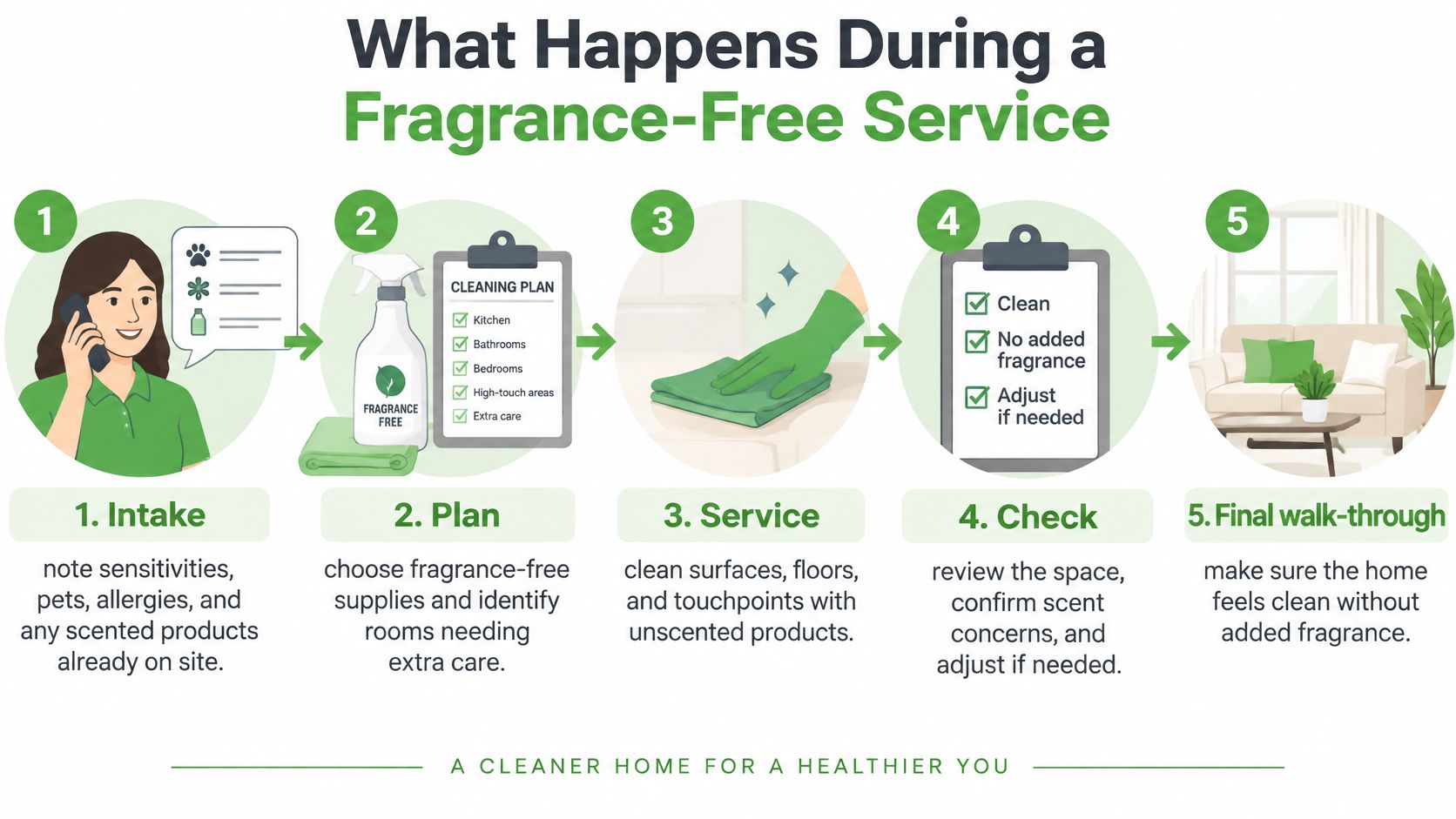
- Intake. Note sensitivities, pets, allergies, and any scented products already in the house, including plug-ins and candles.
- Product check. Confirm plant-derived and mineral-based products with no bleach, no ammonia, and no synthetic fragrance, and ask for the Safety Data Sheets.
- Scent-free team. Technicians bring their own tools and products, with no scented sprays or air fresheners in the caddy.
- Dilution. Mix only as the label directs, and never blend two products in one bottle.
- Ventilation. Open windows when the weather allows, or run exhaust fans and a fresh-air setting on the system.
- Top to bottom. Clean high surfaces first, and leave each product for the dwell time on its label.
- Residue control. Wipe film off floors and low trim, where crawling and napping happen.
- Re-entry. Air the rooms before sensitive occupants come back, and ask how long that should take.
Fabric holds odor longer than tile. If a sofa cover has been sprayed for years, washing or swapping it helps the room stay quiet after the team leaves. A washable option from the Casamé Home couch cover collection is one way to reset that fabric without another scented spray.
Botanical does not mean low emission
Fragrance-free is not the same as low-emission. Botanical or essential-oil disinfectants can still release terpenes such as limonene, pinene, thymol, and linalool. Purdue research described by the American Chemical Society found those compounds reacted with indoor ozone during ordinary mopping, spraying, and wiping, and quickly formed ultrafine nanoparticles. Researchers reported indoor concentrations and particle formation substantially above typical outdoor conditions. A provider should say whether it uses essential oils, masking agents, aerosols, or ozone-generating equipment, and how it ventilates during and right after the clean.
Gmaids Certified Cleaning Teams® are trained, background-checked, and insured, and you can read how the green cleaning and non-toxic maid service is set up. Move-out work and post-construction jobs need extra dust control, because fine powder keeps moving through returns long after the scraps are gone. Capture the dust. Don't cover it with a scent.
Questions to Ask Before You Book a Provider
Fragrance-free only means something when a provider can prove it. In a shared office or a multi-occupant home, you need a measurable definition. Does it mean no intentionally added scent, no residual odor after the visit, no scented products on the technicians, or a building rule that also covers air fresheners and candles?
Public-health guidance from the Vermont Department of Health notes that fragrances in cleaning products, personal-care products, and essential oils can trigger asthma, and it recommends avoiding them in shared spaces such as offices and classrooms. Exposure is not limited to the mop water. A coworker's body spray or a candle lit after the team leaves can undo the visit.
Use the table as a buyer's checklist. A reassuring answer is specific. A red-flag answer dodges the product, the paperwork, or the follow-up.
| Question to ask | Good answer | Red flag |
|---|---|---|
| Do you use any synthetic fragrance, masking scent, or air freshener? | No, and team members bring no scented products | They'll add a light scent |
| Which products do you use, and can I see the ingredients or Safety Data Sheets? | Named products, a written ingredient list, and SDS on request | A proprietary blend with no detail |
| Do you use essential-oil or botanical products, and how do you ventilate? | They name the products and the ventilation steps | "Natural means safe, so no ventilation is needed" |
| Are your teams background-checked and insured? | Yes, with consistent team assignments when possible | No answer, or a verbal promise only |
| What happens if I notice a scent after the visit? | The team revisits within 24 hours and corrects it | No follow-up process |
| Can you put a fragrance-free standard in writing for our office or rental? | Yes, with pre-service intake and checklists | Verbal promises only |
What a manager or landlord should add
A workplace or a rental needs three more questions the table can't hold.
- Notice: How do occupants hear about the service before the team arrives, and how long should they wait before returning?
- Complaints: Who checks an odor complaint, and what does that check look like on site?
- After the team leaves: What happens if a coworker plugs in an air freshener, or a tenant lights a candle, once the clean is done?
Practical rule: If the answer can't be written on a checklist, it isn't a standard yet.
A strong answer looks ordinary in practice. Written standards, the same checklist on every visit, inspections, and the same team when scheduling allows. Gmaids uses that pattern across Dallas–Fort Worth offices and homes, and its 24-hour satisfaction policy says that if something isn't right, you call within 24 hours and the team makes it right. That is an accommodation, not a slogan, for a medical practice, a coworking room, or a property manager turning a unit.
Dallas–Fort Worth Seasons and Your Clean
North Texas doesn't give you one cleaning season. Pollen, a long cooling season, and closed windows stack on each other.

NBC DFW reports that mountain cedar season generally runs from late December through February, with pollen concentrations peaking around mid-January. The highest cedar concentrations sit southwest of the Dallas-Fort Worth area, west of the Interstate 35 corridor, which is relevant for households in Southlake and Flower Mound. Oak pollen and other spring allergens begin as cedar levels taper toward early March.
Summer heat keeps many Dallas homes closed up while the air conditioner runs for months, moving dust through vents and back onto floors. Pet-friendly houses in Bishop Arts and Oak Cliff track that dust indoors on paws. Busy families in Uptown, Lakewood, and Highland Park often clean around work and school, then host over the holidays. New-construction homes in McKinney, Prosper, and Celina can hold a fine film in every room after the builders leave.
A fragrance-free clean fits this calendar because you can lift settled dust and residue without adding fragrance chemicals during pollen season. Pair the indoor work with a filter change or a green pest visit when the house has been shut for weeks. The season tells you where to spend the time.
| Season | What is in the air | Where to focus |
|---|---|---|
| Late December through February | Mountain cedar, peaking around mid-January | Floors, vent covers, and entry areas |
| Early March through May | Oak and other spring pollen | Windowsills, door frames, and high-touch surfaces |
| Summer | Long AC seasons and recirculated dust | Bedrooms, vents, and floors |
| Fall and holiday hosting | Guest traffic and closed-up rooms | Kitchens, bathrooms, and entry areas |
Cedar season is a dust job, not a scent job. Spring is a sill-and-frame job. Summer is a vent-and-bedroom job. Fall is a reset before guests arrive. In each case, skip the air freshener. It doesn't remove pollen, and it adds another vapor to a house that is already shut.
Fragrance-Free Booking FAQ
Does fragrance-free mean the home will smell like nothing? Not exactly. It means no synthetic fragrance or masking scent is added. A faint smell can remain from floors or fabrics, so ask how the provider checks for residual odor after the visit.
How long before sensitive people return? Ask for the airing time, and whether rooms should be ventilated before children, pets, or anyone with allergies comes back. Get that number before the team arrives, not after.
Do certifications prove a product is fragrance-free? Not on their own. EPA Safer Choice labeling signals reviewed ingredients, but you should still request the product list and the Safety Data Sheets.
Are essential-oil cleaners acceptable? Ask whether the provider uses them and how the team ventilates. Terpenes from botanical oils can react with indoor ozone during ordinary mopping and wiping.
Can a renter or office manager get a standard in writing? Ask for a fragrance-free standard and an intake form you can keep for the rental or the workplace. A verbal yes is hard to hand to the next tenant or the office manager.
What should I prepare before calling? List sensitivities and pets, note scented products already on site, and decide whether the job is a one-time reset or a recurring routine.
Book a Fragrance-Free Clean in Dallas
Before booking, list any sensitivities and pets, note plug-ins, candles, and scented detergents already in the home, and choose whether you need a one-time clean or a recurring visit. These details help the team set up the service around your household.
Match the job to the service you need:
- Basic cleaning suits a home in good condition that needs routine upkeep.
- Deep cleaning tackles built-up grime in kitchens, bathrooms, and trim.
- Move-in and move-out cleaning includes the inside of the fridge and oven, plus cabinets, drawers, and closets.
- Post-construction cleaning removes dust and debris after a renovation or new build.
- Recurring maid service is available weekly, biweekly, or monthly.
- Office cleaning and commercial cleaning can be scheduled daily, weekly, or after hours.
- Sanitizing cleaning focuses on high-touch areas.
For fragrance-free cleaning, treat the standard as something to confirm when you book. Ask which products the team will use and explain any sensitivities. Gmaids provides residential and commercial cleaning across Dallas–Fort Worth, with trained, insured technicians and non-toxic, fragrance-free products. You can review the Dallas house cleaning service area and choose a service that fits your home or workplace.
Request a quote at www.gmaids.com or call 214-997-6918. Have your sensitivity list and service type ready so the first visit is set up correctly.
Gmaids serves homes and workplaces across Dallas–Fort Worth with fragrance-free cleaning. To discuss a clean for your house, rental, or office, contact Gmaids by phone or through its website.


Ready for a healthier, cleaner home?