Office Cleaning Dallas: What to Expect
It's 7:45 on a Tuesday morning and you're the first person into your Dallas suite. Yesterday's trash is still by the printer, the shared kitchen smells faintly stale, and the conference table has rings from the last meeting. A client arrives at nine. Nothing here needs a dramatic intervention. It needs a clear, written plan for what gets cleaned, how often, and with what.
That's where most offices get stuck. Office cleaning in Dallas can mean a quick after-hours tidy or a detailed reset with restrooms, kitchens, high-touch points, and records. This guide separates routine cleaning from targeted disinfection, explains why fragrance matters in a sealed, air-conditioned office, and shows you how to match a schedule to the way your team uses the space.
Table of Contents
What Office Cleaning in Dallas Actually Covers
An office cleaning plan should name each task, how often it happens, and which rooms it covers. The table below gives you a starting point for matching service to the way your floor is used.
Dallas office cleaning scope by service
| Service | Typical timing | Main tasks | Best for |
|---|---|---|---|
| Nightly or daily cleaning | After close or early morning | Trash, restrooms, kitchen surfaces, traffic-path floors, high-touch points | Occupied suites with daily visitors |
| Weekly cleaning | One set day, often after hours | Desks, interior glass, dusting, kitchen reset | Standard professional offices |
| Monthly detail | Scheduled add-on | Baseboards, vent grilles, edges, and buildup | Offices that look fine day to day but collect dust |
| Sanitizing cleaning | Tied to illness or higher-risk rooms | Soil removed first, then EPA-approved disinfectant on a written high-touch list | Sick-day response or higher-risk shared rooms |
| Post-construction cleaning | One-time after a build-out | Fine drywall dust, debris, and surface residue | Renovated suites and new offices |
| Move-in or move-out cleaning | Between tenants | Break-room fridge and oven, cabinets, drawers, and closets | Tenant turnover and handoff |
How to Pick Rows for Your Floor
A busy floor with frequent visitors may need daily attention to trash, restrooms, and traffic paths, plus a weekly pass for desks, interior glass, and dusting. A partly occupied floor may need weekly cleaning in active rooms and a monthly detail for baseboards, vent grilles, and edges.
Practical rule: Mark each room on your floor plan as occupied, shared, or empty before requesting a quote. Empty suites rarely need the same cadence as a reception area used throughout the day.
Sanitizing is a separate, targeted service. Soil is removed first, then an EPA-approved disinfectant is applied to specified surfaces. A written high-touch list makes clear what the service covers and when it is scheduled, rather than leaving it as an undefined part of every visit.
Post-construction cleaning removes fine drywall dust, debris, and surface residue after a build-out. Move-in and move-out cleaning addresses the spaces and storage areas left behind between tenants, including the break-room fridge and oven, cabinets, drawers, and closets. A written commercial cleaning checklist can help you compare which tasks each proposal includes.
Gmaids provides office cleaning with non-toxic, fragrance-free products and supplies its own tools. The same product approach applies to its basic, deep, recurring, and office cleaning services.
Settle supply responsibilities before service begins. Your office might stock paper, soap, and liners itself, or ask the cleaning team to flag low supplies. Include the arrangement in the cleaning checklist, alongside facilities procurement advice from Monopack. Restocking and cleaning are separate tasks, so the checklist should say who handles each one.
Why Fragrance-Free Matters in a Sealed Office
Think of a Dallas office in July as a closed box. The windows stay shut, the air conditioning runs for months at a stretch, and the same air circulates while people print, eat lunch at their desks, and meet in small rooms. Whatever you spray into that box tends to stay in it for a while.
Indoor air works through three controls that have to cooperate. You manage the source by reducing what gets released into the air in the first place. You dilute what's left with ventilation, and you filter the air as it moves through the system. Cleaning belongs to the first control. It removes soil and residues at the source, but it can't substitute for outdoor air or a maintained filter. A crew that damp-wipes horizontal surfaces instead of dry-dusting, and keeps vents and return grilles unobstructed, is helping the HVAC system do its share rather than competing with it.

Two Bottles, Two Different Jobs
Here's a simple way to picture the choice. One bottle lifts soil off a surface and leaves nothing much behind. The other perfumes the room, the way an air freshener covers a smell without removing what caused it. Fragrance-free means synthetic scent is left out entirely. It's not the same as unscented, which can still include a chemical that masks odor so you don't notice it. One approach removes the source. The other covers it.
That definition isn't just a marketing phrase. Under the EPA Safer Choice standard, the separate Fragrance-Free designation requires EPA review confirming that the product contains no fragrance materials, and chemicals with dual functionality, including use as a fragrance, are not permitted. That's a tighter, verifiable standard than a loose claim like natural or green on a label.
Why does that matter in a sealed office? Pine and citrus scents can react with indoor ozone and add particles to the air, and some fragrance ingredients can irritate people who are sensitive to them when levels get high enough. The honest claim is modest. Fragrance-free cleaning means fewer harsh chemicals in the room and a setup that's better for sensitive households and workplaces. It isn't a cure and it doesn't prevent illness.
Residues are part of this, too. What stays on a desk ends up on hands, keyboards, and lunch containers. What stays on a floor matters when a visiting child crawls during a family-friendly office event, or when a small office lets an employee's dog nap under a desk. Gmaids uses plant-derived and mineral-based products and skips bleach, ammonia, and synthetic fragrance, so the goal is a surface that's clean rather than coated. If you want the fuller explanation of how that standard works day to day, our guide to a fragrance-free cleaning service walks through the product choices in plain language.
When to Clean and When to Disinfect
A healthier office doesn't mean spraying or fogging every surface every night. That assumption sounds thorough, but it usually adds chemical exposure without adding much protection. Cleaning and disinfection are two different jobs, and most offices need far more of the first than the second.
According to CDC guidance on cleaning and disinfecting, in most situations cleaning with soap and water removes most germs, and disinfection is generally needed when someone has been sick or when occupants face greater risk. The same guidance notes that detergent and water are adequate for surfaces in non-patient-care areas such as administrative offices. It also warns that fogging, fumigation, and wide-area or electrostatic spraying are generally not recommended as primary surface-disinfection methods unless the product label specifically permits them, because of safety risks.
Clean versus disinfect by office area
| Area | Ordinary cleaning | Disinfect when | Not the default |
|---|---|---|---|
| Reception and conference rooms | Regular wipe of desks, tables, touchpads, and phones | Someone in that room has obviously been ill | Fogging the whole room |
| Restrooms | Every service day, fixtures and floors, soil removed first | Ongoing high-touch fixture disinfection per the product label | Untimed spray-and-wipe |
| Shared kitchen | Daily counters, sinks, and handles | Illness in the space or a written higher-risk plan | Disinfectant on every wall |
| Workstations | Desk surfaces on the weekly or daily plan | A known sick occupant at that desk | Blanket disinfectant on all electronics |
| Low-touch walls and ceilings | When visibly dirty | Rarely, and only for a defined incident | Routine disinfectant |
| Whole suite | Keep a high-touch checklist and ventilate while products dry | Label-permitted method only | Fogging, fumigation, or wide-area spraying as the main method |
The Sequence That Actually Works
When disinfection is justified, order matters. Remove visible soil first, because organic matter can interfere with how a disinfectant performs. Then apply an EPA-registered product and keep the surface wet for the full contact time printed on its label. A fast spray-and-wipe looks efficient, but if the surface dries before the label time is up, the product hasn't done the job it was chosen for. Increase air circulation while it works when your building allows it, and follow the label's guidance on protective equipment and re-entry.
A written high-touch inventory by room, recording the product, any dilution, application time, and completion, is what turns disinfection from a promise into something you can actually check.
One boundary is worth drawing clearly. Medical practices and clinical rooms follow a tighter model, including high-touch cleaning at least daily, because their risk profile is different. That doesn't mean a law office or design studio should copy a hospital protocol onto every wall. An ordinary Dallas office does better with regular cleaning of the surfaces people touch often, such as door handles, elevator buttons, touchpads, and restroom fixtures, plus targeted disinfection when someone in that space has obviously been ill. Targeted and correctly timed beats indiscriminate every time.
How Dallas Offices Use These Services
One metro doesn't produce one cleaning pattern. Early 2025 shows why. In the first quarter of 2025, CBRE reported that Dallas-Fort Worth net absorption was negative 305,000 square feet, the vacancy rate reached 27.2%, and approximately 62 million square feet of office space stood vacant. Available sublease space rose to 8.5 million square feet, and about 4.4 million square feet was earmarked for conversion or demolition. Occupied floors still need presentation and high-touch care every week. Empty and turning space needs resets, not recurring visits.
Four Workplaces, Four Different Plans
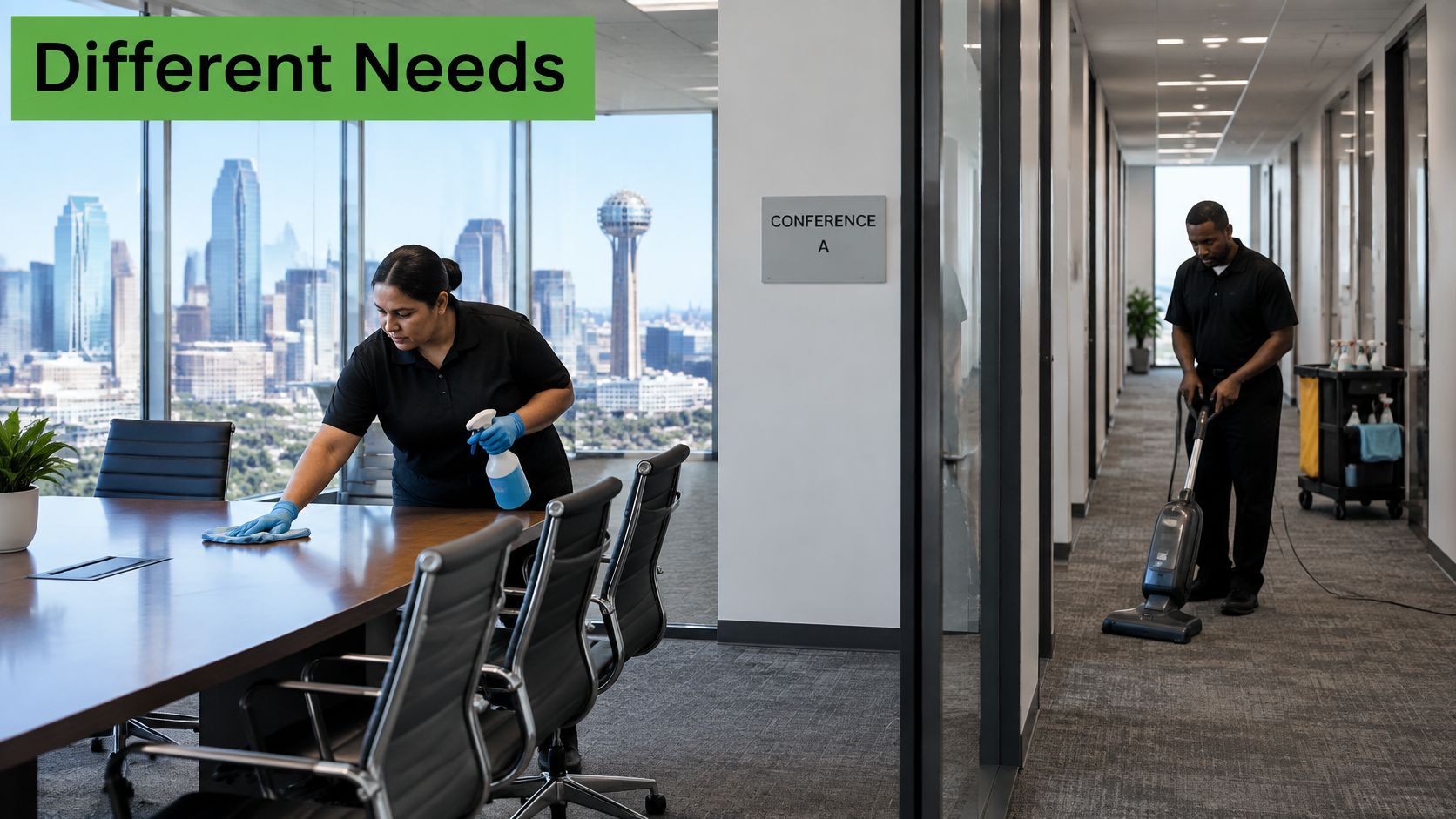
Say you're running a professional suite in Uptown with client meetings most days. Your priority is a weekly after-hours clean that never interrupts a meeting, with reception and conference rooms ready before the first visitor. After-hours work raises its own questions about keys, alarms, and who can enter which rooms, which is why multi-tenant buildings increasingly think through commercial property access control alongside their cleaning schedule rather than treating entry as an afterthought.
Now picture a new office in Plano or Frisco right after a build-out. The floors look swept, but fine drywall dust keeps resettling on desks and ledges. That office needs post-construction cleaning first, with repeated damp-wiping of horizontal surfaces, before any recurring plan makes sense. A small studio office in Bishop Arts or Oak Cliff sits at the other end. A weekly visit plus a monthly detail is often enough, since traffic is light and the same few people use the space.
A Dallas medical practice lands somewhere else again. Its administrative rooms need a tighter high-touch rhythm than a quiet back office, yet there's still no reason to treat every non-clinical wall like a patient room. Across all four examples, Dallas seasons add one shared task. Spring oak pollen and winter cedar pollen get tracked in on shoes, so damp-wiping entry surfaces works better than anything that blows dust back into the air.
Property managers, realtors, and movers often book the turnover clean between tenants, since they're the ones handing over keys. Your job is simpler. Find the example closest to your office, then adjust the cadence up or down rather than buying every add-on on the list.
Questions to Ask Before You Hire
A short phone call can reveal whether a cleaning plan fits your office. Ask specific questions, and write down the answers. Clear details about tasks, products, and access make it easier to compare providers.
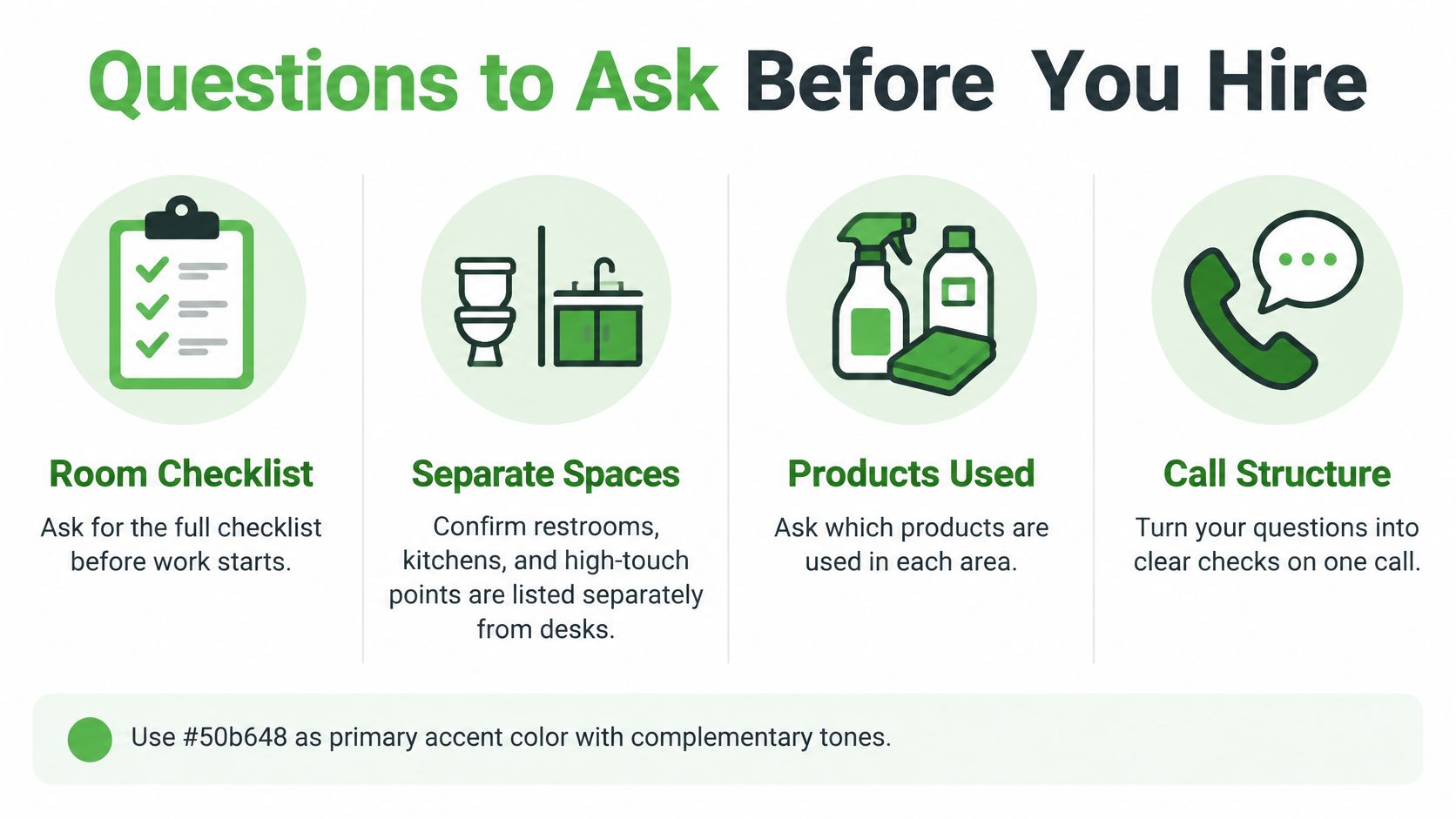
- Can I see the room checklist? Check that restrooms, kitchens, desks, and high-touch points have specific tasks assigned to them.
- Which products will you use? Ask whether they are fragrance-free and free of bleach and ammonia. The provider should be able to identify which products are used on desks and restroom fixtures.
- Who will be in my suite? Ask about training, background checks, insurance, and whether the same team can return. Gmaids uses trained, background-checked, insured Certified Cleaning Teams and aims to keep team assignments consistent.
- How does after-hours access work? Agree on keys, alarm codes, and rooms that must stay locked before service begins.
- How is sanitizing documented? Ask which product is used, how long it must remain on the surface, and how the task is recorded. Find out whether fogging is optional or part of the routine.
- What happens if a task is missed? Ask how the provider handles corrections and whether it offers a re-clean at no extra charge. Find out how inspections and checklists support follow-through.
What Shapes the Quote
Two suites with similar floor areas can need different amounts of work. The room mix, visit schedule, and type of cleaning all affect the quote, so share those details before comparing prices.
What shapes an office cleaning quote
| Pricing factor | What it changes in the quote |
|---|---|
| Suite size | Crew hours per visit |
| Restrooms and kitchens | Number of high-touch fixtures and surfaces |
| Cadence | Daily, weekly, biweekly, or monthly visits |
| After-hours labor | Scheduling outside business hours |
| Post-construction dust | Extra detail work after a build-out |
| Sanitizing | A recurring task or an incident-related add-on |
Ask for a quote based on your actual rooms and requested tasks. A useful proposal names the products, explains access arrangements, and clarifies who will clean the suite.
Gmaids has served Dallas–Fort Worth since 2004. Ask any provider how its cleaning plan, inspections, and team assignments will work in your specific office.
What to Expect and Common Questions
What happens on the first visit? Before service begins, set up a room-by-room checklist that identifies the areas to clean. The team uses standardized checklists, giving each visit a clear starting point.
Who comes into the office? Gmaids' cleaning teams are trained, background-checked, and insured. Consistent team assignments are used where possible, so cleaners can become familiar with the suite and its needs.
What products are used? Gmaids uses non-toxic, fragrance-free products without bleach or ammonia. Technicians bring their own supplies and equipment, so you do not need to stock a supply closet.
Is sanitizing included on every visit? Sanitizing is a separate service using EPA-approved disinfectants, with attention to high-touch areas. Routine cleaning removes soil; targeted disinfection can be added when a specific need calls for it.
Why isn't fogging the default? Fogging is one of the available sanitizing methods, not a substitute for routine cleaning. For everyday upkeep, prioritize removing soil and cleaning the surfaces people touch, then choose sanitizing for specific needs.
Does fragrance-free mean unscented? It means fragrance is left out of the cleaning products. To address an odor, identify and clean its source rather than masking it with added scent.
What if something is missed? Report it promptly and name the specific room or surface. That helps the team address the exact spot and update the checklist if the task was not clearly listed.
Service Area, Scheduling and Your Quote
For a Dallas office, the right cleaning plan depends on the rooms people use, how often they use them, and when the work can happen without disrupting the day. Gmaids serves Dallas and surrounding cities across Dallas–Fort Worth, with office cleaning as well as residential and other commercial services.
Setting Your Schedule
Office visits can be scheduled daily, weekly, or after hours. Recurring maid service is also available weekly, biweekly, or monthly. Choose a cadence that fits the traffic through your restrooms and kitchen, then adjust as you learn what those spaces need. Post-construction and move-in or move-out cleanings are available as one-time visits, either on their own or alongside a recurring plan.
If an HVAC company is changing filters, you can coordinate a vent and grille check with the cleaning visit. These tasks address different parts of the same indoor environment: filter care does not remove dust already on desks and ledges, and surface cleaning does not replace filter changes.
Before requesting a quote, gather your approximate square footage, number of restrooms and kitchens, preferred schedule, and whether the first visit should be a full reset or a maintenance clean. A preferred start day and after-hours access window can also help clarify the schedule. For a closer look at how those details affect pricing, read how much office cleaners charge.
Request a quote at www.gmaids.com or call 214-997-6918 to discuss your rooms and cleaning cadence. Gmaids has served homes and businesses across Dallas–Fort Worth since 2004, with office cleaning available on flexible schedules.
Your quote should reflect the space and the work it needs, rather than a one-size package. Gmaids provides non-toxic, fragrance-free office cleaning, with trained, insured technicians and options for recurring visits, after-hours service, and one-time resets. Visit Gmaids or call 214-997-6918 to discuss your office.


Ready for a healthier, cleaner home?