

Pet Safe Cleaning Products: A Practical Guide for Pet Owners

The mop is still drying when the dog trots in, lowers his nose, and takes a careful look at the kitchen floor. A cat does the same thing in her own way, stepping across the damp path and then grooming her paws like nothing happened. That's the core problem with cleaning in a pet household: the surfaces that need the strongest cleaning are the same ones paws, noses, and tongues reach first.
Pet safe cleaning products are less about a perfect ingredient list and more about making smart choices in a real home. You still need to cut grime, lift stains, and, sometimes, kill germs. The difference is knowing which products are gentle enough for routine use, which ones need pets kept out of the room, and which ingredients should never be anywhere near a dog or cat.
Table of Contents
The Reality of Cleaning a Home With Pets
A clean pet home is never sterile, and it doesn't need to be. It does need to handle mud from the yard, litter dust near the box, hair on the couch, and the occasional accident on a rug without leaving behind a residue that turns into a second problem. The tension is simple, pets live where you clean, and they don't read warning labels before they walk, lick, or groom.
The floor tells the story
A freshly mopped kitchen can look spotless and still be a bad place for a curious animal to step before it's dry. A damp floor carries cleaner into paws, and paws carry residue into mouths later. That's why the safest routine isn't “use less cleaning,” it's use the right cleaner, then keep pets away until the surface is fully dry.
If you already keep a stash of gentle wipes for paws, faces, and quick cleanups, the logic is the same. A helpful starting point for that kind of routine is this guide to dog wipes for body, which shows how pet-focused cleaning products are usually chosen with contact, residue, and skin sensitivity in mind.
Cleaning well and cleaning safely are different jobs
A product can make a room smell fresh without being gentle. It can also be gentle once dry, yet still be a poor choice while a pet is present. That's the part many owners miss, because the visible mess is gone long before the invisible residue is gone.
Practical rule: if the surface is still damp, your pet is still too early.
That same logic shows up in indoor professional cleaning too. For homeowners comparing approaches, a healthier home cleaning guide can be a useful reference for how cleaners think about residue, ventilation, and product choice in lived-in spaces.
A good way to think about pet-safe cleaning is this, you're not trying to avoid all chemistry. You're trying to choose products and routines that fit the room, the mess, and the animal sharing the space. For some households, that means fragrance-free maintenance cleaning. For others, it means an enzyme cleaner for a urine spot and an actual disinfectant only when the situation calls for it.
What Pet Safe Cleaning Products Actually Mean
In plain terms, a pet safe cleaning product is one that does its job without creating an acute or ongoing toxic risk for animals that walk across it, breathe near it, or occasionally lick treated surfaces. That definition matters because “safe for people,” “natural,” and “non-toxic” don't always mean the same thing.
Three labels that get mixed up
Many shoppers lump everything into one bucket, but there are really three ideas here.
A general human-safe cleaner is made for home use, but it may still irritate a pet's skin, lungs, or stomach if they contact it wet.
A non-toxic formula usually means the brand is trying to avoid the harshest ingredient classes, but the claim is often loose and not standardized.
An EPA Safer Choice product sits in a different category. The U.S. EPA says Safer Choice products are evaluated by federal scientists and must meet performance and safety standards, and the program includes a searchable list of certified products. The agency also expanded the framework in 2024 with an Outdoor Use Safer Choice label that explicitly includes outdoor-use products, including pet care products, as part of a broader federal labeling system, not a niche marketing claim. EPA Safer Choice products list
Why that label matters
Safer Choice isn't a pet-test badge. It's an ingredient-and-performance screen administered by the EPA, and that honesty matters. It helps you separate a product that merely sounds gentle from one that has been reviewed against federal standards for what it contains and how it performs.
The best label is the one that tells you what the product is, not just what it wants to sound like.
If you're sorting through local service options or comparing cleaning philosophies, this Dallas-Fort Worth page on green flagship non-toxic cleaning shows how one service frames non-toxic cleaning in practice, which can help you understand how labels and service choices often overlap.
The next thing to learn is where the actual risk comes from, because most of the concern isn't abstract. It's tied to specific ingredient families that veterinarians see again and again in household exposures.
Ingredients That Worry Vets the Most
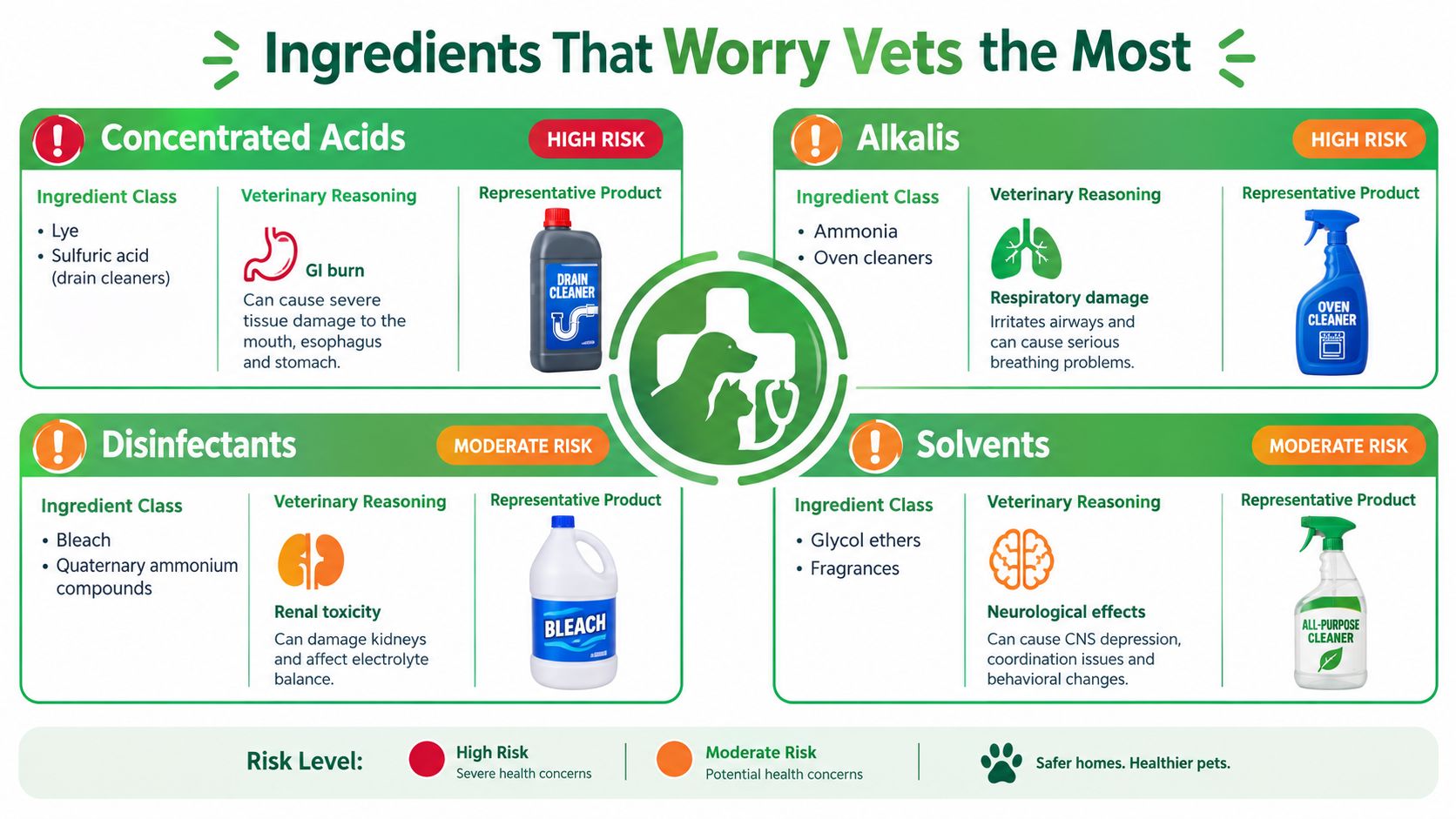
The most worrying ingredients are usually the ones that burn, irritate, or affect breathing before you ever notice a smell. Veterinary toxicology sources consistently flag bleach, ammonia, phenols, alkalis, and cationic detergents or quaternary-type disinfectants as major concerns in homes with dogs and cats. Merck Veterinary Manual on household cleaners
The corrosive group
Strong acids and alkalis are the first category I warn people about. Products like lye-based drain openers, sulfuric-acid drain cleaners, and harsh oven formulas can burn skin, paw pads, mouths, and eyes on contact. These are not “stronger versions” of normal cleaners, they're a different risk level entirely.
Bleach deserves its own warning because people treat it like a universal solution. It can irritate mucous membranes and, in a closed room, its fumes can be rough on cats and small dogs. Quaternary ammonium compounds, often used in disinfectants and fabric-related products, can also create respiratory irritation when ventilation is poor.
The cat-specific red flag
Phenols and phenolic disinfectants are especially concerning for cats because cats process phenols poorly. That raises the risk of systemic toxicity, even at exposures that might seem minor to a human. Pine-oil products can fall into this concern area too, which is why “fresh pine scent” should never be read as “pet friendly.”
The quiet troublemakers
Some solvents and glycol ethers show up in glass cleaners and floor strippers, and they can cause neurological or organ-related concerns depending on the formula and exposure. Essential oils deserve a careful eye as well. Tea tree, wintergreen, and citrus oils often sound wholesome, but that doesn't make them safe for cats.
Practical rule: concentration, dwell time, and ventilation matter as much as the ingredient name itself.
A splash of a strong chemical on a paw is a different problem from a diluted cleaner that's wiped, rinsed, and dried properly. That's why you can't judge a product from the front label alone.
Reading a Pet Safe Cleaner Label Without Getting Fooled
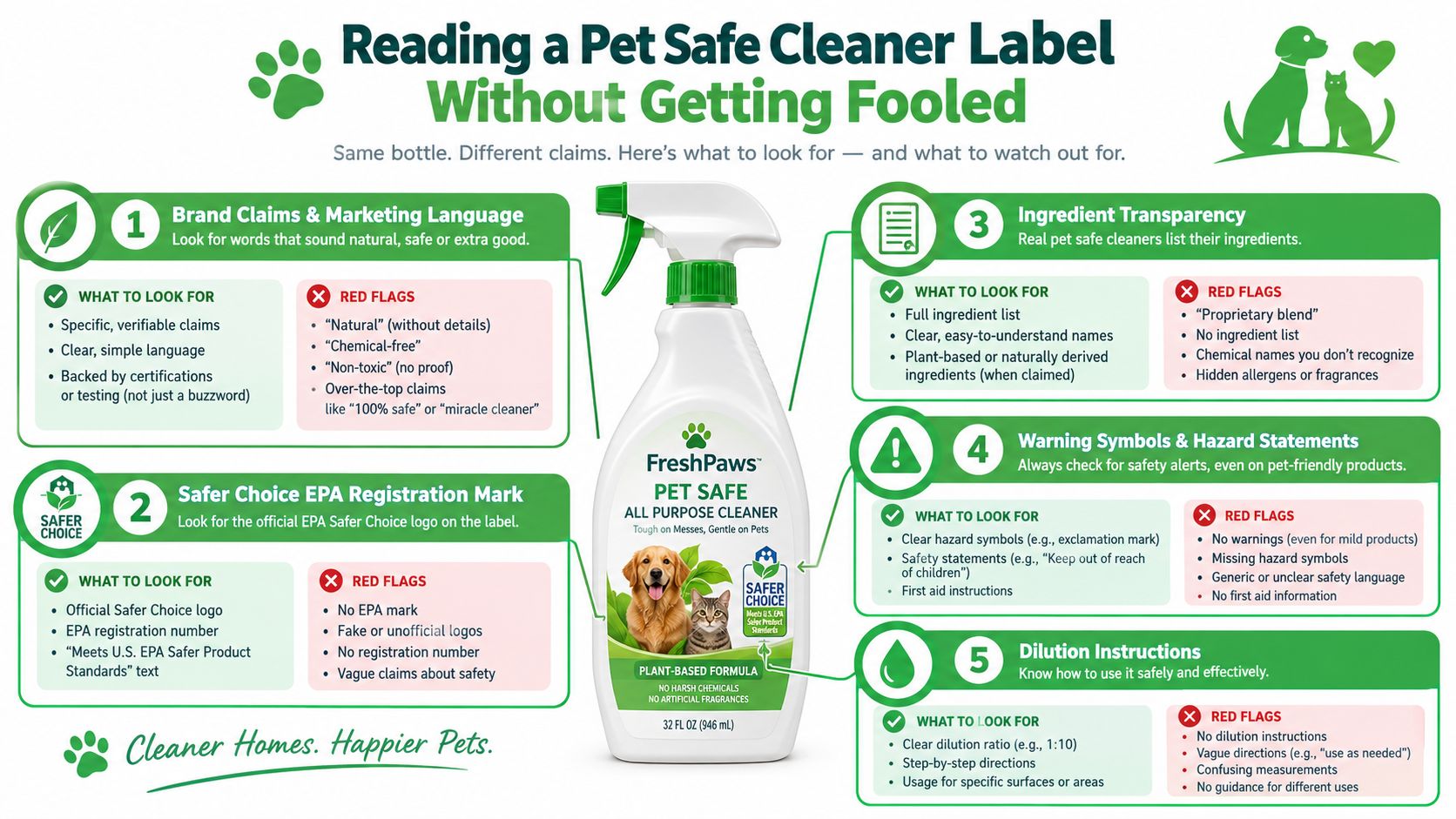
The front of the bottle is marketing space. The back of the bottle is where the true decision begins. Many products use words like natural, green, or pet safe on the front, but those terms do not reveal what is inside, how concentrated it is, or whether it fits the job.
Start with the front panel
Look for a real certification mark before you trust the language. Safer Choice matters because it comes from an EPA review framework, not a vague marketing promise. If a bottle says natural, plant-based, or eco-friendly, treat that as a description, not proof.
Then flip the bottle and read the ingredients. You're looking for actual ingredient names, not just a broad “proprietary blend” with little detail. Surfactants, solvents, preservatives, fragrance blends, and disinfectant actives all tell you something different about the formula.
Know what fragrance is hiding
“Fragrance” or “parfum” can hide a long list of undisclosed chemicals. That's a problem if your pet reacts to scent, but it's also a problem if you're trying to avoid ingredients that don't belong on feeding surfaces or near litter areas.
“Fragrance-free” is not the same as “unscented.” Unscented products may contain masking agents that reduce smell without removing the underlying fragrance chemistry. If your goal is a lower-residue, lower-irritant product, fragrance-free is the cleaner claim to trust.
Concentrate or ready to use
A concentrate can be perfectly fine, but only if it's diluted correctly. A ready-to-use product is simpler because the mixing step is already done. Either way, the safety picture changes if the bottle is used stronger than directed.
- Check the active or listed ingredients first, because the front label can be pure marketing.
- Read dilution directions closely, since a concentrate used too strong can turn a mild cleaner into a problem.
- Look for hazard statements, especially if the product is meant to disinfect.
- Treat fragrance wording as a clue, not a guarantee.
If you're comparing product categories for household cleaning teams or commercial spaces, the home offices disinfecting and sanitizing page is a useful example of how disinfecting services separate routine cleaning from higher-risk sanitizing work.
Choosing Between Fragrance-Free, Enzyme, and Disinfectant Options
The smartest choice depends on what you're cleaning, not just how gentle you want the bottle to sound. A fragrance-free cleaner, an enzyme cleaner, and an EPA-registered disinfectant each solve different problems, and mixing them up creates bad habits fast.
When each type earns its place
Fragrance-free cleaners are the easiest fit for routine dusting, floors, counters, and glass when the main goal is soil removal, not germ kill. They're useful because they reduce the chance of added scent and unnecessary residue, but they usually don't disinfect.
Enzyme cleaners are the workhorse for organic messes. Urine, vomit, and some food-related stains respond well because the cleaner is designed to break down the material behind the odor instead of just covering it up. Even here, though, you still need to watch for hidden fragrance or essential oils inside the formula.
EPA-registered disinfectants are the right tool when the mess calls for disinfection, such as certain kitchen contamination concerns or highly infectious cleanup situations. They require contact time, and pets need to stay out of the area until the surface is fully dry and ready.
What to use where
| Category | Best For | Limitations | Pet Note |
|---|---|---|---|
| Fragrance-free cleaner | Daily dusting, floors, counters, glass | Usually not a disinfectant | Good for routine maintenance when used and dried correctly |
| Enzyme cleaner | Urine, vomit, organic stains, odor control | Not a full disinfectant | Great for pet messes, but check for added fragrance |
| EPA disinfectant | High-risk kitchen cleanup, true sanitizing needs | Requires dwell time and careful use | Keep pets away until dry and aired out |
A lot of owners want one bottle to do everything. That's where mistakes happen. If you're only wiping paw prints or daily dirt, a gentler fragrance-free formula is usually enough. If you're dealing with raw-food splatter or a cleanup that needs germ reduction, a disinfectant belongs in the conversation.
Practical rule: use the least aggressive product that still solves the actual mess.
That's the same logic behind choosing a service plan that matches the job, not the label. A broader house-cleaning routine and a true sanitizing job are different tasks, and they should be treated that way.
Cleaning Room by Room Without Putting Pets at Risk
Kitchens are the hardest room to fake. They need to be clean enough for food prep, but pets also treat them like a travel lane, a sniff zone, and sometimes a snack station. The safest kitchen routine starts with separating food contact areas from general cleaning areas, then choosing a cleaner that matches the job rather than the scent.
Kitchen and living spaces
If the household handles raw meat, a true disinfectant can be appropriate on the right surfaces, but only with the label followed exactly. The CDC says to keep the disinfectant on for the stated contact time and let the item dry fully before pets use it again, and it also notes there isn't enough research showing vinegar cleans or disinfects effectively. CDC guidance for pet supplies
Living rooms ask for a different routine. Vacuuming should remove dander instead of just pushing it around, and pet bedding should be washed in hot water when the care label allows it. Enzyme products fit well here for odor and organic spots, but they should still be used with pets kept away until everything is dry.
Keep the room closed until the surface is dry, then reopen it.
Bathroom and laundry risks
Bathrooms are where lidded trash and closed toilet lids matter more than people realize. A freshly cleaned toilet or wet floor can become a contact point fast, so keep pets out until the room is fully dry. Fragrance-free scrubs are usually easier to live with than heavily scented sprays in a small enclosed space.
The laundry room is the hidden risk zone. Pods, dryer sheets, and liquid detergent caps are easy for pets to investigate, so storage matters as much as the cleaner itself. If a product is sitting out at nose level, it isn't stored safely.
The lock-out-and-dry routine
Humane World for Animals recommends keeping pets out of the room during cleaning, ventilating the space, and waiting until surfaces are fully dry before letting them back in. That same pattern shows up across good animal-care guidance, because the wet stage is where exposure is most likely. Humane World for Animals cleaning safety guidance
A practical room-by-room rule is simple. Clean, ventilate, dry, then return the pet. After that, rinse drinking bowls and mop buckets before you put them back into service.
Your Pet Safe Cleaning Checklist for Every New Product
A new bottle should earn its place in your home. The easiest way to judge it is to use the same sequence every time, because pet-safe cleaning is a habit, not a vibe. If a product passes the checks below, it still needs correct use, safe storage, and the right room.
The decision path I'd use in a pet home
Start with the label, then open the ingredient list. Look for EPA Safer Choice or another meaningful third-party review, and flag phenols, bleach derivatives, quaternary ammonium compounds, phthalates, and synthetic musks before you buy.
After that, ask what the product is really doing. A cleaner that depends on fragrance or essential oils to smell “fresh” may be doing less than the label suggests. A true disinfectant belongs on higher-risk surfaces, while a milder cleaner is often enough for everyday messes. If you want a printable version of this process, use the pet-safe cleaning checklist before trying a new product.
- Confirm the certification or review, so you are not relying on a marketing claim.
- Read the ingredient list, not just the front panel.
- Check dilution and dwell time, especially for concentrates and disinfectants.
- Match the product to the room, because kitchens, bathrooms, and pet areas do not carry the same risk.
- Test a small hidden area first, especially on stone, wood, upholstery, or specialty flooring.
- Keep the original bottle, so you can follow the label if a spill or exposure happens.
- Store it out of paw reach, because safe use starts with safe storage.
The final check is simple. If you cannot explain what the product does, what is in it, and how long it has to sit before a pet comes back, it is not ready for daily use in a pet household. If exposure is ever suspected, call your veterinarian or the ASPCA Animal Poison Control Center right away.
For homeowners who want a non-toxic routine handled by a cleaning team, Gmaids offers fragrance-free residential and commercial cleaning, plus sanitizing services using EPA-approved disinfectants when a job calls for them. If you are trying to keep dogs and cats safe while still getting a completely clean home, visit their site and compare the service options to the kind of cleaning your rooms genuinely need.


Ready for a healthier, cleaner home?

Gmaids is Dallas's original non-toxic house cleaning and maid service green since 2004. We deliver consistent, reliable, eco-friendly cleaning across Dallas–Fort Worth using fragrance-free products that are safe for kids, pets, and allergies, performed by our Certified Cleaning Teams®.
support@gmaids.com