Commercial Cleaning Fort Worth: Services, Costs and Hiring
The lobby glass is already smudged, the restroom soap is low, and the first client is on the calendar. If you run an office, clinic, or shop in Fort Worth, that early scramble is familiar, especially when a Dallas location is supposed to feel just as cared for.
Commercial cleaning in Fort Worth should not be one checklist pasted onto every lease. Match visits to foot traffic, restroom load, and how the air really moves. Match products to who uses the space: kids in a waiting room, pets in a coworking lounge, staff who react to fragrance, and pregnant employees who notice fumes before anyone else does.
This is the practical version. What belongs on the scope, which schedule fits occupancy, where surface work stops and the building systems start, and how to read a quote without chasing a single rate.
Table of Contents
- What Commercial Cleaning in Fort Worth Covers
- Daily, After-Hours and Recurring Service Models
- Which Fort Worth Businesses Need Regular Cleaning
- Non-Toxic Cleaning and Sanitizing Done Right
- Where Cleaning Ends and Air Quality Work Begins
- Pricing Factors That Shape a Commercial Quote
- Commercial Cleaning Questions Fort Worth Buyers Still Ask
- Choose a Vetted Provider and Request a Flat-Rate Quote
What Commercial Cleaning in Fort Worth Covers
A Fort Worth dental office opens at 8. At 7 a.m. the reception desk still holds yesterday's clipboards, the restroom needs a reset, and the break room sink has coffee rings. Nobody is in yet. That quiet hour is when the work should happen, before the first patient sits down.
Commercial cleaning is scheduled cleaning for non-residential buildings. Offices, retail stores, medical practices, and multi-tenant properties in Dallas and across Fort Worth all fit. It is not a home visit stretched across a lobby.
A starting scope, not a contract
| Area | Typical tasks | Typical frequency |
|---|---|---|
| Restrooms | Fixtures, mirrors, sanitizing high-touch points, restocking | Daily |
| Break rooms and kitchens | Counters, sinks, appliance exteriors, trash removal | Daily |
| Workstations and common areas | Dusting, desks, doors, light switches | Daily or weekly |
| Entry and lobby | Glass, door handles, entry mats | Daily |
| Floors | Vacuuming, sweeping, mopping, carpet care | Weekly, or daily in high traffic |
| Periodic detail work | Baseboards, vents, window sills, high dusting | Monthly or quarterly |
Restrooms and kitchens earn a daily pass because soil, odor, and hand contact pile up fastest there. Floors follow feet. A quiet suite can wait a week for a full mop. A retail door on a dusty afternoon cannot. Dusting and detail work, including baseboards, vents, sills, and high surfaces, sit on a weekly or monthly rhythm. They do not reset the room the way a restroom does.
Texas heat and long AC seasons pull fine dust indoors. Spring oak and winter cedar ride in on coats and shoes, so entry mats and lobby glass stay daily jobs even when the interior looks fine. A lighter Plano satellite with the same headcount can ease the floor cadence if the door opens less often.
Practical rule: The table is a starting point, not a contract. Patient flow, floor type, and the lease can move a row.
Walk the space once. Mark each area daily, weekly, or monthly. Bring that list to every provider so each quote prices the same work. Basic cleaning on that list usually means dusting, vacuuming, hard floors, kitchen surfaces, bathroom fixtures, mirrors, trash, and a general tidy. Deep cleaning and post-construction sit outside the daily loop.
Daily, After-Hours and Recurring Service Models
| Model | Best for | Typical timing | Trade-off |
|---|---|---|---|
| Daily service | Medical practices, busy retail, high-traffic offices | Early morning or overnight | Highest cost, most consistent results |
| After-hours service | Offices and coworking suites that need quiet work hours | Evenings or weekends | Requires building access and key control |
| Weekly recurring | Steady offices with moderate traffic | One fixed day each week | Dust and restroom needs may build up between visits |
| Biweekly recurring | Smaller offices with light use | Every two weeks | Needs interim restroom and kitchen attention |
| Monthly recurring | Light-use spaces and detail work | Once a month | Not enough for restrooms, kitchens or entry areas |
| One-time or project | Post-construction, move-out, pre-opening | Scheduled around handover | Single visit, with no ongoing standard |
Match the row to traffic, not to how tidy it looks today
A medical practice with patients in and out all day needs daily restroom and high-touch service. A quiet office with fewer than a dozen people often does well on a weekly plan, with someone on staff wiping the restroom between visits. Looking "fine" on a Monday photo does not change that math.
After-hours service fits businesses that cannot have a crew on the floor during the day. You will need a written access plan: which door, alarm code, key control, and a sign-in step. In many Dallas multi-tenant buildings the property manager holds the alarm, not the tenant. Spell that out before the first night.
A one-time project, after a renovation or before you reopen, can hand off to a recurring plan once people arrive. Use a commercial cleaning checklist so the project list and the ongoing list do not get mixed together.
Start with a trial month. Review results with the crew after two or three visits, then add or drop a day. Frequency is a setting you adjust, not a personality test for the building.
Which Fort Worth Businesses Need Regular Cleaning
The people who usually need a set schedule are office managers, coworking operators, retail managers, medical practices, and multi-tenant property managers in Dallas, Fort Worth, Plano, and Frisco.
A Fort Worth dental or medical suite with patients all day needs daily restroom and high-touch work. A quiet professional office under a dozen people often fits weekly cleaning plus a midweek restroom check. Retail on a busy corridor needs entry glass, mats, and floors often, because heat, dust, and oak and cedar pollen come in whenever the door opens. New construction and fit-outs in Allen and Prosper leave fine dust that ordinary weekly dusting does not clear, so those spaces start with a post-construction clean. Shared lobbies, hallways, and restrooms stay with the property manager even when tenants clean their own suites.
The U.S. Bureau of Labor Statistics May 2023 Occupational Employment and Wage Statistics reported about 46,070 janitors and cleaners, excluding maids and housekeeping cleaners, in the Dallas–Fort Worth–Arlington area, at 11.62 workers per 1,000 jobs and a location quotient of 0.81. That is a real labor market. It does not tell you whether your suite needs a crew. Occupancy, restrooms, and the lease do. Practices that want the clinical side spelled out can start from a medical office cleaning service scope and then trim it to their rooms.
Four checks before you put it in the operating plan
- Count people through the door on a typical day.
- Count restrooms and kitchens, not just square feet.
- Note asthma, allergies, or chemical sensitivity among staff or visitors.
- Read the lease for a required cleaning standard.
If two or more checks show heavy use or a lease rule, put regular commercial cleaning in Fort Worth, or at the Dallas twin site, into the operating plan.
Non-Toxic Cleaning and Sanitizing Done Right
Stronger chemicals do not automatically mean a cleaner office. A lot of "sanitizing" talk just means more product in a closed room. That can leave fumes and film, and it can miss the soil that makes a disinfectant fail.
Split the job in two. Routine cleaning removes soil, dust, and grime with detergent and water. Targeted disinfection is for specific situations, such as illness in the building or occupants at higher health risk. The CDC guidance on cleaning and disinfecting a facility treats door handles, elevator buttons, desks, keyboards, restroom fixtures, faucets, counters, and light switches as priority high-touch surfaces for regular cleaning. Disinfection is additional, not the default on every shelf.
Soil comes off first. Organic residue can interfere with disinfectant performance. Staff should follow the product label for concentration, how to apply it, and contact time, then step up frequency when occupancy rises. A shiny desk is not proof the contact time was met.
What goes in the bottle
Ask for non-toxic, plant-derived and mineral-based products. No bleach. No ammonia. Fragrance-free means synthetic scent is left out entirely. That is not the same as unscented, where a masking fragrance can still be in the formula.
Ingredients matter in commercial rooms for the same reasons they matter at home. Fumes hang in a closed office with the AC recirculating. Residue sits on waiting-room floors where children crawl and, in some suites, where a visiting pet naps. Fragrance is often there to hide a chemical odor, not to make the air healthier. Fewer harsh chemicals is the better bet for kids, pets, pregnant staff, and people with allergies, asthma, or chemical sensitivities. That is a product standard, not a medical promise.
Hand any provider a written touchpoint list. Name each high-touch spot, how often it is cleaned, and which product is used. Sanitizing cleaning then has a map instead of a spray-everything habit.
Where Cleaning Ends and Air Quality Work Begins
Cleaning and air quality are partners. They are not the same job.
Cleaning removes settled dust, soil, and surface contamination, and it cuts the dust that gets kicked back into the air while people work. Ventilation, filtration, and humidity control belong to the building and to HVAC professionals.
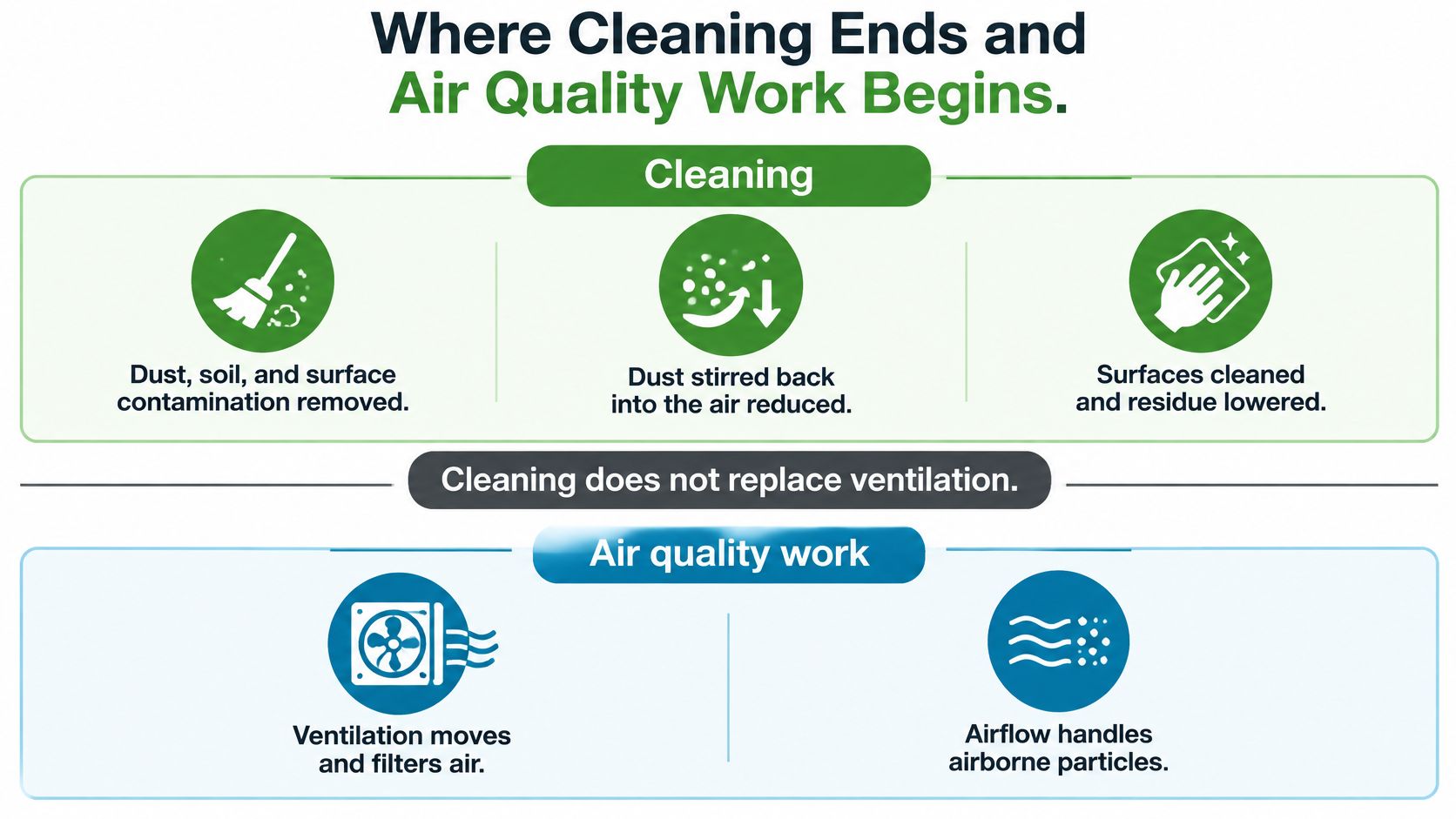
EPA publications on indoor air quality are clear that poor indoor air can come from pollutant sources, weak or poorly run ventilation, and changes in how the building is used. Cleaning alone cannot fix too little outside air or weak filtration. Where it is practical, increase outdoor-air ventilation, and upgrade recirculated-air filtration to MERV 13, or the highest rating the system accepts. Portable air cleaners can supplement that. They do not replace ventilation or source control. Some facilities add commercial purifiers from EcoQuest Purifiers beside the HVAC plan, not instead of a filter check.
Fort Worth makes the split obvious. Long cooling seasons keep air moving through the same equipment for months. Dry heat stirs dust. Humidity swings can leave a musty smell that no mop will erase. Pollen enters every time the door opens.
Signs the building is the problem
- Dust returns within hours of a full clean.
- Musty odors linger after trash, restrooms, and floors are done.
- Condensation shows on vents or windows.
- Rooms stay stuffy even after the crew has finished.
If those show up, call the HVAC contractor. Share the cleaning schedule with the facility manager, run dusty work during low occupancy, and use a HEPA-filtered vacuum so the crew is not redistributing what it just picked up. Ask the contractor to confirm the filter rating in writing.
Pricing Factors That Shape a Commercial Quote
A commercial quote is built from the scope, not from one rate that fits every address. Two suites with the same square footage can land far apart once restrooms, floors, and nights enter the picture.
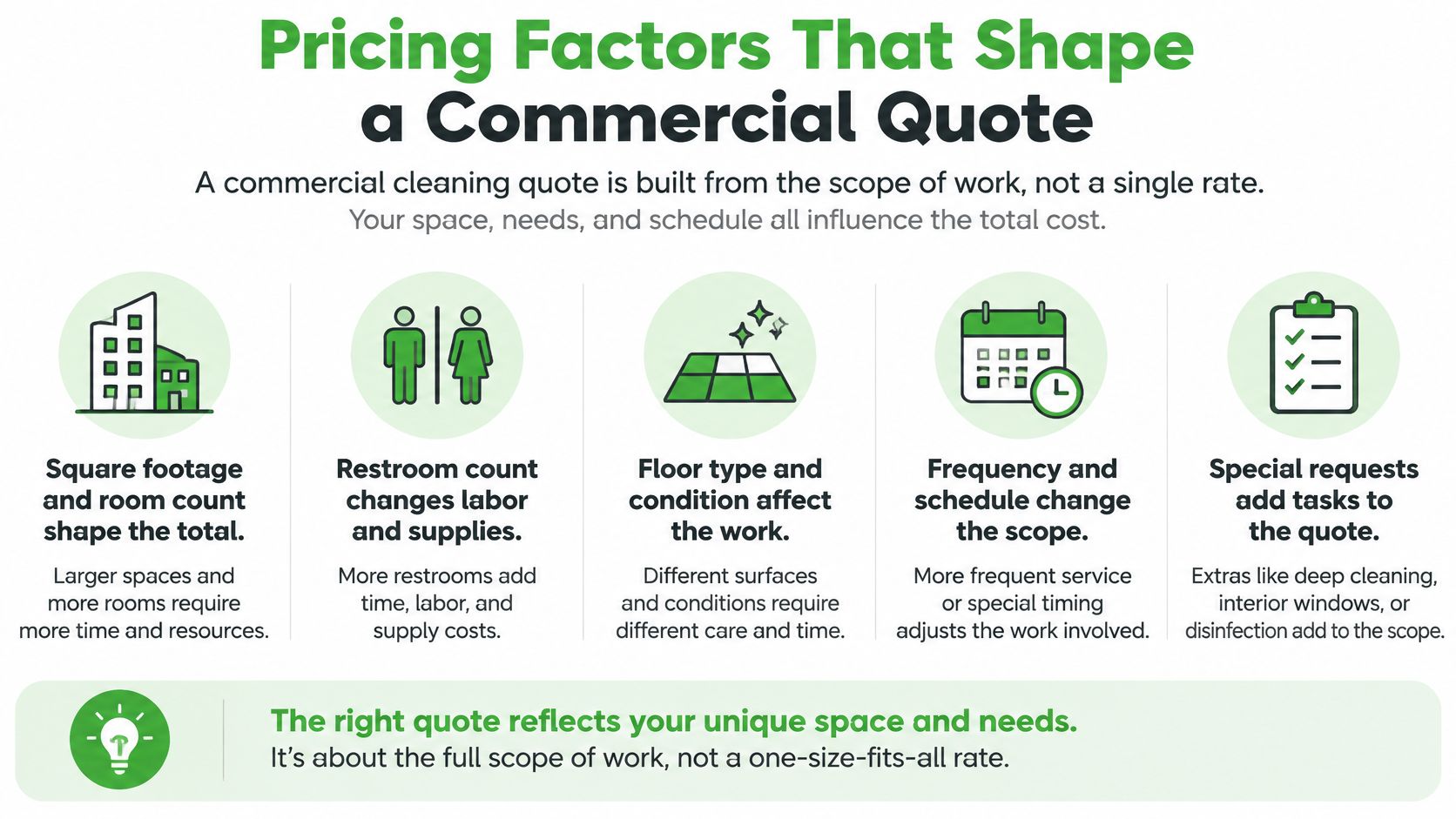
Square footage and room count set the walking time. A chopped-up medical suite takes longer than an open office of the same size. Restrooms and kitchens take the most labor per square foot because of fixtures, restocking, and trash. Floor type changes the tools: carpet and rugs, hard floors, stone, and polished concrete are not the same pass. Frequency cuts the cost of each visit when soil has less time to build, and it raises the monthly total because the crew returns more often. Timing matters too. After-hours and weekend visits need access arrangements and sometimes a different staffing pattern.
Specialty scope sits on top of that base. Post-construction dust removal, sanitizing of named high-touch areas, and detail work on baseboards and vents need different time and equipment. Ask whether the provider brings tools and products, and whether special requests are inside the number or added later. For a closer look at how office buyers compare those pieces, see how much office cleaners charge.
Six steps before you compare totals
- Estimate the square footage you occupy, including shared areas you pay to clean.
- List restrooms, kitchens, and high-traffic zones by name.
- Choose a starting frequency from traffic, not from a neighbor's contract.
- Ask for the scope in writing, task by task.
- Compare what is included, not only the bottom line.
- Make every provider quote the same written scope so the numbers mean the same work.
Commercial Cleaning Questions Fort Worth Buyers Still Ask
Who holds the keys at night? After-hours crews need a written access plan: which door, the alarm code, key control, and a sign-in rule. In a Dallas multi-tenant building the property manager often holds the alarm. If that person is out, the crew should not guess.
Does a clean office fix stuffy air? No. The crew removes settled dust and soil and should run a HEPA vacuum while the suite is quiet. Filter ratings, outdoor air, and humidity stay with the HVAC contractor. If dust is back by lunch, that is a building question.
What should the label say? Fragrance-free means no synthetic scent is added at all. Unscented can still hide a masking fragrance. Ask for plant-derived and mineral-based products, and for no bleach or ammonia. Read the bottle the way you would at home.
What happens after the builders leave? A post-construction or pre-opening clean is one visit timed to handover. It includes the fine dust weekly dusting misses. Once people move in, switch to weekly, biweekly, or monthly based on restroom use and foot traffic. A move-out that also covers fridge, oven, cabinets, and closets is a different one-time job from a nightly janitorial pass.
What if a listed task is missed? Report it within 24 hours so it can be corrected under a written satisfaction policy. Keep the same touchpoint list for every bidder. If one quote skips the break room and another includes it, you are not comparing cleaners. You are comparing different buildings on paper.
Choose a Vetted Provider and Request a Flat-Rate Quote
Compare the crew and the paper before you compare totals. A low number on a vague scope is not a bargain. It is a restroom that gets skipped in week three.
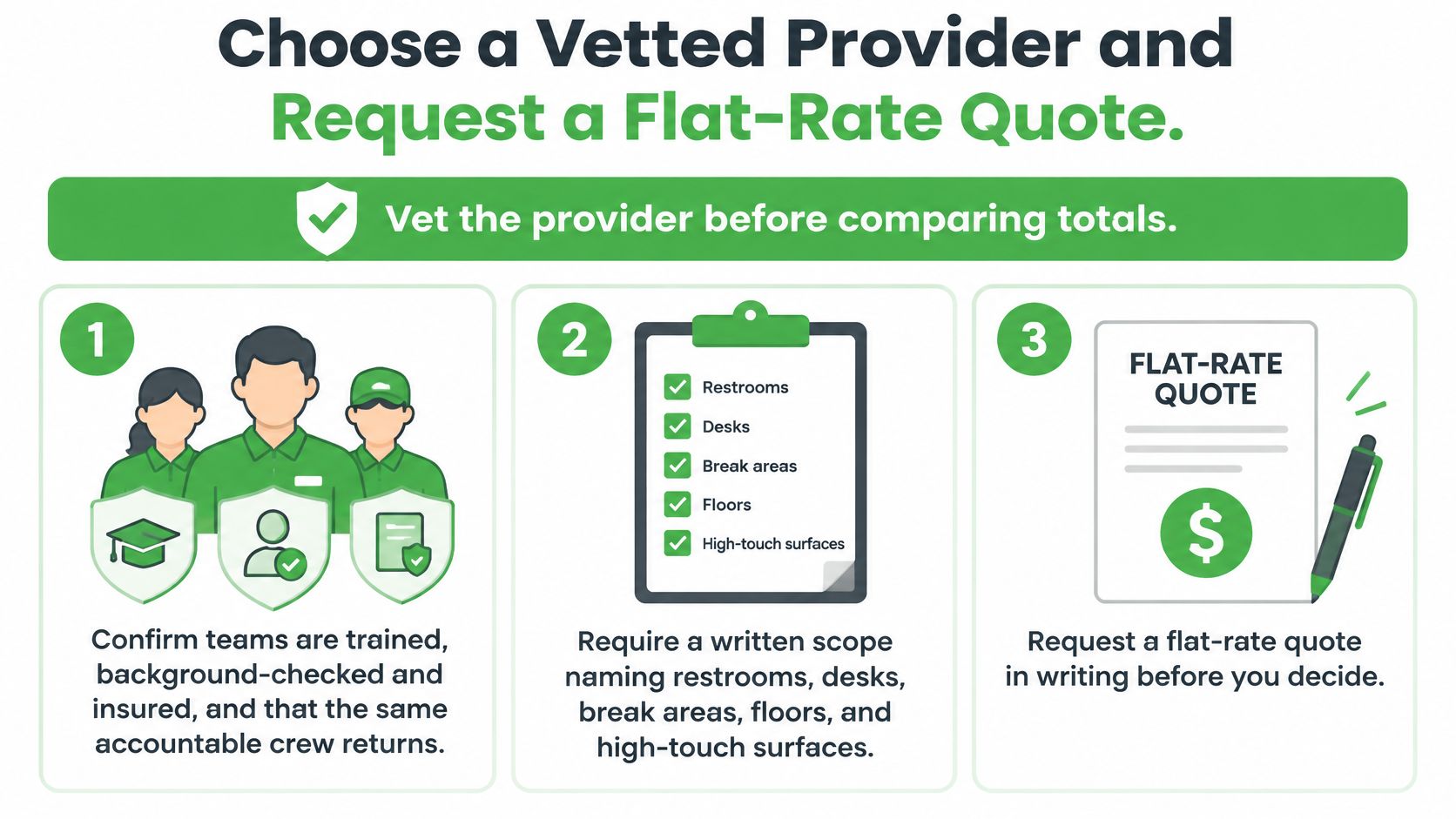
- Confirm the people. Teams should be trained, background-checked, and insured, and the same accountable crew should return each visit. Gmaids Certified Cleaning Teams® work that way across Dallas–Fort Worth.
- Require a written scope that names restrooms, kitchens, floors, and each high-touch point with its frequency. A bidder who will not put that list on paper is pricing a guess.
- Require a product list that is non-toxic and fragrance-free, with no bleach, ammonia, or synthetic fragrance. Office cleaning in Dallas follows that standard and can be set daily, weekly, or after hours, and the same rule applies in Southlake and Irving.
- Match frequency to the space. A quiet suite may only need weekly visits while a medical practice or busy retail floor may need daily or after-hours work. Push back on one identical plan priced for both, because frequency should follow occupancy and foot traffic.
- Ask how inspections work and how the schedule adjusts after the first month. Access, alarms, keys, and missed-task handling belong in writing before the first visit.
Gmaids has served Dallas–Fort Worth since 2004. Once the written scope is set, recurring visits run weekly, biweekly, or monthly, with one-time options when you only need a project. Customized plans are priced by contacting the office, so attach the walk-through frequency list when you call 214-997-6918 and the quote you get back will match the space you walked.
Gmaids brings non-toxic, fragrance-free commercial cleaning to offices, retail, medical practices, and multi-tenant buildings across Dallas–Fort Worth, with schedules built around your hours instead of a single chemical-heavy plan. Call 214-997-6918 or visit Gmaids to request a custom quote, and send the daily, weekly, and monthly list from your walk-through so the scope covers the work you saw on site.


Ready for a healthier, cleaner home?