Home Deep Cleaning Checklist: Room by Room, Step by Step
The ceiling fan in a Dallas living room can look fine from the sofa while a gray film sits on the blades, the vent cover, and the window track. Spring oak pollen and winter cedar ride in on shoes, then the air conditioner runs for months with the windows shut. In Lakewood and Plano, that mix settles on high surfaces that a quick tidy never reaches.
A Saturday reset of counters and floors can still leave the oven, the grout, and the baseboards untouched. That gap is what a home deep cleaning is for. The order of the work matters as much as the product in the bottle, because dust you knock loose will land on whatever you just finished, and the air you leave behind is part of the result.
Table of Contents
- What a Home Deep Cleaning Covers
- Supplies and Products for a Non-Toxic Deep Clean
- Room-by-Room Deep Cleaning Checklist
- How to Sequence a Deep Clean From Top to Bottom
- Indoor Air, Fragrance and Allergy-Friendly Cleaning
- How Often to Deep Clean Your Home
- Decide Between Doing It Yourself and Booking a Pro
What a Home Deep Cleaning Covers
The floors can look clean while the baseboards, vent covers, and oven interior have not been touched in months. A basic cleaning keeps a home that is already in decent shape on track. It covers dusting of surfaces and furniture, vacuuming carpets and rugs, sweeping and mopping, kitchen surfaces and appliance exteriors, bathroom cleaning, mirrors, trash, and general tidying.
A home deep cleaning goes after the buildup those visits skip. In Dallas–Fort Worth, long air-conditioning seasons and spring pollen leave a fine layer on ceiling fans, door tops, and blinds. Daily tidying never quite gets there. In 2023, 75% of Americans who planned to spring clean listed washing windows as a priority, in the American Cleaning Institute survey of 1,000 U.S. adults. Routine visits often stop at mirrors.
| Area | Basic cleaning | Home deep cleaning |
|---|---|---|
| Dusting | Surfaces and furniture dusted | Dusting top to bottom, including ceiling fans, vent covers and light fixtures |
| Floors | Swept, mopped and vacuumed | Edges, corners and under-furniture areas detailed, with carpets and upholstery deep-cleaned |
| Kitchen | Counters, sink and appliance exteriors | Adds oven interior, inside cabinets and drawers, and grease above the stove |
| Bathrooms | Surfaces sanitized, mirrors cleaned | Grout detailed, limescale removed, inside cabinets and drawers cleaned |
| Walls and doors | Spot wiped where visible | Baseboards, door frames, light switches and handles wiped throughout |
| Windows and blinds | Mirrors only | Blinds and shutters hand-wiped, interior window glass and sills detailed |
A quick self-check
Walk one room and look up, then down.
- High spots: Fan blades, vent covers, and the top of the door frame.
- Hidden buildup: Oven interior, cabinet shelves, and grout lines.
- Low edges: Baseboards, under the bed, and the floor beside the sofa.
If several of those deep-clean areas have sat for months, the home needs a deep clean, not another basic pass. The room list below shows where each task belongs, whether you are in Highland Park or a newer house in Frisco.
Supplies and Products for a Non-Toxic Deep Clean
Start with a small kit so you are not hunting for tools mid-room. You need several microfiber cloths, with one color for kitchens, one for baths, and one for living areas. Add a HEPA-filter vacuum, an extension duster, a soft grout brush, two buckets, and gloves. Color-coding keeps bathroom soil off the coffee table.
Plant-derived cleaners and mineral-based cleaners lift soil without bleach or ammonia. Fragrance-free means synthetic scent is left out entirely. That is not the same as unscented. Some unscented sprays still carry a masking fragrance so the formula smells like nothing. Fumes hang in a closed bedroom. Residue stays on the floor where a baby crawls and a dog naps. Fragrance can also hide ingredients you cannot spot by smell alone. If pets share the house, the notes in our guide to non-toxic cleaning products for pets walk through what belongs on floors and what should stay in the cabinet.
Cleaning and disinfecting are different jobs. The CDC states that soap-and-water cleaning removes most germs from household surfaces in ordinary situations, while disinfection is generally for illness in the home or when someone is more vulnerable to infection. Soil and grease block a disinfectant from the surface, so wash visible dirt with detergent or soap and water first. Then apply an EPA-registered disinfectant made for that material, and leave it wet for the label's contact time. Wiping it off early cuts the effect. Use it on doorknobs, light switches, handles, countertops, faucets, sinks, toilets, phones, and keyboards, not on every wall. Ventilate while you work. Never mix products, even two that both say plant-based.
For interior glass, a mineral-based, fragrance-free glass cleaner beats an ammonia formula. If you want a longer look at streak-free glass without harsh chemicals, that walkthrough pairs well with hand-wiped sills.
| Task | Tool or product to use | What to avoid |
|---|---|---|
| Dusting | Damp microfiber cloths | Dry dusters that scatter particles into the air |
| Vacuuming | HEPA-filter vacuum with fresh bags or filters | Standard vacuum with a worn or clogged filter |
| General surfaces | Plant-derived, fragrance-free cleaner | Bleach, ammonia and synthetic-scented sprays |
| High-touch disinfecting | EPA-registered disinfectant used exactly as the label directs | Disinfectant applied over visible dirt, or mixed with other products |
| Glass and mirrors | Mineral-based, fragrance-free glass cleaner | Ammonia-based glass cleaners |
| Grout | Mineral-based cleaner with a soft brush | Acid or bleach-based grout cleaners |
Buy the cloths, the HEPA vacuum bags or filters, and one fragrance-free all-purpose cleaner first. Add the glass cleaner and grout brush before you open the bathrooms.
Room-by-Room Deep Cleaning Checklist
Print this list or keep it on your phone, and check each row as you finish. Mark any spot that needs a second pass before you leave the room.
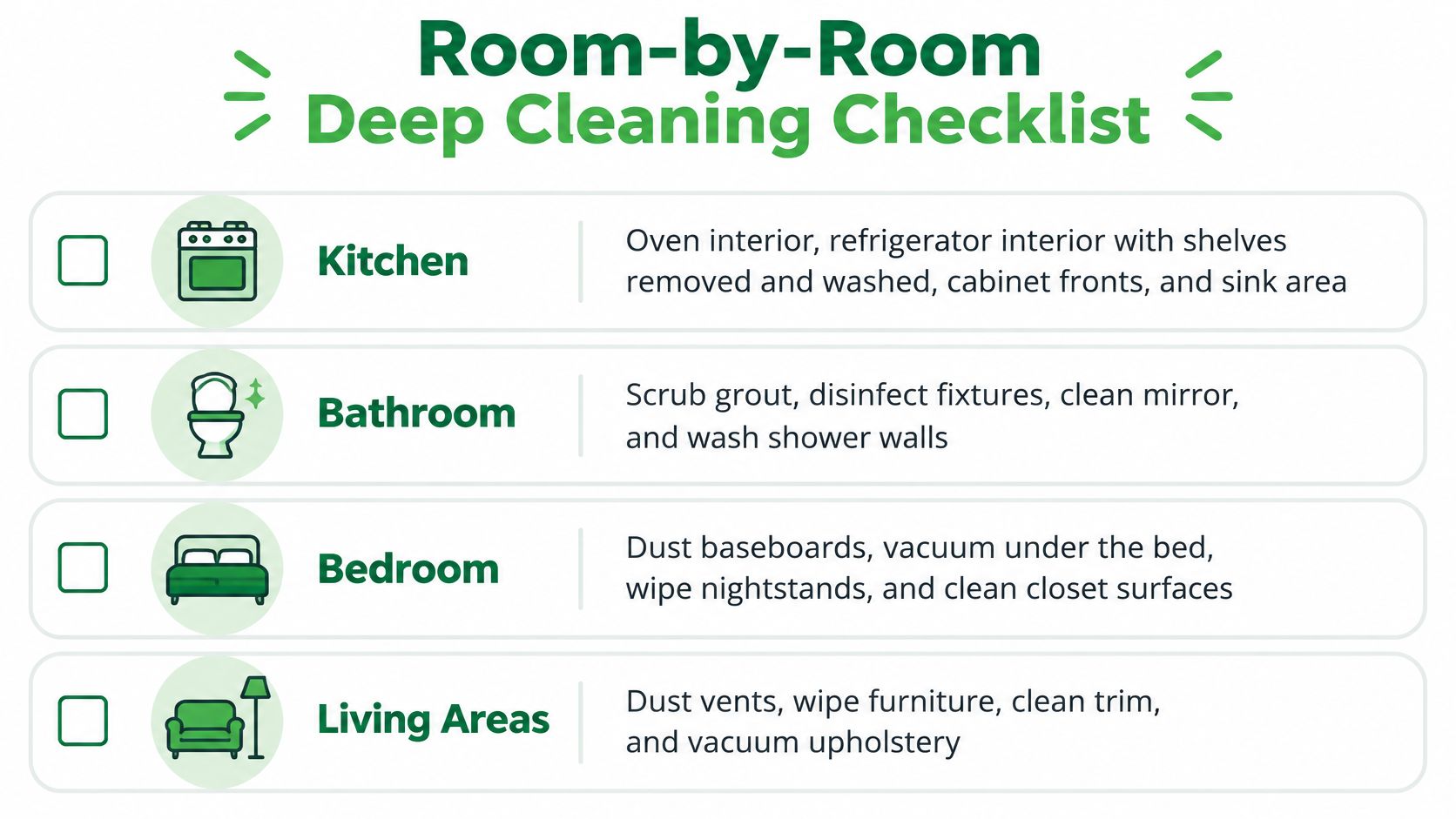
Kitchens collect the most film, so they come first while your energy is high. Grease above the stove does not wipe off with the same cloth you used on the counter yesterday.
| Room | Deep clean focus |
|---|---|
| Kitchen | Oven interior, refrigerator interior, cabinet fronts and drawers, range hood filter, backsplash |
| Bathrooms | Grout lines, tub and shower tile, limescale on fixtures, inside cabinets, exhaust fan cover, behind the toilet |
| Bedrooms | Ceiling fan blades, closet shelves and floor, blinds, baseboards, mattress surface, area under the bed |
| Living areas | Ceiling corners, vents, upholstery and cushions, interior windows and sills, baseboards |
| Entryways and hallways | Door frames, light switches, handles, baseboards, doormat area |
| Laundry and closets | Dryer vent area, washer drum and door seal, shelving |
Why each room is on the list
Kitchen: Pull the refrigerator shelves and wash them in the sink, then wipe the walls of the cavity. Degrease the range hood filter, the backsplash, and the cabinet faces around the stove. Drawer interiors hold crumbs that smell fine until the drawer is warm.
Bathrooms: Scrub grout with a soft brush and a mineral-based cleaner, then work tub and shower tile. Lift limescale from faucet bases, wash inside the vanity, pop off the exhaust fan cover, and clean the base and sides of the toilet, not only the bowl.
Bedrooms: Dust fan blades, closet shelves, and the closet floor. Hand-wipe blinds and baseboards. Vacuum the mattress surface with a HEPA-filter vacuum, then the floor under the bed. Yellow marks on a mattress are a different job from dust. A clear method for removing yellow stains from mattresses helps when a vacuum pass is not enough.
Living areas: Clear cobwebs from ceiling corners, wipe vent covers, and vacuum cushions and upholstery. Detail interior glass and sills, then baseboards. Pollen that blew in during a mild week in East Dallas often sits in that sill track.
Entryways and hallways: Wipe door frames, switches, and handles. Shake or vacuum the doormat and the tracked soil around it. That strip is where outdoor dust enters a Bishop Arts bungalow or a Southlake hallway.
Laundry and closets: Wipe the dryer vent area you can reach, the washer drum, and the rubber door seal, then the shelves. Lint and detergent film hide where clothes pile up.
Check every row. A second pass on one greasy backsplash beats rushing into the next room with a dirty cloth.
How to Sequence a Deep Clean From Top to Bottom
Plan the day before the first cloth comes out. Clear counters, floors, and closet entrances the day before. Block one full day so no room is left half-done. Start in the room with the heaviest dust, often the kitchen or a front room that faces a busy street. Move through the house in one direction so you do not walk back across a finished floor. Keep wet supplies out of the path while you are still dusting.
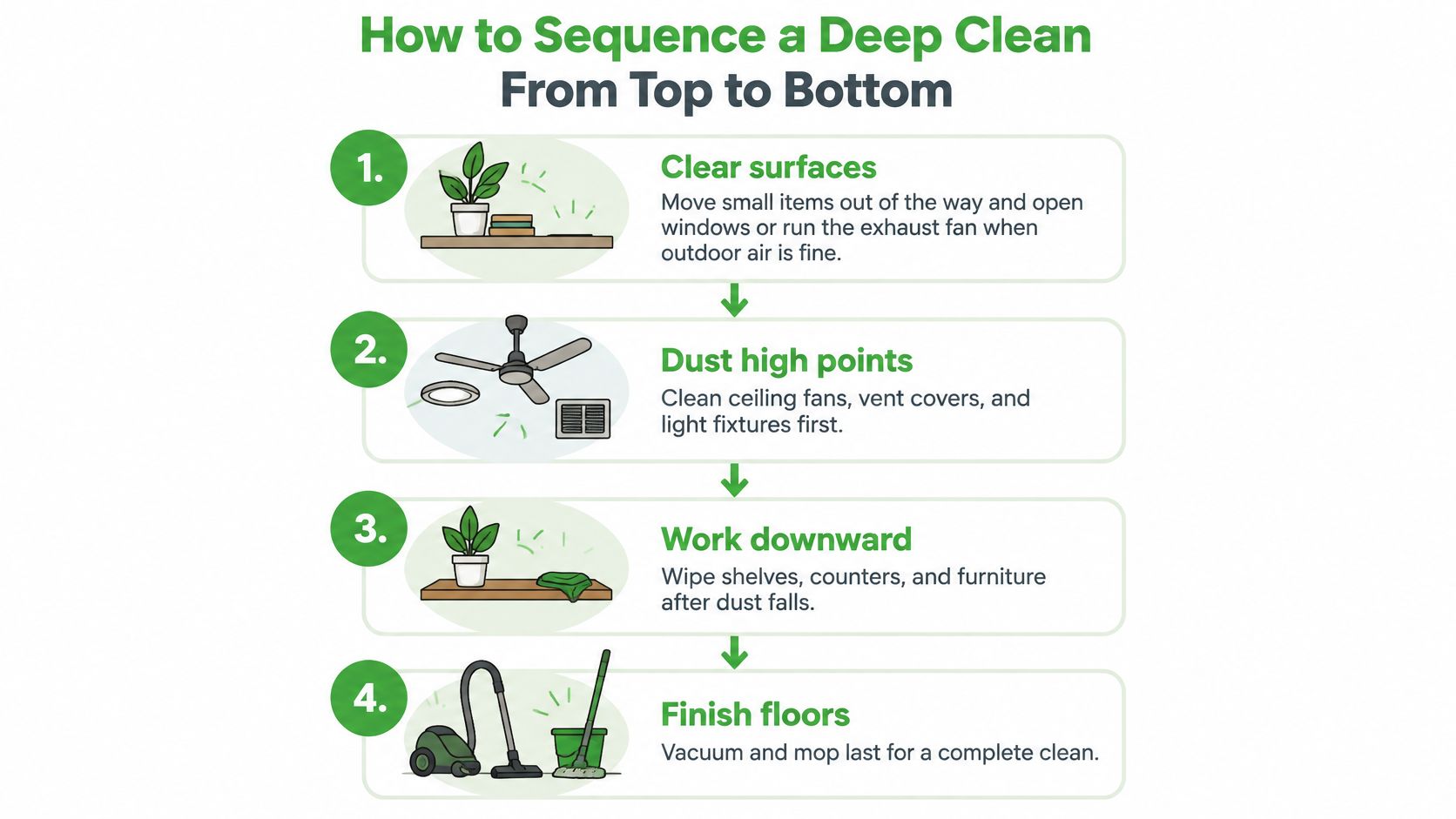
Clear surfaces. Move small items off tables and sills. Open windows or run the exhaust fan when outdoor air is fine. You want a path for dust and product vapor, not a sealed room.
Dust the high points first. Ceiling fans, vent covers, light fixtures, and the tops of door frames come before anything at eye level. Use a damp microfiber cloth so particles stick to the cloth instead of floating.
Wipe walls, switches, door frames, and handles. Work downward. Dust you just loosened is landing, and you want to catch it before it dries into a new film.
Clean kitchens and bathrooms. Appliance interiors, cabinet fronts, counters, sinks, tubs, and grout belong here, after the ceiling work and before the floors. Grease and soap scum should not get ground into a mop later.
Dust furniture, blinds, and shelves from top to bottom. Horizontal surfaces hold the pet dander and fine dust that a glance misses.
Vacuum upholstery and carpets. The U.S. EPA recommends a HEPA-filter vacuum because it reduces captured dust that escapes through the exhaust, and it advises damp dusting rather than dry dusting so moisture binds particles. Vacuum after the high wipe, with slow overlapping passes. Change the bag or filter when it fills, because a clogged filter pushes dust back out. People with asthma or allergies should stay out of the room while you vacuum.
Mop hard floors last. Start at the far corner and work toward the door. Floors are the exit, not the opening act.
Dry dusting, or vacuuming before the high surfaces are wiped, puts fine dust back into the air. It settles on the shelves you already finished.
The usual slip is vacuuming the living room first because the carpet looks worst. Do the fans and vents, then the fabrics, then the floor. Before you leave a room, stand in the doorway and scan fan blades, switches, and baseboard corners.
Indoor Air, Fragrance and Allergy-Friendly Cleaning
Non-toxic does not automatically mean low-impact on indoor air. Plant-based, essential-oil, and conventional sprays are often treated as separate safety buckets. Emerging Purdue research, reported by the American Chemical Society, indicates that fragranced products in those groups can react with indoor ozone and generate ultrafine particles. In a model home, mopping, spraying counters, and wiping surfaces produced billions or even trillions of particles, mostly 1–30 nanometers in size. Researchers reported that the resulting respiratory dose could rival or exceed exposure from standing beside a busy road.
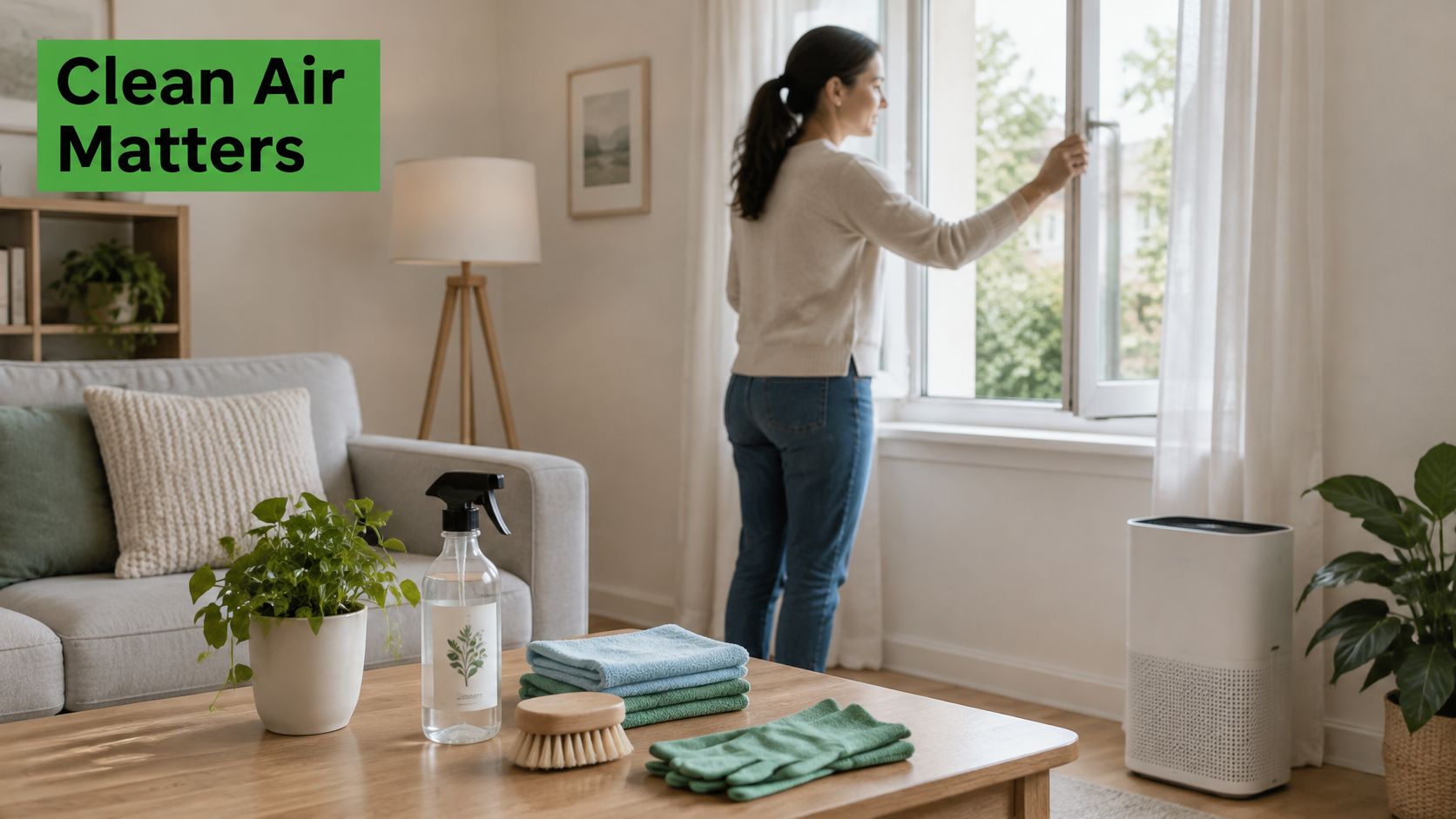
Several scented products in one session can add up. Keep the bottle count low, and choose fragrance-free formulas for the all-purpose cleaner, the glass cleaner, and the floor cleaner. "Green" on a label is not the same test as "no synthetic scent." A fragrance-free cleaning service approach is about what you leave out of the air, not a stronger smell of lemon.
Air-first steps for a closed-up house
Texas heat often keeps windows shut from late spring through fall. That changes how you ventilate a deep clean in Dallas, Richardson, or McKinney.
- When outdoor air is good: Open windows or run the bath and kitchen exhaust fans while you wipe and after you finish.
- When it is too hot or pollen is heavy: Use the fresh-air or ventilation setting on the HVAC system instead of sealing the house.
- Skip ozone gadgets: Do not run ozone-generating devices while you clean.
- Give the room time: Keep children, pets, and anyone who is sensitive out until surfaces are dry and the air has cleared.
Humidity sits beside product choice. The U.S. Environmental Protection Agency recommends indoor relative humidity between 30% and 50%, a range that helps limit conditions that support dust mites, mold, mildew, and bacteria. A deep dust of fabrics does more when the air is not damp enough to feed what you just disturbed. An HVAC tech can check filtration if vents keep shedding dust after you wipe them. That is a partner job, not a substitute for the cloth.
The goal is fewer harsh chemicals and better air, not a claim that any product is risk-free.
How Often to Deep Clean Your Home
A home can look tidy while dust gathers on fan blades, grease clings above the stove, or pet hair settles deep into upholstery. For many households, a deep clean every six to twelve months is a useful starting point. Regular upkeep between visits helps keep buildup from turning into a larger job.
| Household | Suggested interval | Why the interval changes |
|---|---|---|
| Typical home, no pets or allergy concerns | Every 6 to 12 months | Dust and buildup accumulate slowly |
| Home with pets | Every 3 to 4 months | Pet hair and dander settle into fabric, floors and vents |
| Allergy or asthma sensitivity | Every 3 to 4 months, timed before spring and fall pollen | Pollen and dust collect on fabrics, blinds and high surfaces |
| Busy family with young children | Every 4 to 6 months | Crawl-level surfaces and high-touch areas need frequent attention |
| Move-in or move-out | Once, before occupancy or handoff | The whole home needs a thorough clean while empty |
| New construction in the north suburbs | Once after construction dust settles | Fine dust from building work spreads through vents and floors |
Treat these intervals as a calendar guide, then adjust for what your home collects. In Dallas–Fort Worth, a clean before spring pollen or after months with the windows closed can make sense. Before holiday hosting, you might also bring forward attention to the guest bath and oven. In newer builds around Plano and Frisco, construction dust can linger at floor edges and around vents, so a thorough clean after the dust settles may be more useful than repeatedly wiping the same surfaces.
Visible buildup is another cue to shorten the interval. A coating on fan blades, grease above the stove, an odor inside the refrigerator, or pet hair pressed into the sofa suggests certain areas need attention. These signs help you choose when to clean; they are not a judgment on your routine.
Routine cleaning and deep cleaning do different jobs. Regular tidying keeps everyday mess manageable, while a deep clean reaches accumulated grime and less frequently cleaned areas. The right schedule is the one that keeps those tasks from piling up beyond what your household needs.
Decide Between Doing It Yourself and Booking a Pro
A do-it-yourself deep clean may suit a home in fair shape when you have a full day and can work through the checklist. Booking help can make more sense if the home has not had a detailed cleaning recently, you are preparing for a move, or your schedule leaves little time for the job.
Gmaids serves Dallas–Fort Worth, including Dallas, Plano, Frisco, and Southlake. Its trained, background-checked, insured cleaning teams use non-toxic, fragrance-free products without bleach or ammonia. Deep cleaning is recommended for first-time cleanings, seasonal resets, and homes that have not been professionally cleaned recently. Gmaids also offers move-in/move-out cleaning, post-construction cleaning, and recurring maid service. Special requests, including deep cleaning and post-construction cleanup, are included in the quote. To make room for the work, try to schedule when the fewest people will be home.
Mark the overdue tasks on your checklist before deciding. If it calls for high dusting, appliance details, and floor cleaning throughout the home, compare the time and effort of doing it yourself with the cost of hiring help. One-time deep cleaning starts at $412.69. For a quote, visit Gmaids or call 214-997-6918.


Ready for a healthier, cleaner home?