Non Toxic Cleaning Products for Pets That Actually Work

You wipe up a muddy paw print, set the mop down, and then your cat hops straight back onto the kitchen floor like nothing happened. That is the moment most pet owners start wondering whether the cleaner in the bucket was a good idea. In a Dallas home, where the AC runs for long stretches and pets spend plenty of time on tile, hardwood, and rugs, the question is not just whether something smells clean, it is whether the residue is still sitting where paws, noses, and tongues can reach it.
Non toxic cleaning products for pets aren't about chasing a trendy label. They're about reading ingredients, understanding exposure, and choosing products that lower unnecessary risk without making your home harder to maintain. For Dallas families with dogs underfoot, cats on counters, and a steady stream of dust from the season, that difference matters.
Table of Contents
Why the Bottle Matters When a Pet Lives Down on the Floor
A clean floor can still leave a trail behind it. A dog crosses a freshly mopped hallway, a cat jumps from the sofa to the counter, and a puppy noses the baseboards before the surface has fully dried. Pets do not just share a room with cleaners. They meet them at paw level, nose level, and sometimes mouth level.
Cleaning-product exposure is a real household safety issue. The ASPCA Animal Poison Control Center assisted 401,550 animals in 2021 across all 50 U.S. states, and case volume rose by more than 22% that year, with household items including cleaning products and paint among the major toxin categories (ASPCA Animal Poison Control Center case volume). A peer-reviewed hazardous-substance analysis of calls involving dogs and cats found that household products accounted for 15.5% of reported inquiries, including 12.5% for dogs and 3.0% for cats, with cleaners, detergents, bleach, and solvents appearing often in that group (peer-reviewed hazardous-substance analysis).
Practical rule: ask what remains after the surface dries, not just what the bottle says before you spray it.
That is the point of non toxic cleaning products for pets. Safety depends on the ingredient, the concentration, how much you use, how long it sits, and whether the animal is likely to lick, breathe, or rub against it. “Pet-safe” is not a label claim by itself. It is a decision about ingredients plus exposure.
Dallas homes add one more layer. Long AC seasons keep indoor air moving in circles, so residue and fumes can hang around longer than people expect, especially on hard floors where pets sleep, eat, and turn in place. For cats, that matters even more, since grooming turns floor contact into ingestion.
How Pets Are Actually Exposed to Cleaners
Pets don't meet cleaners the way people do. A human sprays a counter, wipes it, and moves on. A dog walks through the area, licks its paws, and may swallow whatever stuck to the pads. A cat does that too, but with even more grooming baked into the routine.

Four routes matter most
Paw contact is the simplest one to picture. Fresh residue sits on tile, laminate, or the grout near a water bowl, then gets transferred to fur and mouths. Oral exposure can happen without anyone seeing a spill, because grooming does the work.
Inhalation matters too. Vapors and aerosols hang low near the floor, which is exactly where pets breathe. Skin exposure can happen on belly fur, paw pads, and noses when an animal lies down or rubs against a treated area.
Wet surfaces are the danger zone, not just dirty surfaces.
That's why “diluted” doesn't automatically equal safe. Dilution changes concentration, but it doesn't erase residue, and it doesn't stop a cat from licking a floor that still smells fresh. It also doesn't make fragrance harmless, because fragrance-free means no synthetic scents are added at all, while “unscented” can still hide odor-masking chemicals.
The safest mental model is simple. Think about where your pet's paws go, where its tongue goes, and whether a product leaves anything behind there. In Dallas and Plano homes, that matters even more when the HVAC is cycling air around the clock and the same residues can stay in circulation on surfaces and in dust.
Ingredients to Avoid and Ingredients Worth Seeking
A pet can live inches from the floor, so the label has to do real work. Fancy packaging says very little. The ingredient list and the Safety Data Sheet tell you far more, especially if you are trying to keep residue, fumes, and skin contact down in a home where paws, noses, and tongues meet every surface.
The short list to avoid
Phenols, bleach, ammonia, quaternary ammonium compounds such as benzalkonium chloride, pine-oil formulas, and strongly fragranced products deserve the closest reading. Veterinary shelter-medicine guidance says phenol-containing cleaners can be toxic to cats, warns against strong fragrances and essential oils because they may irritate the respiratory system, and describes quaternary ammonium exposure as capable of causing ulceration and nasal or ocular discharge (veterinary shelter-medicine guidance). Cats are especially vulnerable because grooming moves residue from paws and fur into the mouth.
The same caution applies to products sold as “natural.” That word describes marketing, not a safety review. Essential oils and concentrated botanical ingredients can still be harmful if swallowed, inhaled, or applied in the wrong amount. A cleaner should earn trust through ingredient disclosure, dilution directions, ventilation needs, and dry-time control, not through a leafy label.
What to look for instead
The U.S. Environmental Protection Agency's Safer Choice program gives you a clearer benchmark than vague green claims. EPA evaluates every chemical ingredient in a certified product, applies criteria for human health and environmental hazards, requires full ingredient disclosure, and says certified products are safer for families, pets, workplaces, neighborhoods, and the environment (EPA Safer Choice FAQ). EPA also says its Safer Chemical Ingredients List includes more than 950 chemicals, and that Safer Choice has certified approximately 2,000 products (EPA Safer Choice basic information).
| Ingredient Decision Lens for Pet Households | Action | Why it matters for pets |
|---|---|---|
| Bleach | Avoid for routine cleaning around pets | Can irritate airways and leave harmful residue |
| Ammonia | Avoid | Vapors are harsh, and mixing with bleach is dangerous |
| Phenols | Avoid, especially in cat homes | Cats are more vulnerable to this class of ingredients |
| Quaternary ammonium compounds | Avoid, especially around cats | Residues can irritate skin, eyes, and mucous membranes |
| Strong fragrance or essential oils | Use with caution, or skip | Can add unnecessary airborne and surface exposure |
| Transparent, fragrance-free formulas | Look for them | Easier to evaluate and easier to control |
| Safer Choice-certified products | Strong option | Built around ingredient disclosure and hazard review |
For a second check, the Eco Clean Solutions safe cleaning options page makes the same basic point, transparency beats vague “green” language. If a label does not tell you what is inside, you do not have enough information to judge the risk.
Read the full ingredient list, then read the SDS. If a brand will not show you both, keep moving.
Dallas families often need the same habit even more, because long AC seasons keep indoor air moving and can let residues linger in dust and on low surfaces. Gmaids' pet-safe cleaning products guide reinforces that practical approach, full disclosure beats cute branding every time.
Five Misconceptions That Lead to Unnecessary Exposure
A lot of pet owners are trying to be careful and still get tripped up by familiar-sounding claims. The problem isn't effort. It's that a few common shortcuts sound reasonable but don't hold up once you think through how pets move through a home.

Myth and reality, side by side
| Myth | Reality |
|---|---|
| Natural means safe | Essential oils and concentrated botanicals can still be risky for pets |
| If it's diluted, it's fine | Dilution lowers concentration, but residue can still remain on surfaces |
| Unscented is the same as fragrance-free | Unscented can still hide masking agents |
| Pet-safe labels are regulated | The phrase is a marketing claim, not a guarantee |
| If the floor is dry, everything is solved | Dry is better, but residue, ventilation, and species still matter |
The bleach-ammonia issue deserves its own spotlight because it's the most dangerous mix in many homes. CDC guidance says never to mix household bleach with ammonia or any other disinfectant because the combination can produce vapors that are very dangerous to breathe, and the Pet Poison Helpline identifies the result as chloramine gas, which is corrosive to the lungs (CDC bleach guidance, Pet Poison Helpline cleaning products and pets).
A few real-world examples help
A plug-in diffuser that smells “natural” can still sit in the same room as a cat and add airborne exposure for hours. A pine-oil toilet cleaner can leave a bathroom smelling fresh while still being a poor fit for a pet household. A “green” product with no ingredient list leaves you guessing, which is not where you want to be when a dog licks the floor.
One more thing gets missed a lot. The phrase “pet-safe” isn't standardized in the United States, so it doesn't tell you what's inside or how the product should be used. That's why ingredient lists matter more than front-label language, especially in homes with cats.
For a deeper look at why families get misled by the wrong label cues, the disinfectant cleaning products guide is a helpful companion read.
DIY Recipes That Hold Up with Pets in the House
Most pet owners don't need a chemistry set. They need a few simple recipes that clean everyday messes without adding unnecessary scent, residue, or confusion. The trick is knowing what each mix can do and where it stops.

Keep the toolkit small
A soap-and-water cleaner works well for routine floors because soap lifts soil instead of masking it. A baking-soda paste is handy for tubs, grout lines, and the occasional litter-area drip. A vinegar-and-water spray can handle mirrors and glass when you want a quick, fragrance-free wipe-down.
Here's the limit on each one. Vinegar smells sharp but it doesn't disinfect. Soap removes grime but it doesn't kill pathogens. That matters if you're cleaning up after illness or a mess that needs disinfection, because that's the moment to use an EPA-registered disinfectant exactly as the label says, not a homemade mix.
A simple home kit
- Everyday floor cleaner: warm water plus a small amount of mild castile soap, then wipe or mop lightly and let the surface dry before pets return.
- Baking-soda scrub: make a paste with baking soda and water, then use it on tubs, sinks, and spot-cleaning around litter areas.
- Glass and mirror spray: mix white vinegar and water in a spray bottle, test a small patch first, then wipe dry.
Do not mix vinegar or any acid with bleach. Do not add essential oils as a “boost” if a cat can walk across the surface later. And don't use DIY recipes on a surface that needs pathogen control and then assume it's disinfected.
If you like a broader look at household ingredients people use in low-tox cleaning, the Barefoot Organics weed killer guide is a useful reminder that “natural” still needs context, dilution, and caution.
A Pet-Safe Cleaning Routine from Start to Finish
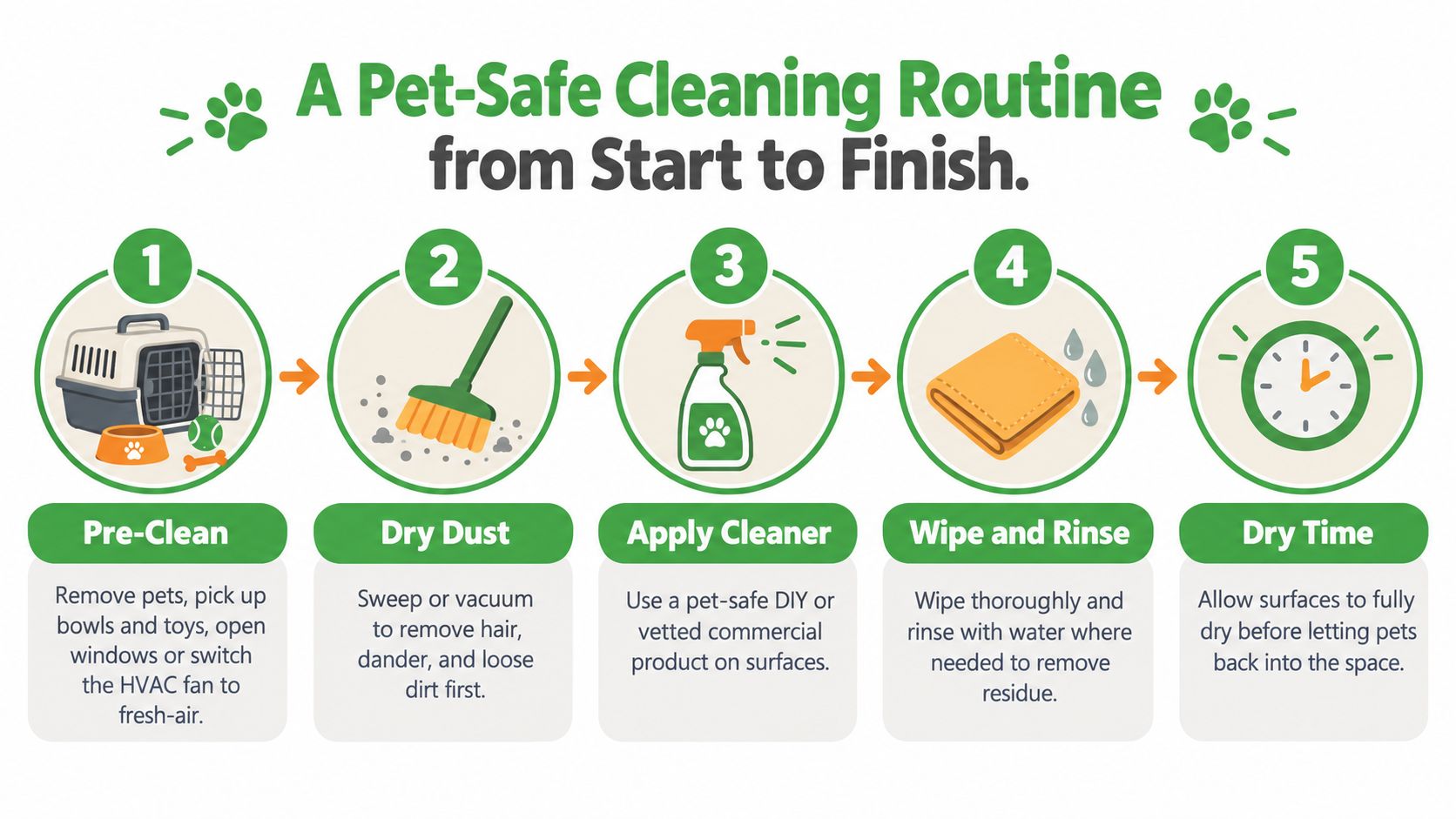
A good routine matters more than a perfect product. If you remove pets first, clean with intention, and give surfaces time to dry, you lower a lot of avoidable exposure without making the job harder.
The sequence that works
Start by pulling bowls, toys, and bedding out of the way. Move pets into another room, open windows if the weather allows, or switch the HVAC fan to fresh-air mode so fumes aren't recirculating in the same space. Then sweep or vacuum first, because cleaning over loose hair and dust just spreads more material around.
Apply a small amount of cleaner to the surface, not the animal, and keep the product confined to the area that needs it. If you're disinfecting, the surface has to stay visibly wet for the label-specified contact time, then be rinsed when required and allowed to dry completely before pets come back.
Dry time is part of the cleaning step. It isn't an optional wait.
That matters in Dallas, where AC seasons are long and indoor air tends to keep moving from room to room. Even a brief chance to let fresh air in helps lower the chance that a spray or disinfectant smell keeps cycling around the house.
The rooms pets touch most
Kitchen floors collect spills and crumbs that invite licking. Areas around water bowls stay damp. Litter zones, the spot by the door, and the couch cushions all collect residue differently, but they all sit at pet level. A routine that handles those spaces carefully does more for a pet household than a once-in-a-while deep scrub with the wrong product.
If you're trying to reduce dust and airborne irritation in the same home, the vet-backed dog allergy prevention guide offers a useful reminder to think about the whole indoor environment, not just the floor spray.
Pet-Heavy DFW Homes and When to Bring in a Green Clean
Dallas homes have their own rhythm. Long AC seasons keep indoor air circulating, spring and winter pollen show up at the wrong time, and new-construction homes in places like Plano, Frisco, and McKinney can pair fine dust with fresh pet messes in the same week. Add busy schedules, holiday hosting, or multiple shedding pets in Lakewood or East Dallas, and the job can get away from people fast.
When a professional green clean makes sense
Post-construction cleaning is a big one when a new build or renovation leaves dust on every ledge and a young dog is already living in the house. Recurring maid service helps in homes that need weekly, biweekly, or monthly reset work to keep fur, dander, and floor residue from building up. Move-in/move-out cleaning is useful when a turnover includes inside the fridge, oven, cabinets, drawers, and closets, and nobody wants to hand over a dusty, smelly space.
For homes that need a more deliberate hygiene reset, sanitizing cleaning can make sense around a sick pet area or a space that got especially messy. The point isn't to reach for stronger chemicals. It's to use the right method, with the right product, on the right surface.
Gmaids offers non-toxic, fragrance-free cleaning with plant-derived and mineral-based products, and its Certified Cleaning Teams® are trained, background-checked, and insured. It's one option for Dallas households that want routine help without bleach, ammonia, or synthetic fragrance, and it's been serving DFW since 2004. If you want a local service that fits into a pet-aware routine, its green cleaning and non-toxic maid service is built around that exact idea.
Gmaids can help keep Dallas homes cleaner with non-toxic, fragrance-free service that fits pet households, busy schedules, and allergy-conscious families. If you want an instant, flat-rate quote, visit Gmaids or call 214-997-6918, and ask about a cleaning plan that works around your pets and your routine.


Ready for a healthier, cleaner home?