Post Construction Cleaning Cost: A Practical Breakdown
A typical Dallas–Fort Worth post-construction cleaning bill lands around $274 to $707, and bigger or more involved projects can reach about $1,300. The big reason is simple, labor makes up roughly 90% of the bill, so the quote moves with square footage, dust load, access, and how many cleaning stages the job really needs.
That's why a new build in Frisco or a remodel in Plano can look “almost done” and still need a serious budget line before anyone should move in. The products matter, but they don't drive the invoice the way repeated passes, careful dust control, hauling, and detail work do. In Dallas, where contractors are often finishing on tight handoff dates and families want the place ready fast, the wrong quote leaves you paying for surprises later.
Table of Contents
What a Post-Construction Cleaning Quote Really Covers
A finished renovation in Dallas doesn't mean the site is ready for keys, photos, or furniture. It usually means the trades are done enough that a cleaning crew can start sorting what belongs in the dust bin, what needs wet wiping, and what should be left for another pass after final punch-list work.
A serious quote should describe the job by scope, not just by a single number. That means identifying rough cleaning, final cleaning, touch-up work, and any hauling or disposal that sits outside the mop-and-vacuum part of the job. If a contractor or homeowner only hears “post-construction clean,” they should immediately ask which of those phases is included.
The people involved matter as much as the rooms
In practice, three groups can touch the budget. The cleaning crew handles dust, residue, and surface detail. The hauler or dumpster vendor handles heavier waste. On some jobs, an indoor-air-quality specialist or another trade gets involved if the site has material that needs more than ordinary housekeeping.
Practical rule: If the quote doesn't say who removes debris, who cleans detail residue, and who returns for final touch-up, it isn't complete.
For a homeowner in Highland Park or a property manager in Richardson, that missing detail is where frustration starts. Windows may be cleaned but cabinets not wiped inside, or floors may be done but adhesive residue left behind. A proper estimate should spell out whether fixtures, baseboards, interior glass, appliance interiors, and closet shelving are included.
The right way to think about this service is as a project closeout task, not a standard recurring clean. In other words, you're paying to turn a construction site into an occupiable space, and that requires more decisions than a normal weekly clean. If you want a general primer on the service structure itself, what is post-construction cleaning is a helpful starting point.
The Main Factors That Drive Post-Construction Cleaning Cost
The quote moves because the crew's time moves. That's the part too many people miss. Industry benchmarks put interior post-construction work around $0.15 to $0.60 per square foot, with rough cleaning closer to $0.15 to $0.40 and final or touch-up cleaning closer to $0.20 to $0.60. Hourly pricing commonly lands around $25 to $75 per worker, with an average near $40 source.
Why square footage is only the starting point
A floor plan tells you the shell size, not the labor burden. A 2,000-square-foot home with smooth surfaces, easy parking, and light residue is a different job from the same size home with stair access, heavy drywall dust, and a long list of windows and fixtures.
- Gross floor area: More surface area means more wipedowns, more vacuuming, and more walking time between rooms.
- Debris level: Packaging, scrap, and residue slow the crew before the fine cleaning even begins.
- Surface complexity: Textured tile, grout lines, stone, and detailed trim take longer than flat, open surfaces.
- Fixtures and windows: Each extra pane, cabinet, sink, or appliance adds labor.
- Access: Stairs, elevators, parking distance, and tight entry points all chip away at speed.
- Work timing: After-hours access or coordination with other trades stretches the day.
For a window-heavy property, it helps to compare how window pricing is often broken down separately, which is why a resource like compare window pricing per window can give useful context when you're checking whether window cleaning is included or excluded.
The main point is blunt. If a quote is based only on square footage, it's incomplete unless it also reflects condition, access, and debris volume. In Dallas and the north suburbs, where new-construction homes in places like Plano and Frisco often have multiple surfaces and trade overlap, those variables are the primary cost drivers.
Budgeting rule: The fewer assumptions in the estimate, the fewer change orders later.
How Cleaning Phases Change the Scope and the Price
Post-construction cleaning isn't one visit. It's a sequence of different passes, and each pass has its own labor shape. That's why a low headline quote can look fine until you realize it only covers the final polish.
Rough, final, and touch-up are different jobs
Rough cleaning focuses on big debris, packaging, and coarse dust. Final cleaning goes after floors, windows, fixtures, restrooms, baseboards, and the detail residue that makes a newly built space still feel unfinished. Touch-up cleaning happens after the dust settles again, after the painters, trim crew, or countertop installers come back, or right before walkthrough and occupancy.
Indicative phase ranges commonly look like this source:
| Phase | What it covers | Indicative rate |
|---|---|---|
| Rough cleaning | Large debris, packaging, leftover materials, coarse dust | $0.10 to $0.30 per square foot |
| Final cleaning | Floors, windows, fixtures, baseboards, detailed residue removal | $0.30 to $0.75 per square foot |
| Touch-up cleaning | Final walkthrough corrections and post-trade dust settling | $0.10 to $0.20 per square foot |
The invoice changes because the mobilizations change. A job in McKinney might need a rough pass before the punch list is finished, then a final pass after other trades leave, then a touch-up visit before the owner walks through. That is not a small detail. It is the structure of the job.
The hidden cost is repeated movement
A 2,000-square-foot renovation can easily require more than one mobilization if contractors return, dust migrates, or the site isn't ready for final detail work. The crew has to set up, clean, pack out, and sometimes come back again. That repeated movement is labor, and labor is the cost center.
If you want a good rule for planning, don't budget for “a clean.” Budget for the phases the site actually needs, and assume the final handoff may need a return visit. For a broader renovation context, cleaning service after renovation gives useful background without flattening the work into one generic visit.
Why Dust-Control Requirements Raise the Labor Bill
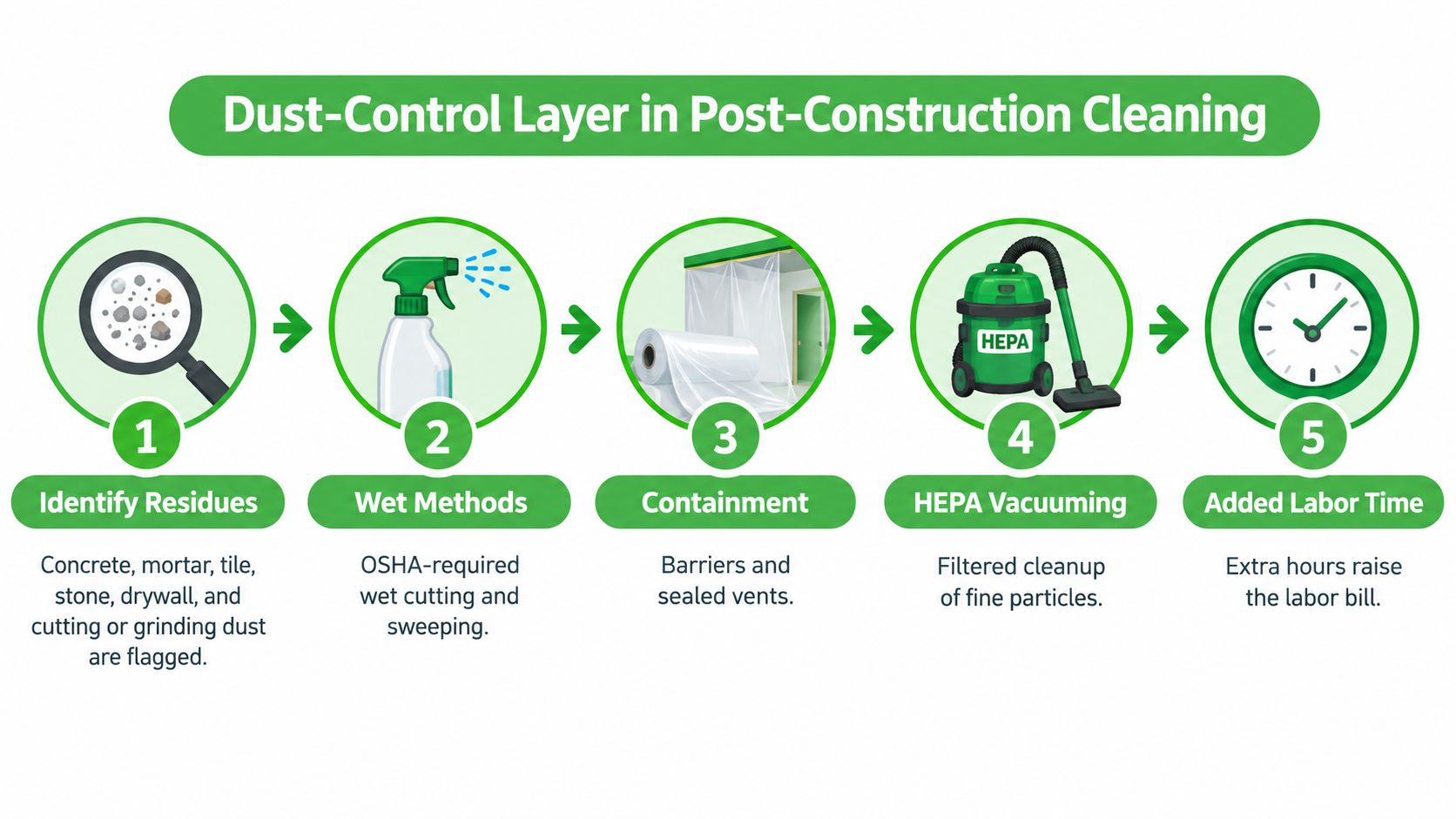
Once construction dust includes silica-bearing material, this stops looking like ordinary cleaning. OSHA's construction rule sets a respirable-crystalline-silica action level of 25 micrograms per cubic meter and a permissible exposure limit of 50 micrograms per cubic meter, both as an eight-hour time-weighted average source. That changes how crews work.
The method matters more than the bottle
When silica-containing dust may be present, OSHA restricts dry sweeping and dry brushing unless safer alternatives are infeasible. It also restricts compressed-air cleaning unless effective capture ventilation is used or no alternative exists source. That means wet methods and HEPA-filtered vacuuming are not extras. They are the practical way the job gets done.
The labor bill rises here. Crews move more slowly, isolate work areas, maintain filters, and spend time on repeated surface-by-surface passes. Projects involving concrete, mortar, tile, stone, drywall, or cutting and grinding residue should carry a higher allowance for containment and extraction because the cleaning method changes the pace.
What a strong scope should mention
OSHA also requires a written exposure-control plan covering tasks, engineering controls, housekeeping, and access restrictions source. On a real site, that means the estimate should spell out who sets up containment, who vacuums, and whether the crew can safely dry-wipe at all.
If a crew cannot clean fast without risking dust spread, the quote should not pretend it can.
For Dallas homes with tile work, masonry residue, or drywall sanding, that detail matters. The property may look clean from ten feet away, but if the residue is still migrating, the crew has to slow down and do the work correctly. That labor time is what you are paying for.
A Realistic Budget Walkthrough for a DFW New Build or Renovation
Take a 2,200-square-foot new build in Frisco with standard finishes, several windows, and enough dust that the final clean can't start until after the last trade leaves. The first thing to budget for is not the mop. It's the sequence.
A quote might start with a rough pass for debris and coarse dust, then a final pass for glass, fixtures, cabinets, floors, and baseboards, then a return visit if the subcontractors leave residue after the cleaning crew has already been through. That setup alone explains why a “cheap” number often isn't cheap at all.
Where the line items usually appear
- Labor for phased cleaning: Rough, final, and touch-up are separate work blocks.
- Debris hauling or disposal: This is often priced outside the cleaning labor itself.
- Extra detail work: Inside cabinets, appliances, and trim lines add time.
- Access and logistics: Stairs, limited parking, or elevator use slow the crew.
- Return visit allowance: If another trade comes back, the site can need another pass.
Debris removal is frequently a separate charge. Small-scale disposal commonly adds about $100 to $300, while more substantial removal can reach about $800 source. That's exactly why a quote should distinguish between rough cleaning, detailed final cleaning, touch-up work, and hauling or disposal.
For a contractor, this is also where cash flow discipline matters. A cleaning crew may finish before handoff, or it may have to wait until the site is ready, and that delay costs money in scheduling. If you want a more general pricing comparison for commercial work, how much do office cleaners charge is a useful reference point for understanding how scope changes the bill structure.
The bottom line is simple. For a DFW remodel or new build, the right budget is a range with phases, not a single number with wishful thinking.
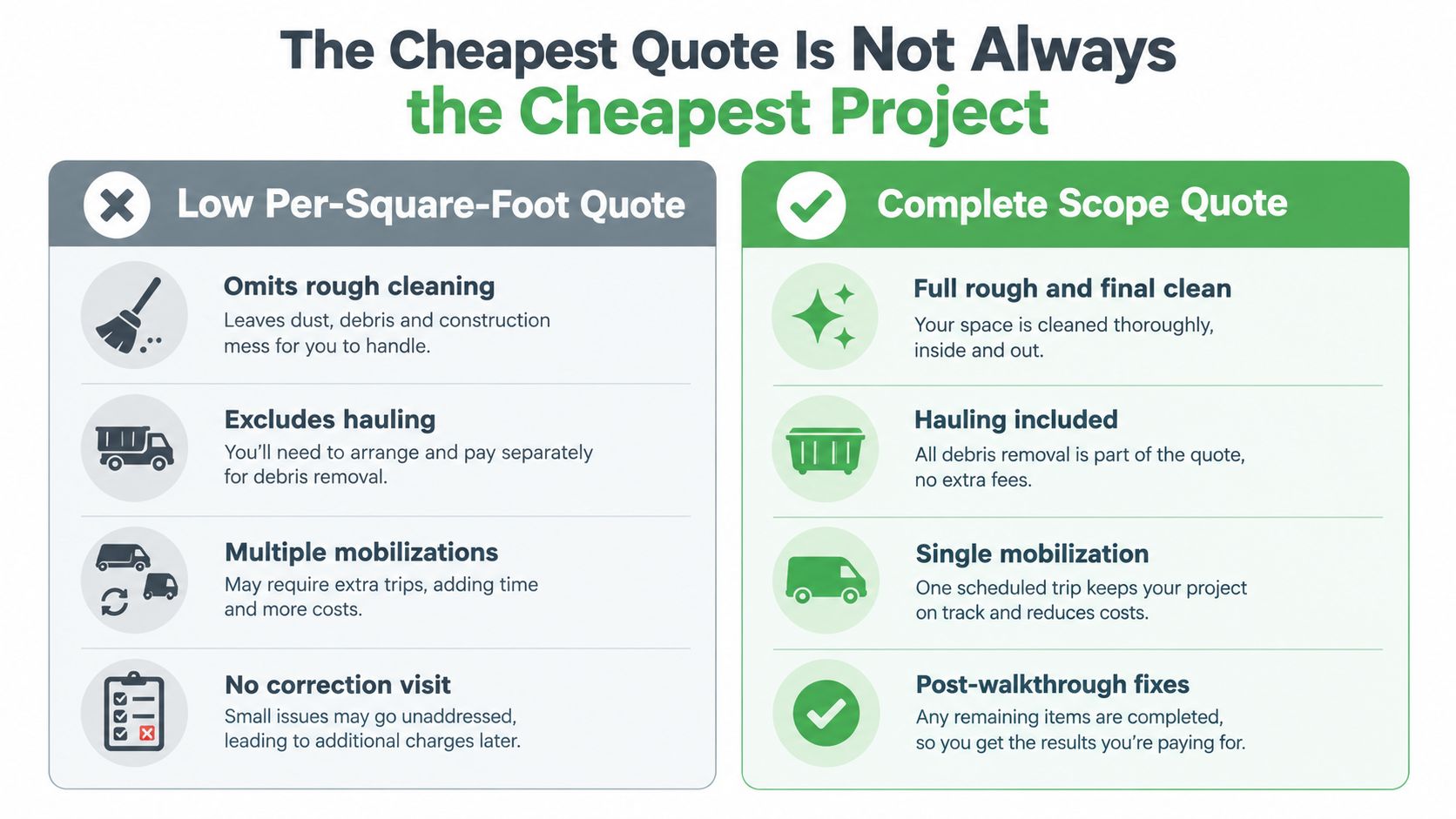
The Cheapest Quote Is Not Always the Cheapest Project
A low per-square-foot number can be a trap if it leaves out the parts that take the most time. The cheapest headline price often looks good because it's missing rough cleaning, hauling, multiple mobilizations, or a correction visit after walkthrough.
Compare scope, not just the total
A low bid might cover final wiping only. A stronger bid may include the rough pass, waste staging, hauling coordination, and a return visit if the site still sheds dust after other trades finish. That second quote looks higher at the start, but it usually protects the project from add-ons.
- Omits rough cleaning: The crew arrives too late to handle debris efficiently.
- Excludes hauling: Someone else has to move waste, or the cleaner has to wait.
- Multiple mobilizations: Every return trip adds labor and scheduling friction.
- No correction visit: Final dust migration becomes an unpaid problem.
A more complete scope usually wins in practice because it reduces change orders. That's especially true in Dallas investor and renovation work, where closing dates and occupancy dates don't move just because the cleaning quote was too thin. If you want broader financing context around project budgeting, real estate investor loan articles can help frame why predictable closeout costs matter before handoff.
Rule of thumb: A quote that looks too simple usually is too simple.
When two bids are close, compare what each one includes. If one leaves debris, windows, or post-walkthrough correction outside the scope, the lower number is only lower on paper.
Budgeting Tips for Homeowners and Contractors in DFW
Start with the schedule, not the spreadsheet. In Dallas, Plano, and Frisco, the biggest budgeting mistake is booking cleaning before the last trade is fully finished. If painters, countertop installers, or trim crews are still moving around, the cleaning budget needs a return-pass cushion.
Ask every company the same questions in writing:
- What phases are included: Rough, final, and touch-up need to be spelled out.
- What's excluded: Hauling, appliance interiors, cabinet interiors, and windows should never be assumed.
- Who handles debris: Oversized waste and hazardous materials need a clear owner.
- How many visits are assumed: One mobilization is not the same as two or three.
- What happens after walkthrough: A correction visit should be planned, not improvised.
Don't forget indoor-air quality and product choice
In Dallas homes with kids, pets, allergies, or chemical sensitivities, the products matter because residues stay on floors, trim, and other touchpoints. Fragrance-free cleaning means synthetic scents are left out entirely, which is not the same thing as “unscented.” It's a better fit for households that don't want masking agents sitting in the air or on surfaces.
Gmaids uses non-toxic, fragrance-free, plant-derived and mineral-based products, with no bleach, ammonia, or synthetic fragrance. That matters on post-construction work because the job already brings enough dust without layering harsh fumes on top.
If you're comparing providers for offices, shared spaces, or a home that has to be ready for immediate occupancy, look for trained, background-checked, and insured teams and confirm whether HEPA extraction is part of the plan when dust load is heavy. In Highland Park and Addison, that level of clarity saves time because nobody has to argue over what “clean” meant after the fact.
Ask for the quote that tells you what it buys, not the one that sounds cheapest.
Plan Your Post-Construction Cleaning the Right Way
The right budget starts with scope. Post-construction cleaning cost is a phased production task shaped by debris, access, and dust control, not a single number pulled from square footage alone. If you plan it that way, the quote makes sense before the crew ever walks in.
For Dallas homeowners, landlords, and contractors, that means choosing a team that can handle the closeout clean without harsh chemicals or vague exclusions. Gmaids serves Dallas, Plano, Frisco, and surrounding DFW areas with Gmaids Certified Cleaning Teams® using non-toxic, fragrance-free products. If you want the quote to reflect the actual job instead of guesswork, get an instant, flat-rate quote online at www.gmaids.com or call 214-997-6918.
If you want a post-construction clean that matches the full scope of the job, Gmaids can price the work around the phases, dust, and handoff timing that matter in Dallas and across DFW. Visit Gmaids for an instant quote, or call 214-997-6918 and talk through the details before the surprises start.


Ready for a healthier, cleaner home?