What Is Post Construction Cleaning in Dallas
Post-construction cleaning is a specialized cleanup phase that happens after a build or renovation is finished and before anyone moves in. In recent market research, that niche was estimated at about USD 7.73 billion in 2025 and projected to reach USD 12.8 billion by 2035.
You can have a freshly painted Dallas kitchen, new flooring, and sparkling fixtures, yet still be breathing through a cloud of fine dust that settled after the contractors packed up. That's why this work is more than a final sweep, it's a staged process that clears microscopic residue, not just visible mess.
Table of Contents
Understanding Post Construction Cleaning
A Dallas remodel can look done at 5 p.m. and still feel off the next morning. The counters are wiped, the trash is gone, and the rooms are open again, but there's a thin layer of dust on the baseboards, inside cabinets, and along the vents. That's the point where post-construction cleaning starts, and it's very different from routine housekeeping.
Industry guides describe it as the cleanup phase between construction completion and use of the premises, which is why it sits between the contractor's final walkthrough and a family's actual move-in day. If you want a simple comparison, the stages of post construction cleaning are a helpful way to see why the work has to happen in steps, not in one quick pass. Gmaids also organizes services by need, so the broader cleaning services page can help place this service in context.
What changes after the builders leave
Construction cleanup has a different goal than regular house cleaning. Instead of keeping a lived-in home tidy, it removes residue that building work leaves behind, including fine dust on horizontal surfaces, around fixtures, and in air pathways. That residue doesn't behave like ordinary household dust, which is why a simple dust-and-mop routine often misses the problem.
Practical rule: if you can still trace dust with your finger after the contractor's sweep, the space isn't ready for normal occupancy yet.
In a Dallas home, this matters even more because families often want to move fast after a renovation. A parent sees the new cabinets, the finished tile, and the polished glass, and assumes the house is ready. The hidden part is the powdery material that settles after the work ends, especially near supply vents, door frames, and trim.
The Hidden Health Risks of Renovation Dust
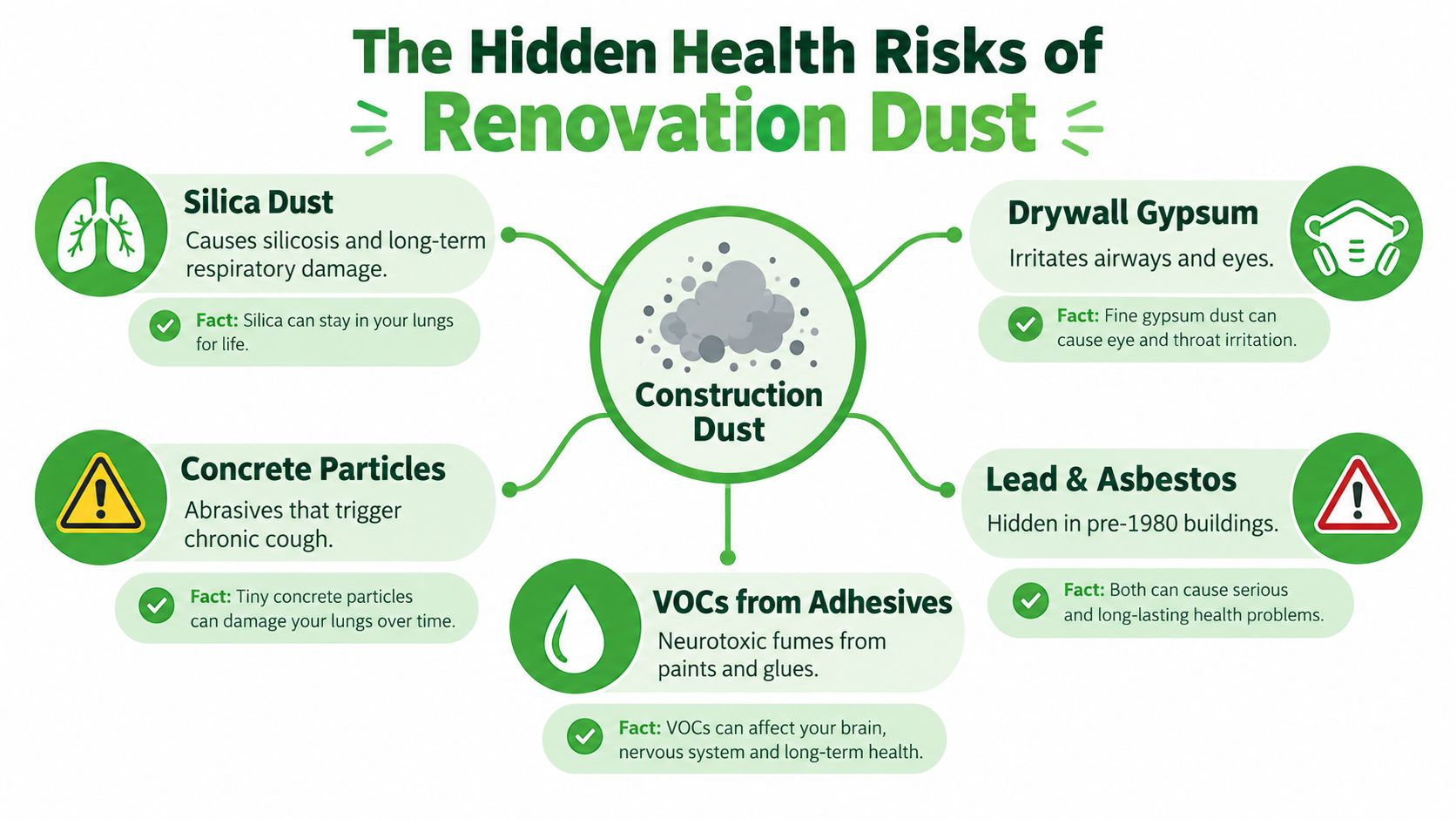
Construction dust is not one thing. Drywall powder, concrete residue, tile-cutting fines, and sanding dust each behave a little differently, but they all share the same basic problem, they're small enough to spread far beyond the work zone. EPA guidance for renovation cleanup specifies HEPA vacuuming, and true HEPA performance means capturing 99.97% of particles at 0.3 microns, the most penetrating particle size, which is why ordinary cleanup tools don't come close to the same standard.
Why standard vacuums fall short
A consumer vacuum can pull up visible crumbs and larger debris, but fine renovation dust often passes through or gets blown back into the room. That matters because dust isn't just sitting there, it's moving with walking, vacuuming, and airflow. In a house with active HVAC, that movement can spread particles from one room to another.
OSHA's current U.S. respirable crystalline silica limit is 50 micrograms per cubic meter over an 8-hour shift, with an action level of 25 micrograms per cubic meter that triggers additional monitoring. Those numbers exist because the tiny particles created during construction can reach deep into the lungs. Fine dust from drywall, concrete, brick, tile, and sanding can remain airborne for 24 to 48 hours or longer, so the cleanup approach has to be built around containment, HEPA vacuuming, and damp wiping.
For readers who like a structured safety lens, the logic is similar to identifying risks in industrial settings, except the “worksite” is now your home.
What the dust can do indoors
Independent guidance says renovation dust can irritate the eyes, nose, throat, and lungs, and very fine particles can be breathed deep into the lungs. It also warns that wet methods work better than sweeping or dry dusting, because dry methods push particles back into the air. That's why a real post-construction clean isn't about moving dust around, it's about removing it from the air and from the surfaces where it settles.
Simple takeaway: if the cleanup creates a visible puff every time a cloth or broom moves, the method is wrong for renovation dust.
The Three Stages of Professional Cleanup
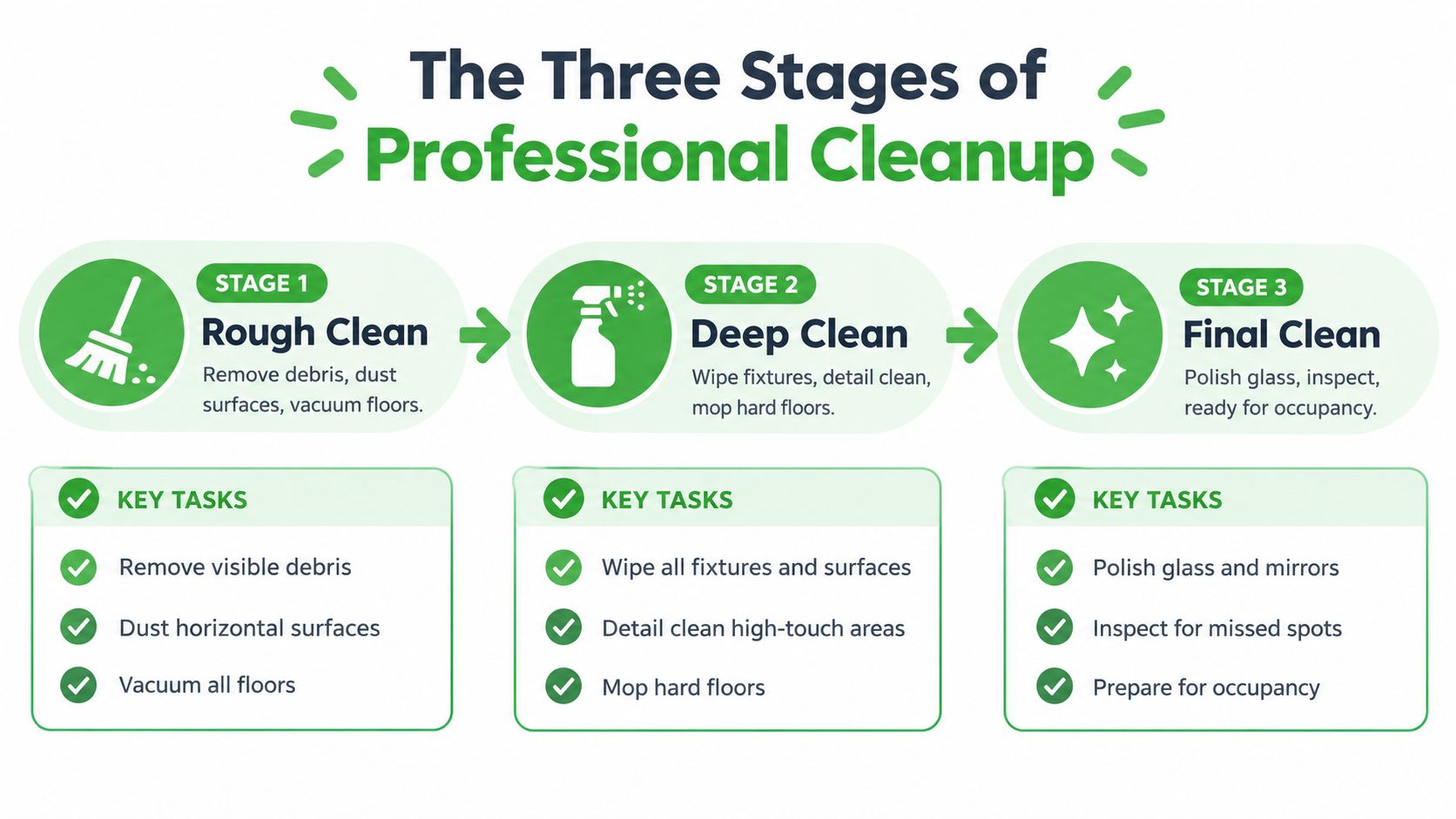
Professional crews don't treat post-renovation dust like a one-and-done chore. They move through the space in a sequence so the first pass doesn't undo the last one. Best-practice cleanup typically follows containment, HEPA vacuuming, and damp wiping, and many guides advise waiting at least 24 to 48 hours after construction stops before final cleaning so dust can resettle first.
Rough clean
This first pass removes the obvious leftovers, scrap material, stickers, packaging, nail fragments, and heavier debris. Crews clear the room so the finer work can happen without grinding grit into floors and trim. This is also the stage where containment matters most, because dust that escapes here spreads quickly.
Deep clean
The deep-clean stage is where the detail work starts. Technicians vacuum with sealed HEPA equipment, wipe cabinets, ledges, and fixtures, and use damp microfiber instead of dry dusters. That wet method matters because it traps particles rather than flicking them back into the room.
Final clean
The last pass is a presentation and inspection step. Glass gets polished, fixtures get checked under better lighting, and missed edges are corrected. If a home has been closed up during the build, this stage often reveals the difference between “looks clean” and “is clean enough to occupy.”
Useful habit: clean from high to low, then from clean rooms to dirty rooms, so dust doesn't migrate back over finished surfaces.
Why Dallas Homes Require Specialized Dust Control
Dallas renovations face a local indoor-air challenge: fine construction dust can meet a steady stream of outdoor pollen. North Texas allergy seasons can begin early and continue through spring, with oak pollen lingering well into the season. A newly finished home may therefore hold two kinds of particles at once, even when every visible scrap has been removed.
Homes in Plano and Frisco can be especially affected when renovation residue reaches HVAC return vents. The system may circulate microscopic particles through bedrooms, living areas, and supply registers, turning one dusty room into a whole-home air-quality problem. Because North Texas cooling runs through much of the warmer year, return vents can pull residue into ductwork while seasonal pollen is still entering the indoor environment. For practical guidance on ongoing upkeep, see our house cleaning Dallas TX services.
HEPA filtration helps address what ordinary sweeping cannot see. A sealed HEPA vacuum captures fine particulate instead of redistributing it, while careful wiping removes the film left on trim, ledges, and other surfaces. Used with non-toxic products, this approach treats post-construction cleaning as an indoor-air intervention, not a cosmetic final sweep.
Dallas households also have real scheduling pressure. School routines, pets, work-from-home arrangements, and hosting plans can make a quick move-in tempting. Yet a room can look complete while airborne irritants remain. Specialized dust control helps the home feel ready because it addresses the residue beneath the shine.
The Importance of Non-Toxic Cleaning Products
Renovation dust already asks a lot from your lungs and your HVAC system. Adding bleach, ammonia, or heavy synthetic fragrance into that mix can make the space feel even harsher, especially for households with children, pets, or anyone sensitive to strong smells. That's why non-toxic, fragrance-free products make sense in a newly finished home.
Gmaids' philosophy, “Healthy Homes, Families and Souls. We green clean without toxic chemicals,” fits this kind of work well because the goal is to leave behind less residue, not more. Fragrance-free matters here in a literal sense, meaning synthetic scents are left out entirely. It's not the same thing as unscented, which can still contain masking chemicals.
Why ingredient choice matters after construction
Fine dust settles on floors where babies crawl and pets nap. It also lands on cabinet shelves, door pulls, and countertops, where residue can transfer to hands throughout the day. A cleaner with a strong odor might seem “fresh,” but odor isn't the same thing as clean air.
If you're choosing products for a home with pets, Gmaids also shares guidance on pet-safe cleaning products, which fits the same logic of reducing unnecessary irritants.
Gmaids uses plant-derived and mineral-based products, which is the right direction for newly renovated spaces that need careful wiping rather than harsh chemical masking. The best result is a home that smells like nothing and feels like nothing got left behind except actual clean surfaces.
Timeline Expectations and Preparing Your Space
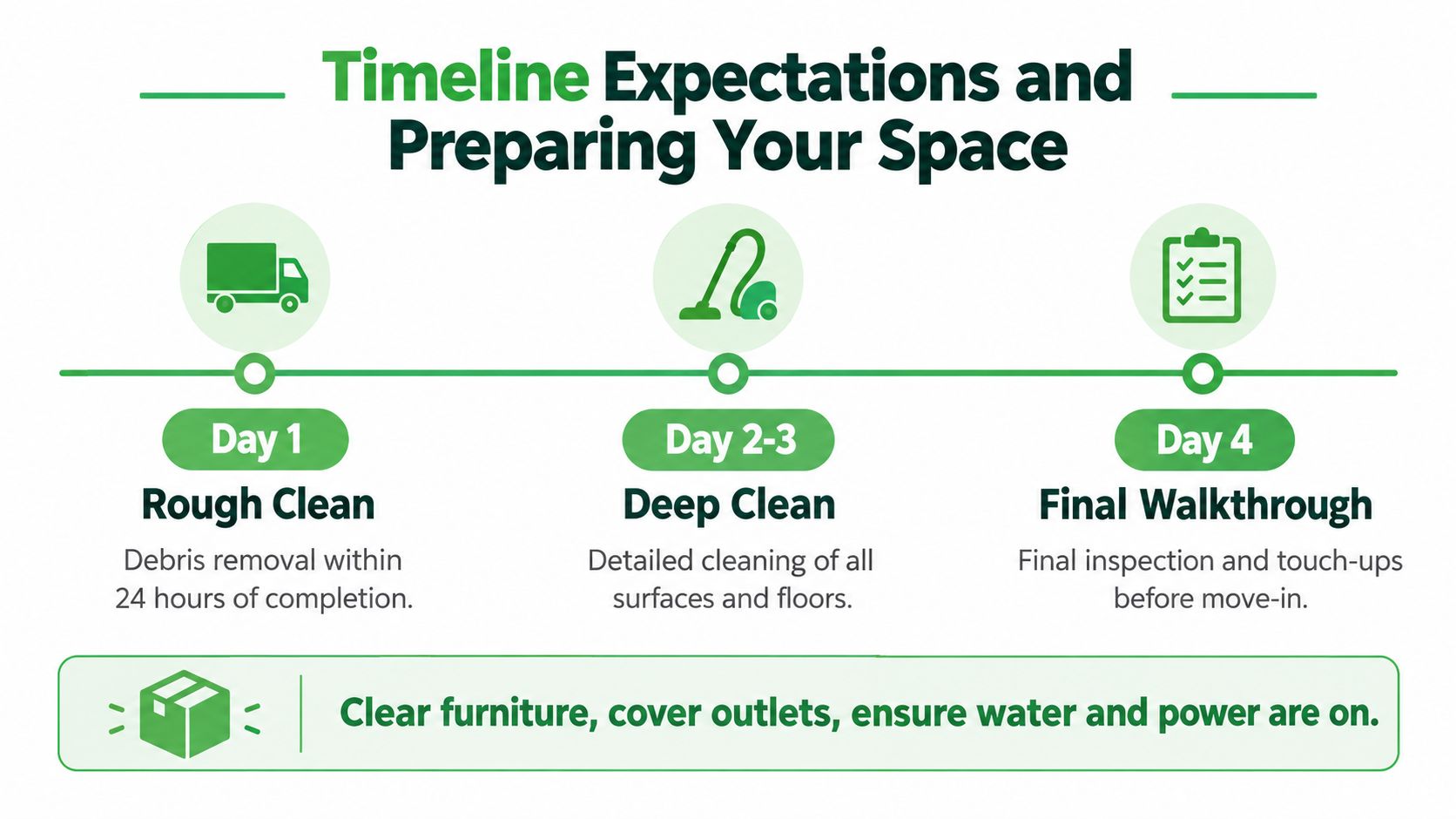
A major renovation usually needs more than one visit. Recent guidance says fine drywall and sanding dust keeps re-settling, which is why a staged sequence works better than a single sweep. A top-to-bottom, room-by-room approach with HEPA vacuums is the standard that makes sense for a freshly built or remodeled Dallas home.
How to plan the transition
The safest rhythm is to let construction finish, give the dust time to settle, and then schedule the detailed clean before occupancy. Some guidance advises waiting 24 to 48 hours after the last construction work so the resettled dust can be captured instead of chased around. That waiting window helps a lot in closed-up homes where vents and fans have been running.
What to clear before the crew arrives
A little prep makes the visit smoother.
- Move loose items out of the way. Countertops, vanity tops, and floors are easier to detail when they're clear.
- Make sure water and power are on. Cleaners need working utilities for vacuums, mops, and inspection lighting.
- Check HVAC filters. If the system ran during construction, a fresh filter can help reduce recirculated dust.
- Leave access to closets and cabinets. Built-ins often hold the residue people miss first.
The staged timeline matters for property managers and homeowners in places like Southlake or Irving, where move-in dates are often tight. A final walkthrough should confirm that the visible finish and the air quality feel aligned, not rushed.
Securing a Healthy Home with Gmaids
After a Dallas renovation, the rooms may look finished while fine particles remain on ledges, flooring, fixtures, and inside the air system. Open doors can also bring seasonal pollen indoors, while a running HVAC system may circulate what renovation work left behind. A proper post-construction clean therefore works like an indoor air quality reset, controlling microscopic residue instead of treating the job as a final sweep.
Gmaids has served Dallas–Fort Worth since 2004. Its Certified Cleaning Teams® are trained, background-checked, and insured, with post-construction service covering dust, residue, glass, floors, fixtures, and overlooked edges. That attention suits homes throughout Dallas neighborhoods, including Uptown, Preston Hollow, Highland Park, University Park, Lakewood, East Dallas, and Bishop Arts/Oak Cliff, as well as Plano, Frisco, McKinney, Allen, Southlake, and Grapevine.
The service can help busy families and pet owners prepare a home for occupancy, particularly when visible debris is only part of the concern. Gmaids also offers a 24-hour satisfaction policy, allowing customers to report an issue promptly.
The meaningful difference is the target: surfaces are cleaned, while microscopic particulate control receives equal attention through non-toxic products and HEPA-based methods. That matters in a Dallas home where pollen, renovation dust, and HVAC circulation can share the same indoor air.
For an instant, flat-rate quote, visit Gmaids or call 214-997-6918 to schedule service.


Ready for a healthier, cleaner home?