Cleaning Disinfection and Sterilization Explained
You've read the bottle. It says it kills 99.9% of germs. You sprayed, counted to five, wiped, and moved on. So the counter is disinfected, right?
Maybe. That gap between what the label promises and what happened on your kitchen counter is where most of the confusion lives. We tend to treat cleaning, disinfecting and sterilizing as one job at three strengths, so the instinct is always to reach for the strongest thing on the shelf and assume more chemical means more safety.
The three levels aren't a dial. Each is a different process with its own job, its own conditions for success, and its own limits. A disinfectant doesn't sterilize. A wipe doesn't clean. And a product that would work perfectly on a clean surface can fail on a greasy one, even when you followed the directions on the back.
Dallas homes make this practical fast. Between the long AC season that keeps windows shut from spring through fall, oak pollen in spring, cedar pollen in winter, and the fine dust that settles on every sill, most of what you're fighting at home is soil and allergens, not pathogens. Knowing which level you need saves money, chemical exposure, and time.
Table of Contents
- Cleaning, Disinfection and Sterilization Side by Side
- Which Level Your Situation Needs
- Clean First, Then Keep It Wet Long Enough
- Why Sterilization Stays in Specialized Settings
- Reading Labels and Mixing Products Safely
- Cleaner, Sanitizer or Disinfectant on the Label
- Choose the Right Level and Take the Next Step
Cleaning, Disinfection and Sterilization Side by Side
Picture your kitchen after dinner. You wash the dishes in hot soapy water and leave them to dry. That's cleaning. Later you chop raw chicken on a board, rinse it, wipe it with a disinfectant and let it stay wet for the full time the label asks for. That's disinfection. Now picture a hospital autoclave hissing shut on a tray of surgical instruments. That's sterilization, and nothing in your kitchen should be described that way.
The CDC's infection-control definitions draw the line the same way. Cleaning removes visible soil and other debris, usually with detergent and water or an enzymatic cleaner. Disinfection uses heat or chemicals to destroy pathogenic microorganisms on inanimate objects, but it doesn't reliably eliminate bacterial spores. Sterilization destroys or eliminates all forms of microbial life, spores included.
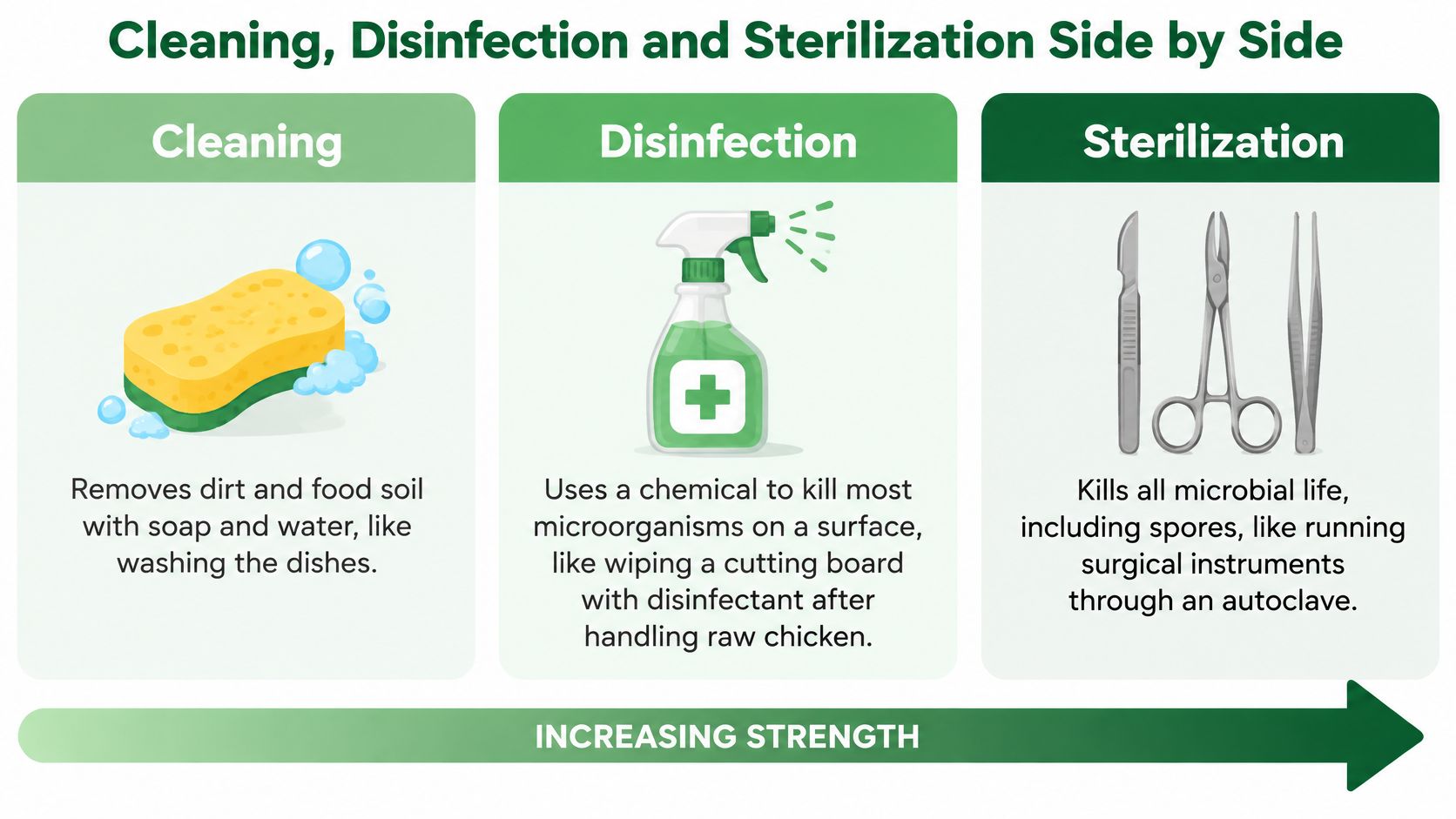
That spore detail is the hinge the whole topic turns on. Bacterial spores are the toughest thing on the list, so a process that leaves spores behind isn't sterilization no matter how strong it smells. It's also why a product labeled as a disinfectant can carry a long list of organisms it kills and still make no claim about spores at all.
Here's the three-level comparison in one place.
| Process | What It Removes or Destroys | Typical Method | Where It Fits |
|---|---|---|---|
| Cleaning | Visible soil, dust, grease and some microorganisms | Detergent and water or an enzymatic cleaner | Everyday kitchens, bathrooms, floors and surfaces |
| Disinfection | Many pathogenic microorganisms on hard, inanimate surfaces; not reliably bacterial spores | EPA-registered disinfectant used exactly as the label directs | High-touch surfaces after illness or during higher-risk periods |
| Sterilization | All microbial life, including spores | Validated steam or appropriate chemical sterilant in controlled reprocessing | Medical devices and laboratory work, not ordinary homes |
A rule to carry through everything below: clean often, disinfect when the situation calls for it, and treat sterilization as a specialist job rather than a housekeeping claim. In our own work, routine visits are cleaning with fragrance-free, plant-derived products. Disinfection enters at the sanitizing level, where it stays targeted instead of becoming the default.
Which Level Your Situation Needs
The CDC's household guidance is more relaxed than the cleaning aisle suggests. Routine disinfection at home is generally unnecessary unless someone is sick, someone visited while sick, or a household member is at higher risk from infection, according to the CDC's guidance on when and how to clean and disinfect. Plain soap or detergent handles ordinary surfaces, with extra attention to doorknobs, switches, handles and countertops.
That's the verdict. What readers need is a lookup, so here it is.
| Situation | Clean | Disinfect | Sterilize |
|---|---|---|---|
| Routine household, no one ill | Regular soap-and-water cleaning | Not needed | No |
| Someone in the home is sick or had a sick visitor | Regular cleaning | Targeted on high-touch surfaces, following label contact time | No |
| Household member at higher risk from infection | Regular cleaning, more often | Targeted on high-touch surfaces during elevated risk | No |
| Shared office or break room during cold season | Daily cleaning | High-touch surfaces during illness spikes | No |
| Rental between tenants | Full cleaning | Only where high-touch surfaces warrant it | No |
| Reusable medical or dental devices | Required first step | Required, as part of reprocessing | Yes, validated process by trained staff |
Read across a row and notice how rarely the third column fills in. Sterilization shows up once, for equipment that will contact broken skin or sterile tissue, and never for a countertop.
Over-cleaning has a cost that doesn't show up on the invoice. Extra disinfection adds chemical exposure and workload without benefit when nobody in the house is at risk, and disinfectant sprayed onto a dirty surface wastes product because the soil blocks it from doing its job. If you manage rentals, a condo turnover disinfection guide is worth reading before you build a between-tenant protocol, since turnover cleaning and turnover disinfection are separate line items with separate standards.
Most of what a Dallas home needs in allergy season is cleaning, full stop. Oak pollen in spring and cedar pollen in winter land on every surface that faces an open window, and Texas dust settles whether the windows are open or not. That work is vacuuming, damp wiping and floor care. For pet-friendly households, feeding areas and bedding zones deserve regular cleaning attention, and any disinfection there follows the label rather than a habit. Understanding how germs and viruses spread on shared surfaces helps you decide which few surfaces in your home earn the extra step.
The rule is simple. If the reason is dirt or allergens, clean. If the reason is illness or a higher-risk person, clean first and then disinfect the high-touch surfaces.
Clean First, Then Keep It Wet Long Enough
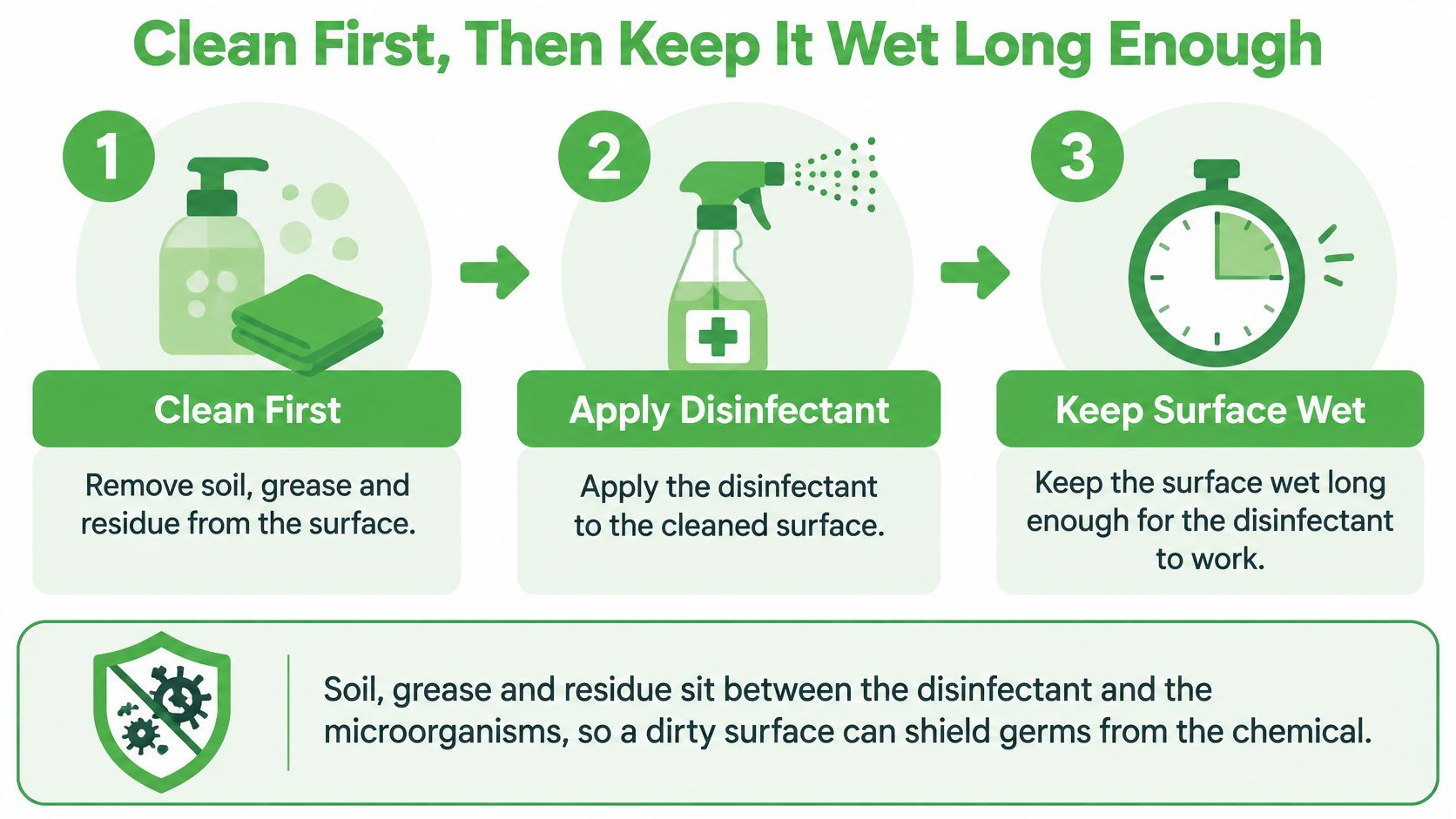
Disinfectant doesn't push through dirt. Soil, grease, fingerprint film and dried residue sit between the chemical and the microorganism, and a dirty surface can fail even when you used the right product at the right dilution. The CDC's infection-control glossary says it directly: cleaning removes adherent visible soil, blood, proteins, microorganisms and other debris, and leftover organic or inorganic soil can interfere with the effectiveness of the disinfecting step that follows.
So the order is fixed. Five steps, in this order, every time.
- Remove loose debris. A dry microfiber cloth takes crumbs, pet hair and dust off the surface before they turn into mud.
- Wash with detergent and water. This is what lifts grease, fingerprints and the thin film that builds up near stovetops and door handles.
- Rinse or wipe away residue if the label asks for it. Some disinfectants are deactivated by detergent residue, and some stone and finished wood react badly to it.
- Apply the EPA-registered disinfectant at the dilution on the label, not a stronger guess.
- Keep the surface visibly wet for the full contact time, and reapply if it dries early. Restart the clock when you reapply.
Step five is the one people skip, and it's the step where most disinfecting fails. The EPA's guidance on registered disinfectants requires the surface to stay visibly wet for the entire label contact time, with reapplication if it dries early. Registered labels may call for one, three, five or ten minutes depending on the organism and the application method. One label specifies ten minutes for tested bacteria but a shorter three-minute period for electrostatic-sprayer use under its stated conditions.
That range surprises people, because the front of the bottle rarely mentions it. The contact time lives in the small print, and it works like the steeping time on a tea bag: pull it early and you get colored water instead of tea. A spray-and-wipe that dries in thirty seconds isn't validated disinfection, and neither is a fog or a "99.9%" phrase on the front of the bottle.
Practical rule: if the surface dried before the timer ran out, you cleaned it and sprayed it. You didn't disinfect it.
Local conditions make step one heavier than people expect. Post-construction dust in a new build in Plano or Frisco is fine, adhesive and gypsum-heavy, and it needs real removal before any disinfectant has a chance. Pollen film on patio doors and window sills behaves the same way.
Before you start, run these checks.
- Confirm registration. The product should carry an EPA registration number and name the organism you're targeting.
- Measure the dilution. Guessing strong doesn't shorten the contact time and can leave residue that attracts soil.
- Set a phone timer for the label time rather than counting in your head.
- Apply enough product that the surface stays wet, not a light mist that flashes off.
- Check compatibility with natural stone, finished wood and electronics before you spray.
- Note ventilation and re-entry instructions so kids and pets stay out until the surface is dry and the label allows them back.
Some messes don't belong in this sequence at all. If the soil is animal waste rather than food or dust, it's a contamination problem with its own handling rules, and a FullScope Pest Control rodent odor guide explains why urine and droppings need specialist removal instead of a wipe-down. Gmaids technicians don't service homes with evident biohazard situations such as rodent or pet waste, and that's the right boundary for a cleaning company. Knowing where the line sits keeps everyone safer, and it keeps the five steps above for the jobs they're designed to handle.
Why Sterilization Stays in Specialized Settings
Everything above is about surfaces. Sterilization is about objects that will enter sterile tissue, and that's a different category of promise.
Microbes don't resist in the same way or to the same degree. The CDC's guidance on efficacy factors ranks bacterial spores at the top of the resistance ladder, followed by Cryptosporidium, mycobacteria, non-enveloped viruses, fungi, vegetative bacteria, and enveloped viruses at the easier end. The ranking tracks physical armor: tough spore coats, the wax-rich cell walls of mycobacteria, and the outer membranes of Gram-negative bacteria. The same page shows how load changes the math. Under identical test conditions, killing 10 Bacillus atrophaeus spores took 30 minutes, while killing 100,000 took three hours.
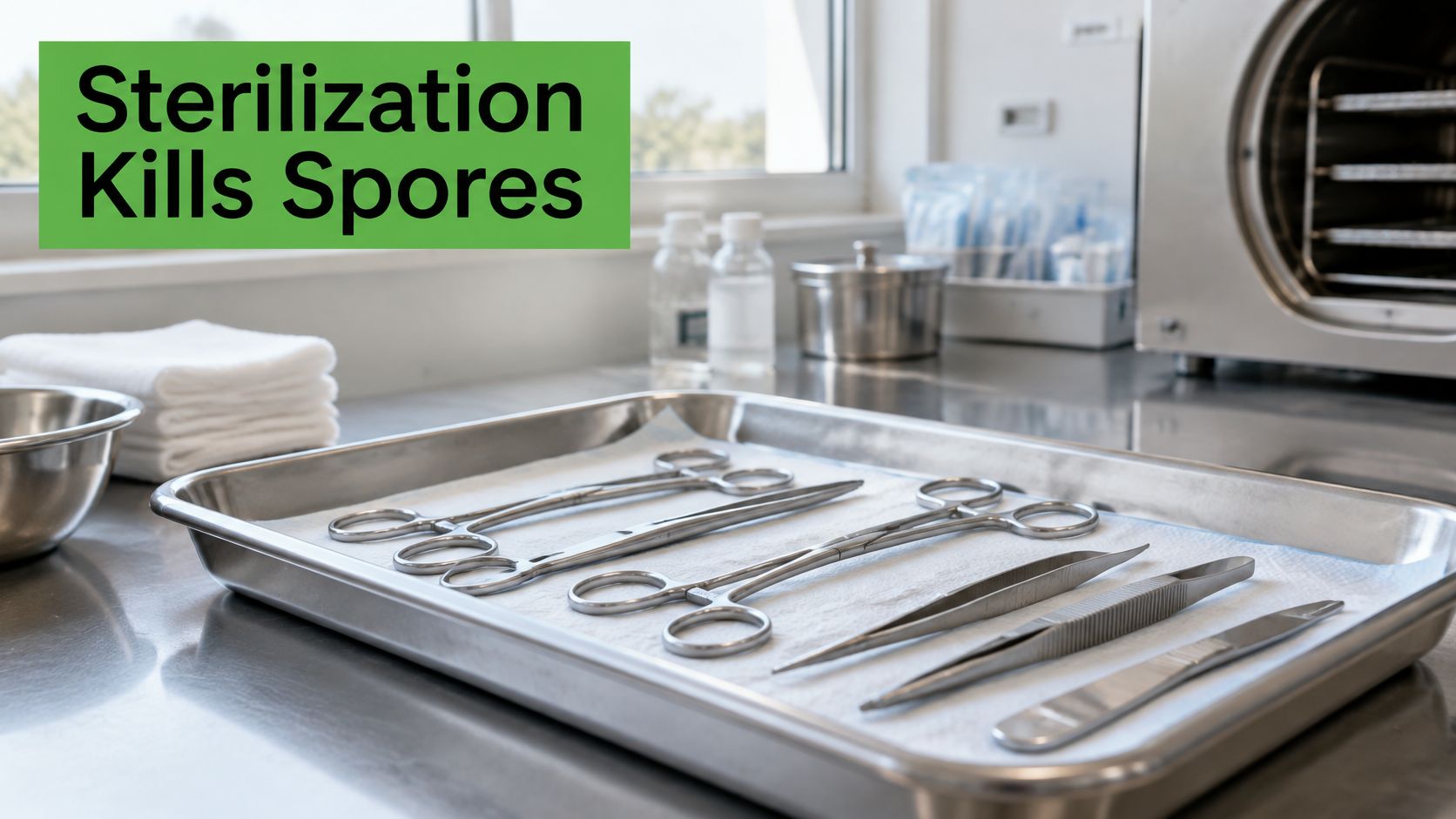
That load effect is the reason soil removal comes first everywhere, not just in hospitals. Ten spores and a hundred thousand spores are the same organism with a different amount of work to do, and a smear of protein gives the survivors somewhere to hide. It also explains why the fastest contact time on a label applies only to the organisms named there. A three-minute claim for one bacterium tells you nothing about how long the same product needs for a tougher target.
For reusable instruments and medical-device components, the sequence is cleaning, then disinfection, then sterilization using validated steam or an appropriate chemical sterilant, handled by trained and regulated staff. Healthcare settings often hand device reprocessing to a sterile processing department for exactly this reason, and medical practices can plan around a medical office cleaning service that keeps room surfaces and instrument reprocessing in separate contracts.
When contamination goes past cleaning into sewage, mold or trauma residue, restoration professionals handle it, and professional decontamination for Suncoast homeowners shows the kind of scope that involves. A house or office cleaning program should never promise sterilization. It should say exactly which level it delivers, on which surfaces, with which product.
Reading Labels and Mixing Products Safely
Two cleaners can be worse together than either one alone. OSHA warns never to mix products containing bleach and ammonia, because the combination can release dangerous gases capable of causing severe lung damage, and its guidance on cleaning chemical safety names adequate airflow as a necessary control whenever cleaning chemicals are in use.
Treat any two products as unsafe to combine unless the label says they're compatible. That includes the instinct to add a splash of vinegar to a bleach solution or to layer a glass cleaner over a disinfectant.
Here's the label routine worth building into a habit.
- Read the full label before the first use, not after something goes wrong. The front panel sells; the back panel instructs.
- Find the EPA registration number and the list of target organisms.
- Check approved surfaces, because some disinfectants etch stone, dull finished wood or damage screens.
- Note the dilution, contact time, ventilation and first-aid lines in one pass.
- Store products separately and never combine them in a single bottle, even a little.
- Keep children and pets out of the room until surfaces are dry and the label allows re-entry.
Fragrance-free and unscented aren't the same claim. Fragrance-free means synthetic scents are left out entirely, while unscented products may still contain masking chemicals that cover an odor without removing its source. In a Dallas house where the AC runs for months and the windows stay shut, that distinction matters more than it does outdoors. Airflow during and after cleaning does real work, so crack a window or run the exhaust fan even in July.
Our own approach is fragrance-free, plant-derived and mineral-based products with no bleach or ammonia, and sanitizing visits that use EPA-approved disinfectants applied by trained teams. If you're comparing providers, what to look for in disinfectant cleaning products is a fair set of questions to ask anyone, including us.
Cleaner, Sanitizer or Disinfectant on the Label
Three product types sit on the same shelf and make three different promises. The front panel usually tells you which one you're holding, and the difference decides whether the bottle can legally claim to kill anything.
| Product type | What it does | Pathogen claim | Typical contact time |
|---|---|---|---|
| Cleaner | Removes visible soil and some microorganisms | None | Not applicable |
| Sanitizer | Reduces bacteria to a level judged safe by public-health standards | Bacteria only | Usually shorter than a disinfectant |
| Disinfectant | Destroys or irreversibly inactivates bacteria, fungi and viruses on inanimate surfaces; not reliably spores | Named organisms on the label | One, three, five or ten minutes depending on organism and method |
A cleaner carries no pathogen claim at all, which surprises people who assume a strong-smelling product must be doing more. A sanitizer reduces bacteria to a level public-health standards call safe, and it says bacteria, not viruses or fungi. A disinfectant is the tier that destroys or irreversibly inactivates bacteria, fungi and viruses on inanimate surfaces, and even then it doesn't necessarily destroy bacterial spores.
To tell them apart on the bottle, look for four things: the EPA registration number, the product type on the front panel, the list of organisms the product is registered against, and the surfaces it's approved for. Those four lines tell you more than any marketing word on the label.
This is also where service names should be honest. Basic and Deep Cleaning are cleaning. Sanitizing Cleaning uses EPA-approved disinfectants applied to the label. Neither is sterilization, and no residential service should blur that.
Fragrance-free or botanical positioning doesn't replace verification. Only an EPA-registered label establishes the legally supported pathogen claim and the operating conditions that go with it, so it's fair to ask any provider which product they use, at what dilution, on which surface, against which organism, for how long.
Choose the Right Level and Take the Next Step
Three questions settle almost every situation.
Is the surface visibly dirty? Clean it with detergent and water. That covers most of a normal week in a Dallas home, including the dust that comes back the day after you wipe it. Scrubbing is doing the work here, and no chemical claim on a bottle changes that.
Has someone been sick, or is someone in the house at higher risk? Clean first, then disinfect the high-touch surfaces with an EPA-registered product and respect the contact time. Doorknobs, light switches, handles and countertops earn the step. Floors and baseboards usually don't. The mistake people make at this stage is spraying and wiping in one motion, which dries the surface long before the label's minutes have passed. Wet is what kills germs. Time is what finishes the job.
Is the item a medical device or part of a lab process? Leave it to specialized, regulated reprocessing. No spray bottle settles that question.
Where professional help fits, it fits along those same lines. Basic Cleaning suits homes already in good condition that need routine upkeep. Deep Cleaning is the right first step for a seasonal reset or a home that hasn't been professionally cleaned recently, and it's what we recommend for first-time cleanings. Sanitizing Cleaning is offered for homes, offices, retail locations, rental properties and shared spaces, using EPA-approved disinfectants, advanced fogging technology and non-toxic botanical solutions for high-touch areas. Recurring Maid Service keeps the whole thing on a weekly, biweekly or monthly rhythm.
Every visit is handled by trained, background-checked and insured Certified Cleaning Teams, and Gmaids has served Dallas–Fort Worth since 2004.
Once you know which of the three levels a job needs, the guesswork disappears and the label becomes the instruction sheet instead of the marketing. You stop reaching for the strongest-sounding product and start matching the method to the risk, which is exactly how the science says it should work. Gmaids cleans homes and workplaces with fragrance-free, plant-derived products and no bleach or ammonia, and Sanitizing Cleaning adds EPA-approved disinfection for the high-touch surfaces that warrant it. Get an instant, flat-rate quote at Gmaids or call 214-997-6918 and tell us what you're dealing with.


Ready for a healthier, cleaner home?