Germs and Viruses: What They Are and How to Clean Them
Your child coughs at breakfast, a grandparent is arriving for the weekend in Dallas, and you're standing in the kitchen wondering whether to wipe everything in sight or just open a window and hope for the best. That's a familiar spot for a lot of families, and it's where germs and viruses stop being abstract words. The goal isn't to sterilize your home. It's to understand what you're dealing with, where effort helps, and when a stronger product is worth using. With a few clear distinctions, you can clean calmly and skip the extra sprays that don't add much.
Table of Contents
Germs, Viruses and Fungi Compared at a Glance
Start with the scan-friendly version, because the word germs lumps together very different things. Bacteria, viruses, and fungi behave differently, need different treatments, and respond differently to cleaning. Mixing them up is why people expect antibiotics to help a cold, or expect a scented spray to fix a damp bathroom corner.
| Type | Typical size | Alive on its own? | Treated by | Common examples |
|---|---|---|---|---|
| Bacteria | about 0.5 to 5 micrometers | Yes, single-celled | Prescribed antibiotics | Streptococcus, E. coli, Staphylococcus |
| Viruses | about 20 to 300 nanometers | No, needs a host cell to reproduce | Antibiotics have no effect; some antivirals for specific viruses | Influenza, norovirus, rhinovirus |
| Fungi (yeasts and molds) | yeasts about 3 to 10 micrometers; mold spores vary | Yes, eukaryotic organisms | Antifungal medicines; cleaning removes damp growth | Candida, Aspergillus, household mold |
Size and Independence
Bacteria are single-celled living organisms that can multiply on their own when food, warmth, and moisture are available. Many are helpful, including the bacteria in your gut, while others can cause strep throat or food related illness. Viruses are far smaller and aren't independent living organisms. They can't reproduce until they get inside a host cell and use that cell's machinery to make copies.
Fungi cover two forms you'll recognize at home. Yeasts are single-celled, and molds grow as branching structures that spread through spores. Candida is a yeast, Aspergillus is a mold, and the dark growth on grout is usually common household mold feeding on moisture and surface film.
Everyday picture: Bacteria are tenants that can live and multiply on a countertop. Viruses are borrowed keys that only work inside a host cell. Molds are gardeners that spread by seed wherever damp soil, meaning moisture, lets them settle.
Why Treatment Differs
The most practical row is the treatment row. Antibiotics target bacteria and have no effect on viruses, so a clinician won't prescribe them for influenza or a common cold. Some specific viruses have antiviral medicines, but many viral illnesses are managed with rest, fluids, and monitoring. Fungal infections may need antifungal medicines, while visible mold at home starts with removing moisture and cleaning the surface.
Cleaning fits across all three rows, but in different ways. Soap and wiping physically remove bacteria and viruses from hands and hard surfaces, which lowers the number you might transfer to your face or food. For mold, cleaning removes growth and the film it feeds on, but it doesn't solve a leak. If moisture stays, the spores that remain in the air will settle and grow again.
At home, focus on the rows that match the place. Hands, phones, handles, and kitchen surfaces are mainly a bacteria and virus story. Damp bathrooms, under sink cabinets, and window sills where condensation collects in Plano or Dallas homes are mainly a mold story. That distinction keeps you from using the wrong tool for the wrong problem.
How Germs and Viruses Spread Through Homes and Offices
Germs don't teleport. They travel by routes, and once you can name the route you can choose a habit that interrupts it. In Dallas, Plano, and Frisco, long air conditioning seasons keep windows shut for months, so families and coworkers share indoor air, handles, and bathrooms more than they realize during Texas heat, school terms, and busy holiday hosting.
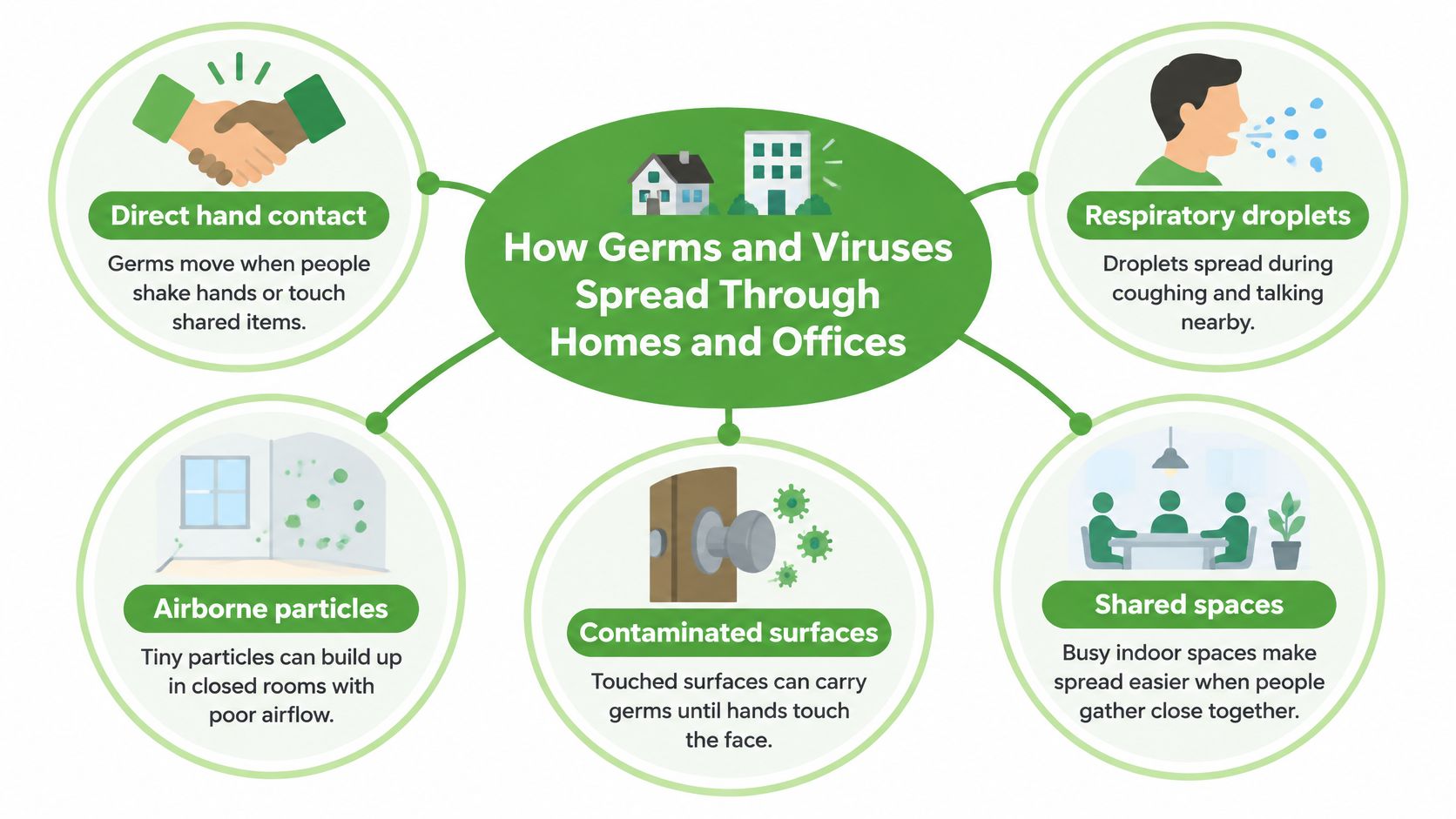
Five Routes in Plain Language
Direct hand contact is the handshake, the shared toy, and the hand that helps a toddler wipe a nose and then opens the fridge. Respiratory droplets leave the mouth and nose when someone coughs, talks, or sings nearby, and they can land on another person or a close surface. Say a guest leans over the kitchen island chatting while you cook. That's droplet distance, not a surface problem first.
Airborne particles are smaller and can build up in a closed room with poor airflow. A conference room with the door shut all afternoon is a good example. Rodent related illnesses show a different airborne lesson outdoors and in sheds, and if you're curious about a less common route, this primer on how hantavirus affects the lungs explains why disturbing contaminated dust needs special care rather than dry sweeping.
- Contaminated surfaces: Someone touches a doorknob, a shared office keyboard, or a bathroom faucet handle, then touches eyes, nose, mouth, or food.
- Food and water: A kitchen sponge that never dries, raw food juices on a board, or pet bowls washed in the same rushed way as dinner plates can move bacteria around the kitchen.
- Shared facilities: Toilets, sinks, break rooms, and guest bathrooms concentrate touch in a small area, especially when several people are ill.
Why Setting Matters as Much as Habits
The scale is worth knowing without letting it scare you. The World Health Organization report on health in 2015 reported that deaths from infectious diseases, including parasitic diseases and respiratory infections, had fallen to 9.5 million globally in 2012, compared with 12.1 million in 2000, and their share of all deaths declined from 23% to 17%. Risk also depends on environment, not only personal behavior, especially where people share surfaces, air, and facilities.
That points to three habits that cut the most routes at once.
- Hand washing: Soap, water, and friction before eating, after toilet use, after coughs, and after handling pets or raw food.
- Ventilation: Open windows when weather allows, run exhaust fans, and give crowded rooms fresh air between uses.
- Keeping sick people home: Rest at home, plus some distance and a separate bathroom if you have one, prevents more spread than extra wiping after the fact.
Illness Patterns at Home and When to Call a Clinician
You don't need to name the virus to respond sensibly. Look at the pattern first, because the route tells you where cleaning helps and where it doesn't. Respiratory viruses tend to move quickly through a household. Stomach viruses tend to concentrate around bathrooms, hands, and kitchen handles.
Respiratory, Stomach, and Longer Term Patterns
Influenza and common colds spread through droplets, close air, and hands that touch the face. You'll often see cough, sore throat, congestion, tiredness, and sometimes fever in more than one person within days. Norovirus and other gastrointestinal viruses move through hands and contaminated surfaces after vomiting or diarrhea, so the bathroom and hand washing matter more than the living room sofa.
Some viruses don't fit either household pattern. Hepatitis B and C persist through blood and certain body fluids rather than casual surface contact, which is why cleaning isn't their main control. The World Health Organization global health data estimates seasonal influenza causes about 1 billion cases annually and between 290,000 and 650,000 respiratory deaths each year, while an estimated 1.3 million people died from chronic hepatitis B and C in 2024. Those are different problems, respiratory spread versus long term infection, and they need different prevention.
A surface plan can't replace vaccination where it's available, staying home when ill, ventilation, and hand hygiene. Cleaning supports those steps, especially on frequently touched surfaces in shared homes and offices.
Who Needs Extra Caution
Be more careful and ask a clinician sooner when illness reaches babies, older adults, or pregnant people. Do the same for anyone with asthma, significant allergies, or a weakened immune system. A quick call can clarify testing, medicine timing, and whether extra precautions at home make sense for that person.
Seek medical care promptly for warning signs such as these.
- Trouble breathing: Shortness of breath, wheezing that is new or worsening, or lips that look blue or gray.
- Persistent high fever: Fever that won't come down, returns after improving, or occurs in a very young baby.
- Signs of dehydration: Very little urination, dry mouth, dizziness, or inability to keep fluids down after vomiting or diarrhea.
- Symptoms getting worse: Pain, confusion, unusual sleepiness, or a clear turn for the worse instead of gradual improvement.
This is general information, not medical advice, and it can't diagnose you or your child. If you're unsure, call your clinician, pediatrician, or urgent care line and describe the pattern, the age of the person, and any chronic conditions. That's more useful than guessing from a single symptom.
Matching Effort to the Situation
More disinfectant isn't automatically better. That's the part many labels leave out. On an ordinary day with a healthy household, disinfection of the whole house usually adds odor, residue, and exposure without much extra benefit. Fragrance-free cleaning with soap and water is often the right level, and it matters where babies crawl and pets nap on the floor in Dallas homes.
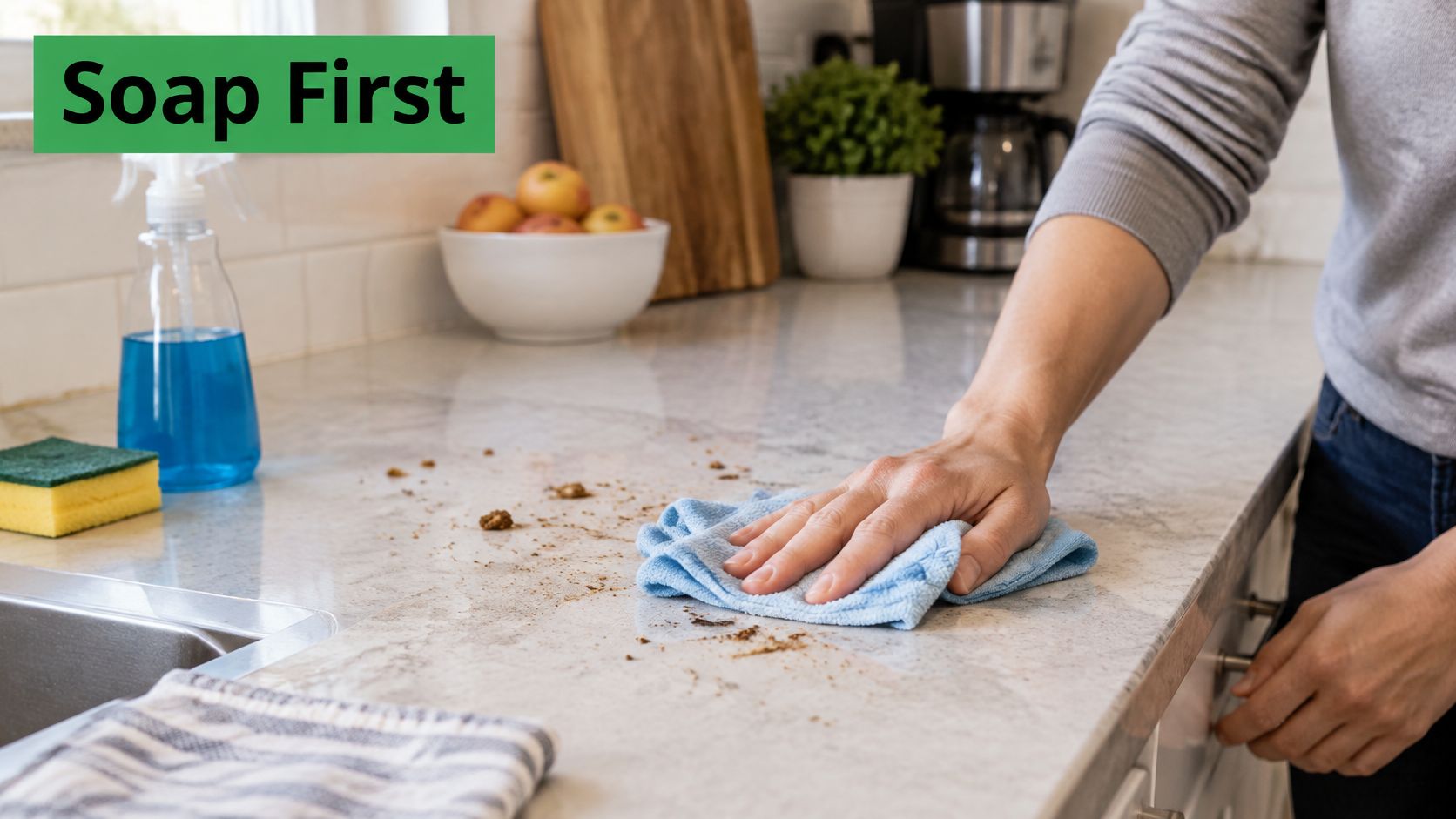
The CDC guidance on cleaning and disinfecting your home says in most household situations cleaning with soap and water removes most germs, while disinfection is generally unnecessary unless someone is sick, has recently visited while sick, or is at greater risk because of a weakened immune system. It also recommends regularly cleaning high-touch surfaces such as doorknobs, light switches, and countertops, while cleaning other surfaces when visibly dirty or as needed.
| Situation | Clean with soap and water | Disinfect | Notes |
|---|---|---|---|
| Ordinary day, healthy household | Yes, high-touch and visibly dirty areas | Not usually needed | Routine cleaning removes most germs |
| Someone at home has a respiratory illness | Yes, first | Yes, high-touch and illness-linked areas | Clean first, then disinfect with a label-matched product |
| Someone at home has a stomach illness | Yes, first | Yes, bathroom and kitchen handles | Ventilate and wash hands after cleaning |
| After a sick guest visits | Yes | Targeted, on surfaces they touched | Focus on doorknobs, bathroom and shared items |
| Vulnerable occupant at home | Yes | Ask a clinician about extra precautions | Do not rely on products alone |
Using the Table on a Real Tuesday
Say your preschooler in Frisco has a stomach illness at 2 a.m. You'd clean the toilet area, flush handle, faucet, and floor spots first, then disinfect those hard surfaces with a product labeled for the job. The bedroom bookshelf doesn't need the same treatment. After a coughing guest leaves, you'd target the guest bathroom, door handles, remotes they used, then ventilate the room.
Dallas context still supports regular visible cleaning. Spring oak pollen and winter cedar pollen bring dust that settles on floors, sills, and handles, and closed windows during long air conditioning stretches let that dust linger. A damp microfiber cloth and a plant-derived cleaner handle that load well. You're removing soil and pollen, not chasing every microbe.
When a household wants a professional team for sanitizing, Gmaids offers sanitizing cleaning for high-touch areas while the rest of the home stays on fragrance-free soap and water cleaning. We clean only with non-toxic, fragrance-free products, with no bleach and no ammonia, which keeps the routine better for sensitive households without turning every visit into a chemical event.
Where and How Often to Clean High-Touch Surfaces
Surfaces matter, but they're a supporting control, not the main event for respiratory illness. That balanced view keeps you from two mistakes at once. Don't ignore handles during a stomach bug, and don't expect wiping a table to offset a crowded, unventilated room with a coughing visitor.
The EPA guidance on cleaning and disinfecting best practices during the COVID-19 pandemic states the risk of catching COVID-19 through touching a contaminated surface is considered low. At the same time, cleaning high-touch areas and disinfecting when someone is sick remain sensible supporting steps. Staying home when ill, hand hygiene, ventilation, and reducing close contact do more of the heavy lifting.
| Surface | Typical touch pattern | Suggested frequency | Method |
|---|---|---|---|
| Doorknobs and handles | touched many times daily | Daily, more during illness | Soap and water; disinfect with a registered product when sick |
| Light switches | several times daily | Daily to weekly | Damp cloth with soap |
| Faucet handles and sink edges | daily | Daily | Soap and water, then dry |
| Toilet flush handle and seat | daily | Daily | Soap and water, with a toilet brush |
| Phones, tablets and remotes | daily | Several times a week; daily when sick | Follow the manufacturer's cleaning guidance |
| Keyboards and shared office equipment | daily in shared spaces | Daily | Lightly dampened cloth; keep liquid out of openings |
| Fridge and oven handles | daily | Weekly | Soap and water |
How to Read the Frequencies
Daily doesn't mean scrubbing like a deep clean. For a faucet handle, it's a soapy wipe while you clean the sink, then dry it so water spots and film don't build up. For light switches, use a cloth that's damp, not dripping, so liquid doesn't enter the plate. Phones and tablets need manufacturer guidance first, because screens and coatings vary and excess liquid can damage them.
During illness, shorten the interval for the items the sick person touches. A bedside remote, a bathroom door handle, and a phone deserve daily attention. A guest room switch they never used does not. That targeted approach saves time and product, and it keeps the work focused where hands transfer germs.
Offices and Shared Workspaces
Apply the same logic in Plano, Frisco, and Richardson offices and coworking spaces. Workstations, shared keyboards, conference room tables, chair arms, and break room handles need daily touch point attention when different people rotate through. Keep tissues and a lined bin nearby, and make it easy for people to wash hands before eating. A clean desk nobody can maintain during flu season won't compensate for presenteeism, so managers help most by letting sick staff stay home.
Fridge door checklist: Wipe handles and switches, clean bathroom touch points, wipe shared electronics as the manufacturer directs, and check the kitchen sink area for sponge and cloth hygiene.
A weekly routine you can realistically finish beats an ambitious list you abandon. Put fresh cloths where you'll use them, wash or replace sponges often, and let cleaned surfaces dry. Wet, bunched cloths left in the sink become part of the problem, so hang them to dry between jobs.
Read the Label, Then Disinfect Step by Step
A disinfectant's label describes specific test conditions, not every use a product might seem suited for. Change the organism, surface, dilution, or wet time, and the claim may no longer apply. Scan four details before using it.
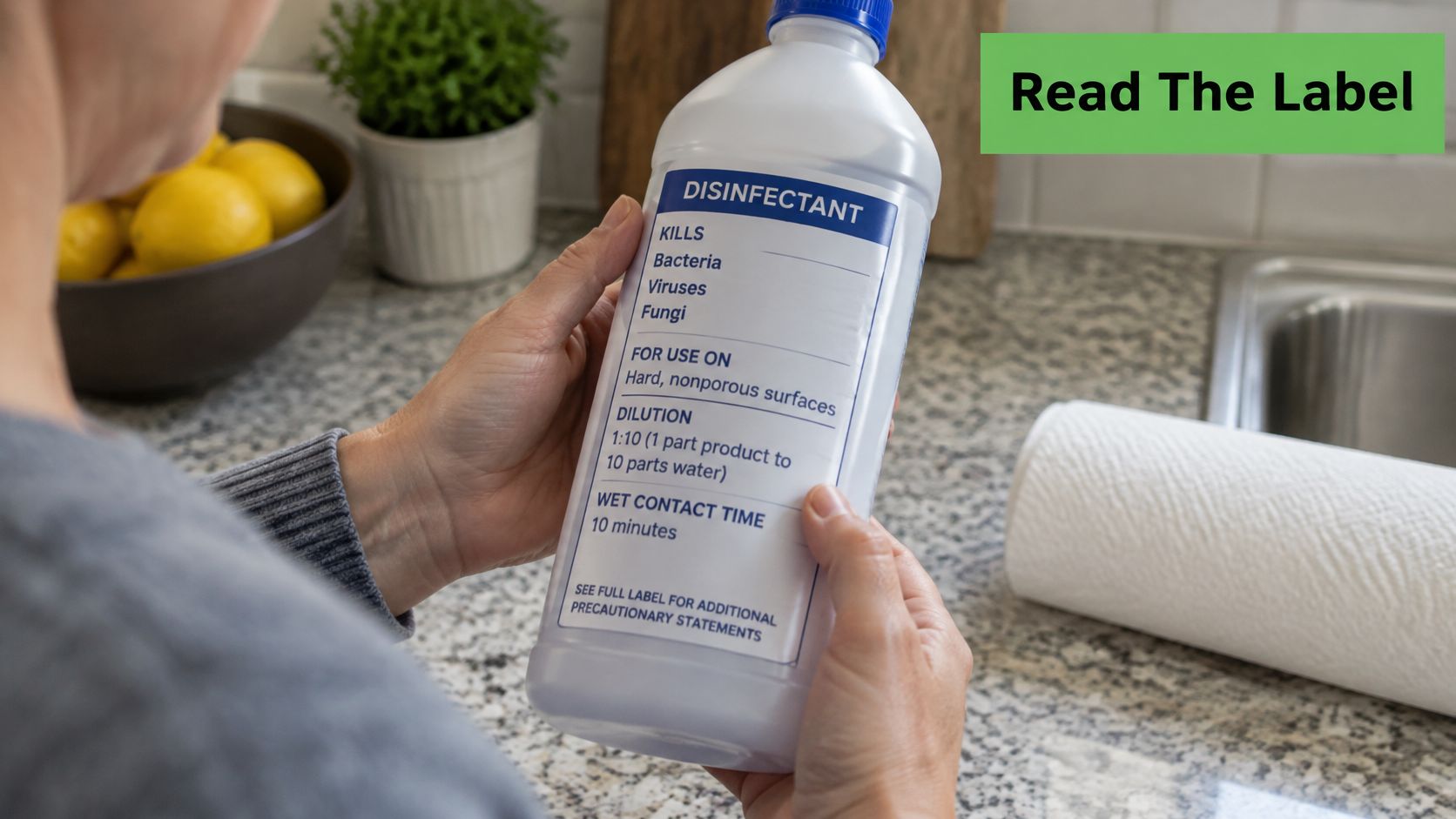
Four Places to Scan Before You Spray
- Named organism: Check for the pathogen you want to address, such as influenza or norovirus. A general claim about germs may not cover it.
- Surface type: A product approved for hard, nonporous surfaces may not be suitable for fabric, unfinished wood, or a phone screen.
- Dilution and directions: Ready-to-use products and concentrates require different handling. Measure concentrates as directed and keep them in labeled containers.
- Wet contact time: This is how long the surface must stay visibly wet. The required time depends on the product and organism, so a quick spray-and-wipe may not be enough.
The CDC guidance on cleaning and disinfecting facilities explains that cleaning with soap or detergent removes soil and lowers the number of microorganisms. Disinfection uses an antimicrobial chemical to inactivate pathogens that remain. Some registered formulations specify 30 seconds for viruses, while others require 1 minute for norovirus or longer. Wiping dry before the label's contact time ends can make the product's claim inapplicable.
Contact time also explains why a surface may need to stay wet. The CDC summary recommendations for disinfection and sterilization reports that many EPA-registered hospital disinfectants historically carried a 10-minute label contact time. Studies have shown effectiveness against some pathogens after shorter exposures, but those findings do not change the directions on the product you're using. If the label says 10 minutes and the surface dries after 5, reapply as directed to keep it wet for the full time.
Norovirus, Alcohol, and Fragrance Words
Norovirus is a useful benchmark because it can be harder to inactivate than enveloped viruses such as influenza. A product label that names norovirus may be relevant during a stomach illness, but you still need to follow its directions for the surface and contact time.
Alcohol needs the same careful reading. The word “alcohol” alone does not show that a product works against a particular organism. Formulation, concentration, surface, soil, and exposure time all matter. If a product lacks an EPA registration and the organism claim you need, treat it as a cleaner rather than a disinfectant.
Fragrance-free means a product has no added fragrance. Unscented products may use masking fragrances to cover an odor. Neither term means a product is antiviral. A botanical or mineral-based cleaner can remove soil, but it is a disinfectant only if its label makes a claim for the organism and surface in question.
Fragrance and disinfecting are separate choices. Choosing a fragrance-free cleaner can avoid added scents, while a disinfectant's label tells you what organisms it is intended to inactivate.
The Step-by-Step Method
- Clean first: Wash visibly dirty surfaces with soap and water or a suitable cleaner. Soil can shield microorganisms and interfere with a disinfectant.
- Rinse and dry if needed: Remove soapy residue when the product directions call for it, so it does not dilute the disinfectant.
- Choose the right product: Select an EPA-registered product labeled for the target organism and surface. This guide to disinfectant cleaning products explains what to check on the label.
- Cover the surface: Apply enough product to wet the whole area. A light mist that misses part of a handle leaves that area untreated.
- Keep it visibly wet: Follow the full contact time on the label and reapply if the surface dries early. Wiping too soon is a common mistake when using disinfectants at home or in the office.
- Finish as directed: Let the surface air-dry, or wipe and rinse only if the label instructs you to, especially on food-contact surfaces.
- Wash your hands and ventilate: Follow the label's safety directions, then store the product upright and out of reach of children and pets.
Never mix cleaning products or use disinfectants on skin. Do not transfer them into drink bottles or unlabeled sprayers. Wear gloves or eye protection if the label calls for them, and keep children away from cleaning while products and equipment are in use.
Gmaids uses non-toxic, fragrance-free cleaning products, with no bleach or ammonia. For Sanitizing Cleaning, the service uses EPA-approved disinfectants, advanced fogging technology, and non-toxic botanical solutions. The right choice depends on the task: routine cleaning removes soil, while targeted disinfection follows a product label's specific claims and directions.
Mold and Damp Spots Without Harsh Chemicals
Mold isn't a bacterium or a virus. It's a fungus, and it grows where moisture lingers, in bathroom corners, under sinks, around window sills, and near air conditioning condensation lines in Dallas and Southlake homes. If you only scrub the spot, you'll likely meet it again next month.
Fix Moisture, Then Clean the Surface
Start by finding the water source. Check for a slow sink trap leak, a toilet that sweats onto the floor, grout that stays dark and damp, or a shower door that traps water against the wall. Fix the leak, run the exhaust fan during and after showers, and wipe condensation off sills. Cleaning can't outpace an active drip.
For visible mold on hard, nonporous surfaces such as tile, sealed countertops, and tub edges, keep it simple. Wash with soap or a plant-derived cleaner, scrub with a brush, rinse, and dry fully with a clean cloth. A mineral based scrub helps in grout lines where film collects, and for shower specifics our guide on how to get rid of mildew in the shower lays out the routine room by room.
- Ventilate while you work: Open a window or run the fan so damp air leaves the room.
- Dry completely: Fans and towels matter as much as the cleaner, because remaining moisture restarts growth.
- Never mix cleaners: Mixing can create dangerous fumes, and we don't recommend bleach or ammonia for DIY work.
Porous materials are a different job. Drywall, carpet pad, ceiling tiles, and insulation with significant growth can't be reliably cleaned from the surface, so have them assessed by a qualified professional. Homes with recurring condensation may benefit from an air duct or HVAC check from a complementary local service, and carpet and upholstery cleaners can handle damp or pet soiled fabric that needs extraction rather than wiping.
Get Your Instant Flat-Rate Quote Today
A quick wipe-down may suit routine upkeep. Move-out grime, post-construction dust, or a workplace that needs regular cleaning can call for a more targeted service. Gmaids offers house cleaning and maid services across Dallas–Fort Worth, including basic, deep, move-in/move-out, post-construction, office, commercial, and recurring cleaning.
Gmaids has served the area since 2004. Trained, background-checked, insured technicians use non-toxic, fragrance-free products, with no bleach or ammonia. Weekly, biweekly, and monthly recurring plans are available.
For a focused approach to high-touch areas, Gmaids' sanitizing and disinfecting service for homes and offices uses EPA-approved disinfectants, advanced fogging technology, and non-toxic botanical solutions. It is available for homes, offices, retail locations, rental properties, and shared spaces. Fragrance-free cleaning products do not, by themselves, mean a surface has been disinfected; the right service depends on the cleaning need.
Get an instant, flat-rate quote online at www.gmaids.com or call 214-997-6918 to discuss the service and schedule that fit your space.
If you're unsure which type of cleaning fits your home or workplace, Gmaids offers residential and commercial services across Dallas–Fort Worth. Request a quote online or call 214-997-6918.


Ready for a healthier, cleaner home?