How to Improve Indoor Air Quality at Home: Steps That Work

About 90% of Americans' time is spent indoors, according to the U.S. Environmental Protection Agency's 2025 Report on the Environment. Sit with that for a second. If your kids are awake for fourteen hours, nearly all of those hours happen inside the same walls, on the same floors, breathing the same air. The air in your house isn't background noise. It's the environment your lungs live in.
Which is why the advice you usually hear, buy a purifier and a snake plant, misses the point. The changes that alter what your family breathes are unglamorous and mostly free: vent the stove, fix the drip under the sink, stop spraying fragrance, change the filter on time. What follows is ranked by impact, not by how good it looks on a shelf.
Table of Contents
- Find the Sources Behind Your Home's Stale Air
- How to Ventilate Without Letting Heat and Pollen In
- Keep Indoor Humidity Between 30 and 50 Percent
- Filters and Cleaners That Lower Pollutants Most
- Clean Dust and Allergens Without Adding New Irritants
- Plan Your First Week of Cleaner Indoor Air
Find the Sources Behind Your Home's Stale Air
Most Dallas homes don't have one air quality problem. They have five small ones running at the same time. A gas range that vents into the kitchen, a hall bathroom with a fan nobody runs, a plug-in freshener by the stairs, a dog bed under the window, and oak pollen that coats the patio every spring. No filter fixes that list. You have to remove the sources.
The EPA's hierarchy is blunt about the order of operations. Source removal and ventilation are the primary controls, with filtration as a supplement rather than a complete solution. Work in that sequence and every dollar you spend afterward does more work.
| Source | Common Home Examples | First Fix |
|---|---|---|
| Combustion | Gas stove, fireplace, attached garage | Run the range hood, never idle a car in an attached garage, and have gas appliances serviced |
| Moisture and mold | Bathroom, leaks under sinks, laundry area | Fix leaks promptly and run exhaust fans during and after showers |
| Fragrance and cleaning chemicals | Air fresheners, scented detergents, bleach | Switch to fragrance-free products and stop using scented sprays |
| Dust and pet dander | Carpets, rugs, bedding, pet beds | Vacuum with a HEPA filter and damp-dust weekly |
| Outdoor pollen and smoke | Oak and cedar pollen, wildfire smoke | Keep windows closed on high pollen or smoke days |
Start where the fix is quickest. Fragrance leaves the house in one afternoon: bin the plug-ins and aerosol sprays, replace scented detergent with a fragrance-free version, and stop buying candles for the guest bath. Moisture takes a weekend of looking under sinks and running fans. Combustion and dust need a little planning. Outdoor pollen is the one category you can't control, only keep out.
The two-hour rule: if you can smell it, it's a source. Perfume, candles, spray cleaner, dryer sheets, the plug-in by the stairs. Fragrance is the easiest category to eliminate and the one most air quality guides skip entirely.
Before you spend money on equipment, get the mechanical side straight. Browse air quality tips from ClimateGuard Cooling Services to understand how your ducts, filter rack, and air conditioner are shaping what you breathe.
One source deserves its own line: renovation dust. If you've just finished a remodel, or moved into a new build in Celina or Prosper, fine drywall dust settles into every surface and keeps re-entering the air for weeks. That's a job for post-construction cleaning, not a normal weekly tidy.
How to Ventilate Without Letting Heat and Pollen In
Ventilation is the cheapest upgrade in the house and the one DFW homeowners get wrong most often. Flinging every window open in August doesn't ventilate, it imports hot, dusty air and makes the AC work harder. Timing decides whether ventilation helps you or hurts you.
The mechanism is simple. Ventilation replaces contaminated indoor air with cleaner outdoor air, and only when outdoor conditions permit it. The EPA's indoor air quality factsheet names the three basic tools: open windows and doors, kitchen and bathroom exhaust fans, and an air conditioner with its vent control open.
Here's the sequence that gets it right without cooking the house.
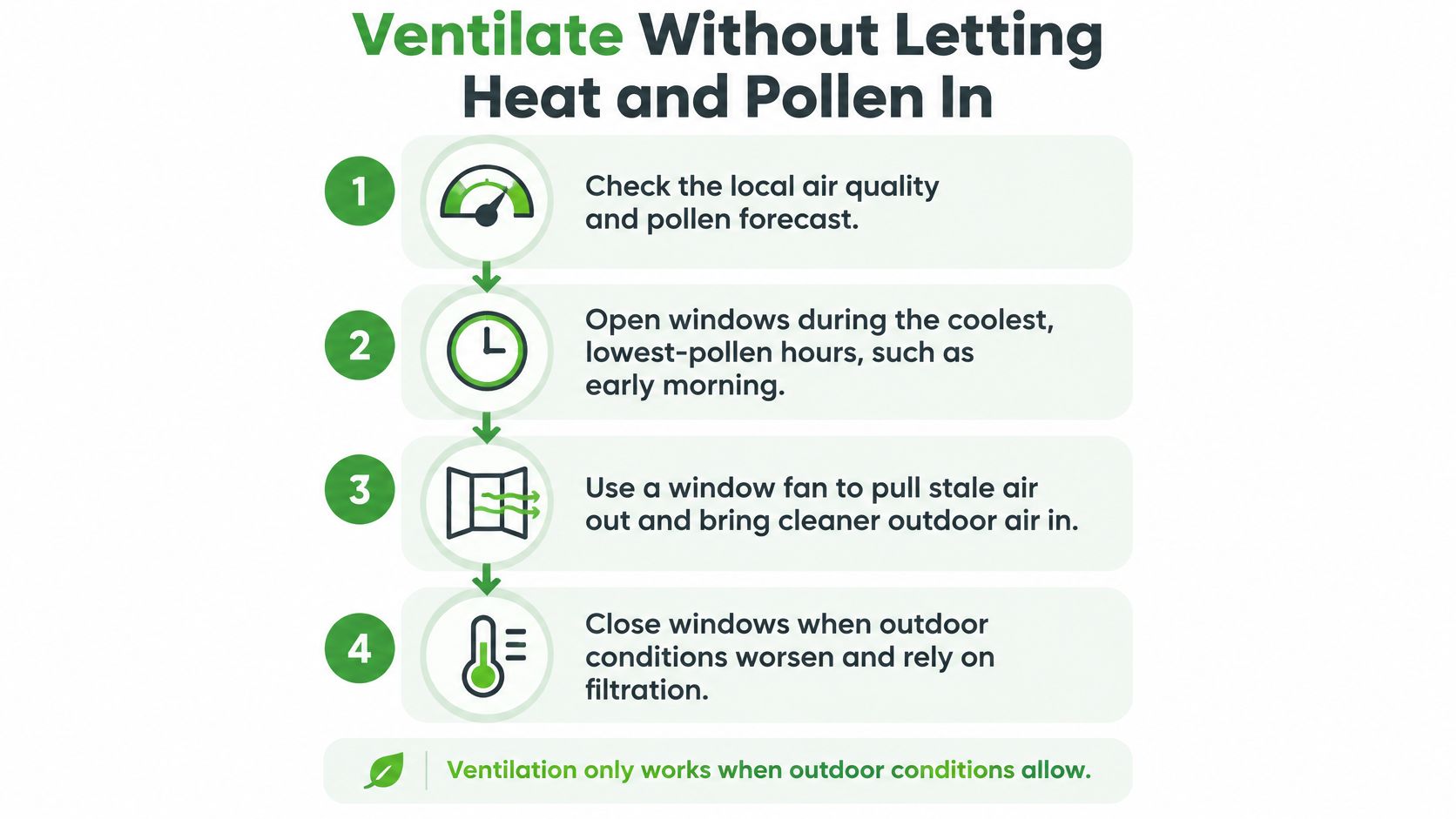
- Check the forecast before you touch a window. Read local air quality, pollen count, and outdoor temperature together, because one without the others is useless. In Dallas, oak pollen peaks in spring and cedar in winter, so a gorgeous breezy morning during cedar season still drags irritants through every room.
- Run the exhaust fans every single time. The range hood goes on before the burner is lit, and the bathroom fan runs during the shower and for 20 minutes after you towel off. Both should vent outdoors through a duct to the roof or wall. A fan that dumps into the attic just moves moisture from one part of the house to another.
- Make a cross-breeze, not a crack. Open windows on opposite sides of the house for 10 to 15 minutes on a mild, low-pollen morning. One open window does almost nothing, since stale air needs somewhere to go.
- Use the fresh-air control on mild days. Many systems have a vent or damper that pulls in outdoor air. Open it when the pollen count is low and you ventilate while you cool, rather than ventilating and then paying to cool the result.
- Close up and filter when outside is worse than inside. Hot, dusty, smoky, or high-pollen afternoons call for closed windows, exhaust fans running, and filtration carrying the load. A 15-minute March morning window clears last night's fish dinner. An August afternoon window just makes the house hotter and dustier.
You'll know it worked when no cooking smell lingers an hour later, a tissue held against the fan grille gets pulled tight, and the humidity gauge stays in range.
If you want actual proof, a nondispersive-infrared CO2 monitor is the honest instrument. Set it at breathing height, away from windows, supply vents, and the people in the room, and watch it across a normal occupied evening. Readings that climb well above outdoor levels mean the room needs more fresh air. Just don't read it as a grade for your filter, because filtration can clean the air without moving CO2 at all.
Keep Indoor Humidity Between 30 and 50 Percent
The EPA's guide to caring for your air recommends keeping indoor relative humidity between 30% and 50%, a band that limits the conditions mold needs while avoiding air so dry it irritates eyes, skin, and airways. Stay inside it and you starve mold of what it wants. Drift above it and you're running a terrarium with furniture in it.
You cannot feel 62% humidity. A house can seem perfectly fine while a closed bedroom in the back climbs all week, especially in Dallas, where a long air-conditioning season pulls moisture out unevenly and shut-up rooms accumulate it.
| Relative Humidity | What It Means | What to Do |
|---|---|---|
| Below 30% | Air is too dry | Check the gauge and use a clean humidifier only if the air stays dry |
| 30% to 50% | Target range | Keep it here with ventilation and regular gauge checks |
| 50% to 60% | Approaching mold-friendly conditions | Run bath and kitchen fans longer and add dehumidification |
| Above 60% | Mold risk rises | Find and fix the moisture source, dry wet materials and run a dehumidifier |
A low-cost gauge settles the question in ten seconds. Put it away from vents and windows, at eye level in a main living area, and read it at a normal time of day rather than straight after a shower.
The usual culprits in Plano and Lakewood homes are boring. A hall bath that stays steamy because the fan is wired to the light switch and dies with it. A laundry closet with a slow supply-line leak behind the washer. A pet door where wet paws track in every afternoon. Fix the water, not the smell.
A hygrometer costs less than lunch and tells you more than any purifier's spec sheet.
If you're already seeing dark grout or pink streaks in the shower, moisture is winning. Here's how to get rid of mildew in the shower without reaching for bleach, which adds its own fumes to the air you're trying to clean.
Filters and Cleaners That Lower Pollutants Most
Filtration earns its keep only after you have cut the sources and aired the house out. A purifier next to an open bottle of cleaner is a machine managing a mess a trash bag and a fan would have handled first.
Rank the hardware by what it pulls out of the air.
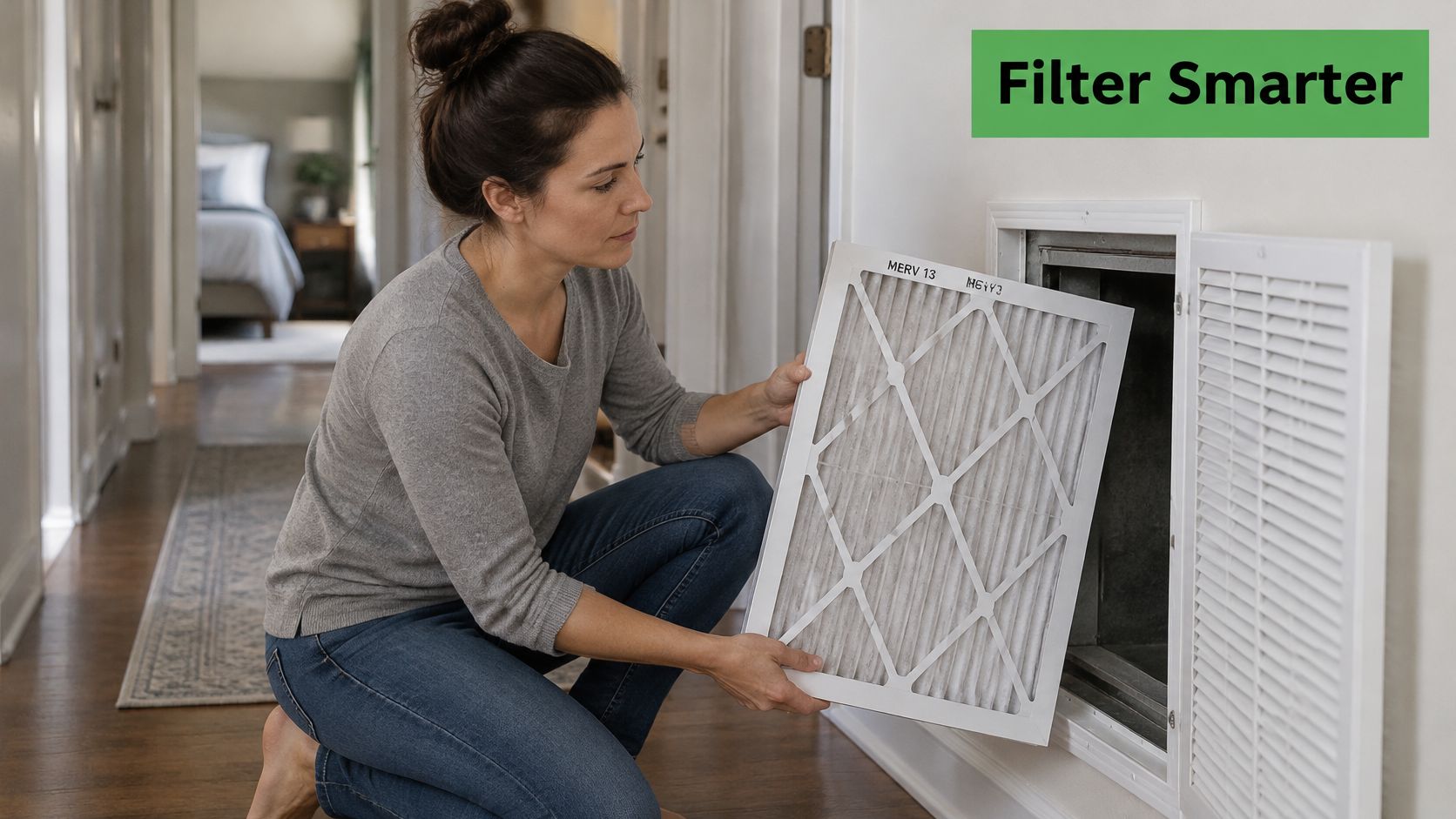
The highest-impact upgrade most homes can make is the HVAC filter: the highest rating the blower and rack can handle, ideally MERV 13 or higher. The EPA's guide to air cleaners in the home treats source removal and ventilation as the primary controls, with filtration as a supplement. That guide, summarizing CDC advice, points to MERV 13 or the highest efficiency the equipment can take without hurting performance. MERV 13 removes at least 50% of particles in the smallest size band tested, 85% of 1 to 3 µm particles, and 90% of 3 to 10 µm particles.
A filter thick enough to choke airflow is a common failure. The system short-cycles, and pressure drop can push air around the filter instead of through it. Read the manual before you buy. Replace the filter when it looks loaded or on the manufacturer's schedule, then listen for changes in airflow and cycling.
ASHRAE Standard 62.2, the residential ventilation standard, raised its referenced minimum filtration level from MERV 6 to MERV 11 in its 2025 edition. That shift matters most in tight new construction around Frisco, Prosper, and Celina, where the house leaks less and the filter carries more of the load.
| Filter or Cleaner | Particle Capture | Best Fit |
|---|---|---|
| Standard HVAC filter, MERV 8 | Basic dust and lint capture only | Basic dust control on older systems that cannot handle higher ratings |
| HVAC filter, MERV 13 | At least 50% for the smallest band tested, 85% for 1 to 3 µm, 90% for 3 to 10 µm | Whole-home upgrade when the system supports it |
| Portable HEPA cleaner | At least 99.97% for 0.3 µm particles | Bedrooms and high-occupancy rooms during smoke or allergy episodes |
A portable HEPA unit is the next priority, and only for one room. Size it to the room's volume, run it continuously or on high during smoke and pollen, and set it where people sit. The bedroom during allergy season beats a unit hidden behind the sofa. Behind the sofa is storage, not air cleaning.
What a filter cannot do
Houseplants are not a filter. A reasonable number of them will not pull meaningful amounts of pollutants out of an ordinary home or office. Keep the fiddle leaf fig. Do not count it.
Most portable cleaners capture particles, not gases such as VOCs, unless they include an activated-carbon or other sorbent stage. No machine fixes mold moisture, an unvented gas appliance, or a strong chemical source. Scented sprays and harsh cleaners belong in that last group. They put irritants into the same air you are trying to clear, especially in rooms where kids play and pets sleep. Those stay source problems until you stop bringing them in.
Clean Dust and Allergens Without Adding New Irritants
Fragrance-free is not the same as unscented. Fragrance-free means synthetic scents are left out entirely. Unscented often means a masking fragrance was added to cover the chemical smell, so the label reads clean while the bottle still puts VOCs into the room. That swap is one of the most common tricks on a cleaning aisle.
It matters at floor level, where a baby crawls and the dog sleeps. Residue from a scented all-purpose spray lands on baseboards, the play mat, and the cushion where the cat naps. Fragrance also covers the smell of the ingredients underneath, so your nose stops warning you.

Rank the work by what lowers irritants. Product choice comes first. Vacuuming and damp dusting come next. A portable cleaner is last, and only if it does not add a new pollutant.
Drop the scented products. Skip bleach, ammonia, and scented sprays. Mix only what the label allows. Never combine two products to make a stronger brew, because some combinations release gases you do not want in a closed bathroom. If you are restocking, start with fragrance-free household cleaners and keep the list short. Wipe door handles, light switches, remotes, and the high chair tray with a plant-derived or mineral-based cleaner. Mild is enough for daily use.
Pull dust out instead of moving it. Vacuum slowly, in two directions, with a HEPA filter so fine particles stay trapped instead of blowing back into the room. Slow passes over the same strip pull far more out of carpet than a quick once-over. Then damp-dust with a microfiber cloth. A dry feather duster lifts dust into the air and lets it settle somewhere else. A slightly damp cloth captures it and carries it away.
Wash the fabrics weekly. Dust mites and dander live in bedding and pet bedding. Hot water plus a real wash cycle in fragrance-free detergent is the part that works.
Mop, then let the floor dry. Floors collect residue fastest. Use a diluted, fragrance-free solution. A dilute mix leaves less behind than a strong one.
For portable cleaners, ASHRAE's residential guidance points to a unit with a high clean-air delivery rate, or a HEPA filter that does not emit ozone. Skip ozone generators outright. In a pet-friendly Dallas home during oak season, the visible difference comes from damp-dusting and the weekly bedding wash, not from the gadget with the blue light.
Plan Your First Week of Cleaner Indoor Air
Fix moisture before you buy anything. A leak, a damp hall bath, or a laundry closet with a slow drip raises humidity more than any gadget can bring it down, and that problem gets worse while you research filters.
Place a humidity gauge in the main living area, away from vents and windows. Log readings for three days and see where the house sits against the 30 to 50 percent range. Next, check the HVAC filter rating against the equipment manual and swap the filter if it is loaded or overdue.
Only then restock. Fragrance and harsh cleaners are indoor pollution that most air-quality lists skip, so choose fragrance-free, plant-derived products and keep the shelf short. Daily ventilation stays with the household. Someone has to handle it when the stove is on, and no cleaner is in the house at that hour.
Hand off the weekly dusting, vacuuming, mopping, and bathroom sanitation. Gmaids has cleared dust, dander, and residue from Dallas–Fort Worth homes without bleach, ammonia, or synthetic fragrance since 2004. Teams vacuum with HEPA filters so allergens do not recirculate, and they use fragrance-free products in the rooms where kids play and pets sleep. Certified Cleaning Teams are trained, background-checked, and insured.
Book Deep Cleaning as the first visit if the house has not had a professional reset. It targets built-up dirt and grime, and deep cleaning starts at $412.69. A recurring plan can hold that line once the reset is done. For a home already in good condition, Basic Cleaning is the routine upkeep option.
Visit Gmaids to see our cleaning services, or call 214-997-6918 to talk through what your home needs, with standard house cleaning starting at $304.44.


Ready for a healthier, cleaner home?