Office Cleaning Service: A Dallas Business Guide
You're choosing an office cleaning service because the floors look dusty, the break room smells stale, or employees keep finding empty soap dispensers. In Dallas, that decision also has to account for tracked-in dust, long air-conditioning seasons, shared workstations, allergy-sensitive employees, and the difference between removing soil and merely masking an odor with perfume.
A reliable program isn't defined by how strong the spray smells. It's defined by what gets cleaned, how often, which products are used, how technicians document the work, and whether the schedule matches the building's actual use. The right provider should make the office visibly cleaner without adding avoidable chemical exposure to the indoor environment.
Table of Contents
What an Office Cleaning Service Should Actually Cover
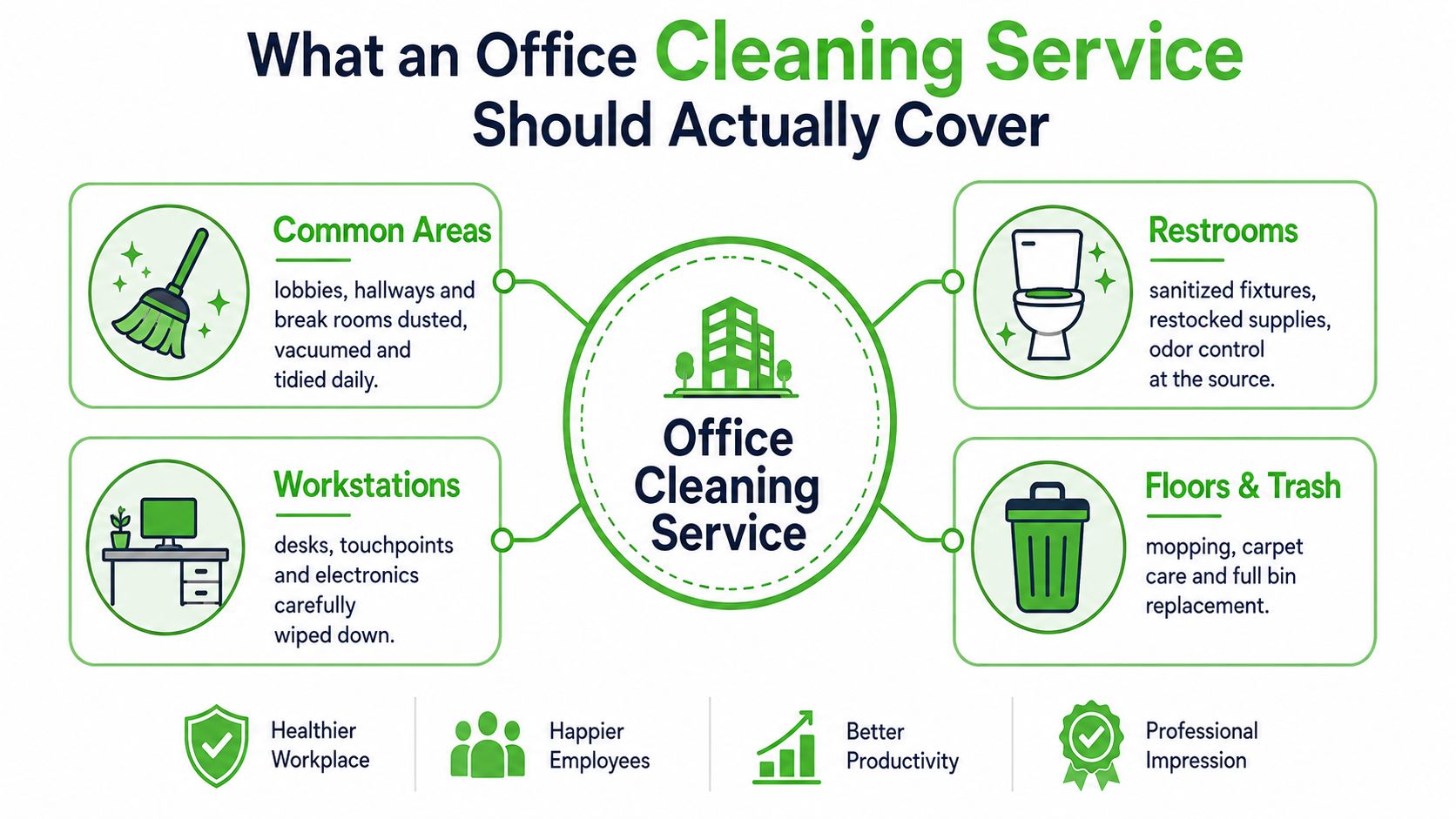
Many Dallas office managers start with a short list, vacuuming, trash removal, restroom cleaning, and dusting. Those tasks matter, but a complete office cleaning service should also address high-touch surfaces, break rooms, floors, supply replenishment, shared equipment, and inspection records. The scope should be written clearly enough that a manager can tell what happens during every visit and what requires a deeper or specialized appointment.
A recurring commercial program usually divides work into routine maintenance and periodic detail work. Routine visits keep common areas, restrooms, workstations, and waste stations under control. Deep cleaning can address buildup, neglected edges, detailed floor care, and areas that don't receive enough attention during a standard visit. Sanitizing cleaning should be specified separately, because it involves product selection, pre-cleaning, application method, and labeled contact time.
Build the scope around the building
A practical office checklist should identify:
- Common areas: Lobbies, hallways, conference rooms, elevators, and waiting areas need dusting, vacuuming, spot cleaning, and attention to door hardware.
- Workstations: Technicians should wipe appropriate desk surfaces, touchpoints, phones, shared keyboards when permitted, and nearby ledges without damaging electronics or personal items.
- Restrooms: The scope should include fixtures, partitions, sinks, floors, mirrors, soap, paper products, and odor control at the source.
- Break rooms: Sinks, counters, appliance exteriors, tables, cabinet fronts, floors, waste containers, and food spills deserve explicit attention.
- Floors and waste: Carpet vacuuming, hard-floor mopping, spot treatment, entryway care, and complete bin replacement should be assigned to a schedule.
A useful office cleaning duties checklist can help a manager compare proposals without relying on vague words such as “complete” or “sanitized.” Ask whether the provider uses standardized checklists, supervisor inspections, and a process for reporting inaccessible areas or damage.
The strongest proposal also states what happens after a spill, illness event, construction project, or unusually busy day. Gmaids provides office cleaning, commercial cleaning, post-construction cleaning, and sanitizing cleaning for Dallas–Fort Worth workplaces, with plans shaped around the facility rather than a generic room count.
How Workplace Safety Rules Shape Cleaning Schedules
An office can look orderly at closing and still fail a basic sanitation check by morning. Overflowing waste, empty soap dispensers, or a restroom left unusable during the workday create operational and health problems, not just cosmetic ones. OSHA's general-industry sanitation standard, 29 CFR 1910.141, requires places of employment to remain clean, waste to be removed often enough to prevent health hazards, and potable water to be available for drinking, washing, cooking, and cleaning utensils. The OSHA's sanitation standard is the governing reference.
A Dallas office does not need a fixed schedule copied from another building. A quiet private suite, crowded open-plan workplace, medical practice, and retail site produce different waste volumes and contact patterns. Set frequencies around occupancy, restroom and kitchen use, waste accumulation, and the surfaces people repeatedly touch.
The schedule should also account for indoor air quality. Sanitizing chemicals and fogging can introduce vapors or aerosols into occupied spaces, while closed, air-conditioned offices may recirculate those contaminants. Routine cleaning with low-odor or fragrance-free products can remove soil without adding perfume that merely covers an odor. Fogging should have a defined purpose, suitable product instructions, ventilation plan, and occupant-protection procedure. It should not replace source control, ordinary cleaning, or targeted disinfection.
Build the schedule around controls
A workable plan assigns each recurring duty to a time, person, and verification method. Waste removal may need daytime attention when food or restroom waste creates odors. Handwashing supplies require checks before they run out, not only during the evening visit. High-use areas may need a daytime response even when detailed cleaning is scheduled after hours.
Inspection records should show completed work, supply shortages, damage, inaccessible rooms, and follow-up actions. The provider should state how service changes after an illness event, renovation, spill, or unusually busy day.
After-hours service limits disruption, but it cannot cover a restroom that loses soap at noon. Contracts should separate scheduled cleaning, daytime response, periodic inspection, and event-based service so a manager can see what happens between regular visits.
Dallas's long cooling seasons make dust control, damp wiping, appropriate vacuuming, ventilation, and product selection relevant to occupant comfort and indoor air quality. Crews should follow label directions and product safety information, avoid improvised chemical combinations, and protect occupants and furnishings while working.
Practical rule: A credible schedule links every task to a space, frequency, responsible person, and verification method.
Cleaning Versus Disinfection and When Fogging Makes Sense
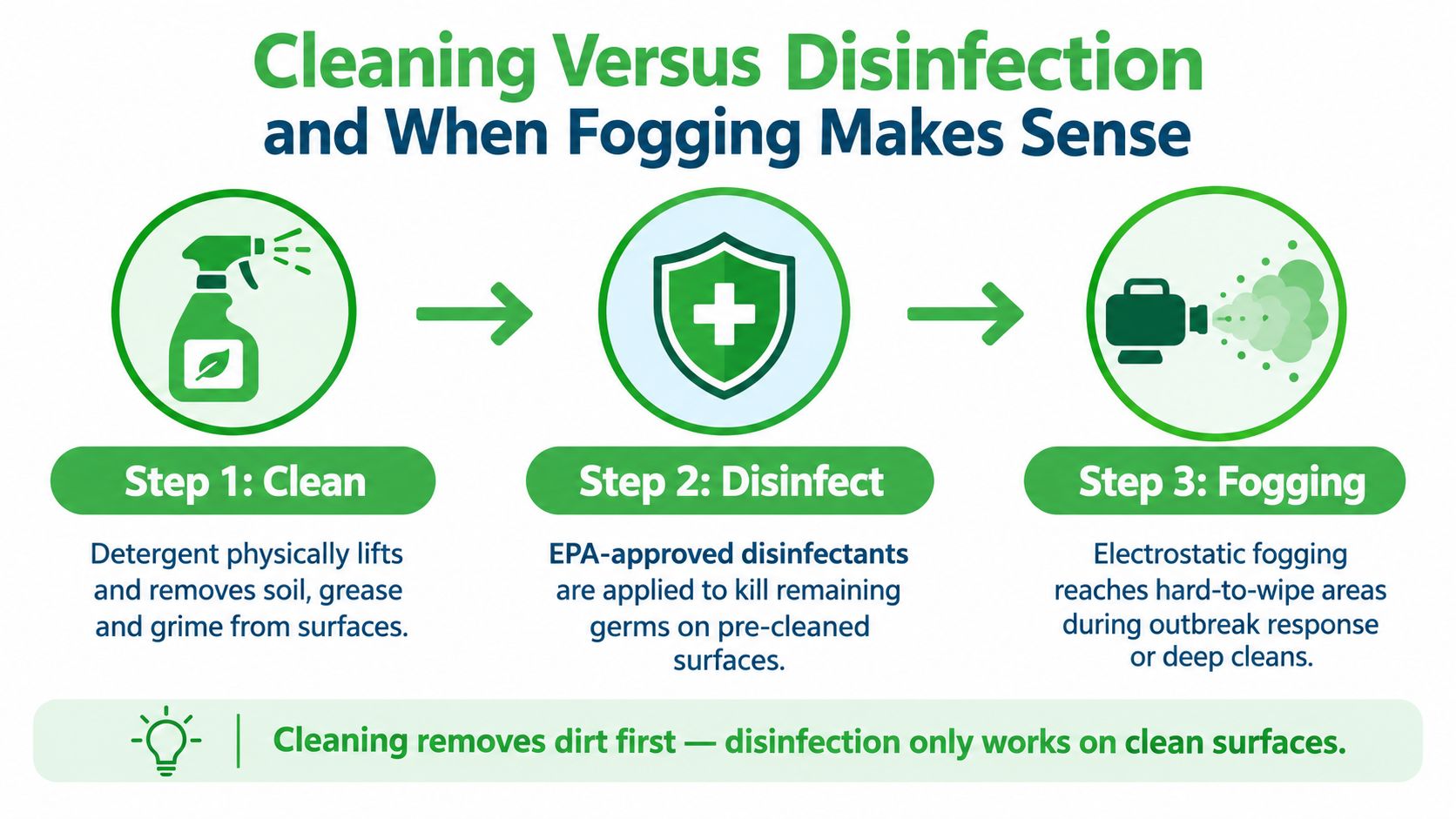
Cleaning and disinfection solve different problems. Cleaning with detergent and water physically removes soil, grease, and some microorganisms. Disinfection uses an appropriate product to inactivate remaining germs after the surface has been cleaned. Spraying disinfectant over visible grime isn't a shortcut. Soil can interfere with contact between the product and the surface.
CDC guidance on cleaning and disinfecting facilities recommends detergent and water for routine surface cleaning in ordinary offices, with stronger disinfection after illness events or in higher-risk areas. After application, the treated surface must remain visibly wet for the product's labeled contact time. A rapid spray-and-wipe routine can look efficient while failing to provide the exposure time the label requires.
Match the method to the risk
Routine cleaning is the baseline for desks, floors, counters, conference rooms, and ordinary shared spaces. It removes the soil employees notice and limits the buildup that makes later work harder.
Targeted disinfection makes more sense when a known illness event, higher-risk area, or frequently touched surface warrants additional risk reduction. Door handles, light switches, shared phones, faucets, and shared equipment should be mapped according to actual occupancy and use. The team should clean first, use a product authorized for the intended surface and pathogen, and document the required wet contact time.
Fogging is a specialized option, not a substitute for wiping. It may help reach difficult areas during a post-illness response or deep cleaning, but it doesn't remove grease, fingerprints, dust, or food residue. It also raises questions about product chemistry, ventilation, re-entry, occupied spaces, and whether the application is appropriate for the room and its contents.
Fogging can extend a cleaning protocol. It can't replace the cleaning protocol.
CDC guidance also supports a risk-based approach to surface care. Respiratory viruses commonly spread through respiratory droplets, so targeted surface work should sit alongside hand hygiene and ventilation rather than becoming a reason to fog an entire office routinely. Stronger chemistry isn't automatically better if it creates unnecessary exposure or fails to address the main pathway of concern.
If a provider promises that one quick fogging visit proves an office is “sanitized,” ask for the product label, application instructions, contact time, ventilation plan, and technician training. For a Dallas workplace, the more defensible approach is usually clean first, disinfect selectively, and reserve advanced application methods for a documented reason. Gmaids describes its sanitizing and fogging service as a specialized option rather than a replacement for routine cleaning.
Why Fragrance-Free Cleaning Protects Indoor Air Quality
A clean office shouldn't need to smell like chemicals. Fragrance-free means synthetic scents are left out entirely. It isn't the same as unscented, which can describe a product that has no obvious perfume but may still contain ingredients intended to suppress or alter odor. Masking a stale break-room smell with fragrance doesn't remove the food residue, dampness, or waste causing it.
EPA guidance on greener cleaning products identifies volatile organic compounds in cleaning products as a potential indoor-air-quality concern. EPA's Safer Choice program helps purchasers evaluate products whose ingredients meet criteria intended to protect human health and the environment, and EPA provides a fragrance-free designation for products formulated without fragrance.
Dallas offices need a source-control mindset
In a tightly sealed office, especially during long air-conditioning seasons, product emissions can remain part of the indoor environment after the technician leaves. A lower-VOC, fragrance-free approach doesn't mean ignoring hygiene. It means choosing plant-derived and mineral-based products where they suit the task, using the least aggressive effective method, improving ventilation when appropriate, and removing the source of odors rather than covering it.
That distinction matters for employees with asthma, allergies, chemical sensitivities, or strong reactions to scented products. It also matters in pet-friendly workplaces and homes where residues can remain on floors or low surfaces. Gmaids uses non-toxic, fragrance-free cleaning with plant-derived and mineral-based products, with no bleach, ammonia, or synthetic fragrance. The company's stated promise is “Healthy Homes, Families and Souls. We green clean without toxic chemicals.”
Product choice is only one part of indoor-air quality. Dust also comes from outdoors, construction residue, printing, copying, and equipment operation. EPA recommends practices such as damp dusting, suitable vacuum filtration, ventilation, and filter maintenance, so an office cleaning plan should coordinate with building management rather than claim that cleaning products alone control the entire air system.
For facilities teams reviewing the broader environment, an HVAC professional's resource on air duct cleaning can help clarify which concerns belong to ductwork and mechanical systems rather than to the cleaning crew. The important boundary is simple: cleaners should control soil, residues, and product selection, while building operators manage ventilation and HVAC maintenance.
A fragrance-free office cleaning service should leave surfaces clean, not perfumed. Ask to see product labels, confirm that “fragrance-free” is used accurately, and verify that technicians won't substitute scented products when an odor needs attention. Gmaids' green cleaning and non-toxic maid service reflects that source-control approach.
Daily Cleaning Versus After-Hours Service for Dallas Offices
A Dallas office can look orderly at 8 a.m. and need attention again before lunch. The right schedule follows headcount, operating hours, traffic, shared-space use, and how quickly dirt builds up, not a standard package.
Daytime service works well where spills, restroom demand, and kitchen use change throughout the workday. After-hours cleaning gives technicians clearer access to floors, conference rooms, workstations, and touchpoints without interrupting meetings or calls. The trade-off is that problems arising after the crew leaves may wait until the next visit.
Match the schedule to the workday
A busy open-plan office with frequent visitors may need daytime checks and detailed evening cleaning. A smaller professional suite may manage with one after-hours visit if restrooms, waste stations, and kitchen supplies remain usable until the next appointment. Medical practices and retail spaces need tighter timing because public access continues after routine cleaning begins.
Choose the service window by asking what must happen during occupancy and what can wait. Daytime staff can:
- respond to spills before they spread;
- replenish soap, paper, and other restroom supplies;
- remove kitchen messes near the time they occur;
- report leaks, damaged fixtures, or other maintenance concerns while employees are available.
After-hours work provides quieter access and a defined handoff before the next workday. It also requires written rules for keys, alarms, sensitive documents, patient information, and personal belongings. Consistent team assignments reduce access confusion, while a checklist should separate every-visit tasks from periodic detail work.
A split schedule can suit offices with heavy daytime use: a lighter daytime touchpoint handles immediate issues, followed by detailed after-hours cleaning. Managers comparing options can review after-hours service planning before setting service windows and access procedures.
Shared Spaces That Matter More Than Most Contracts Cover
A restroom can be technically cleaned and still feel unusable by midmorning. The same applies to a break room with a sour refrigerator, a sticky microwave handle, or an empty soap dispenser. Employees notice these shared areas quickly, and a polished lobby does not offset neglect where people eat, wash their hands, and dispose of waste.
A survey of 2,000 workers found that nearly one in five avoided workplace toilets because of poor hygiene, while 22 percent avoided office kitchens. About 60 percent said they felt more productive in a clean workspace. The survey coverage does not establish that cleaning alone causes productivity changes, but it shows why shared spaces need defined service levels.
Write the overlooked tasks into the contract
The specification should identify who handles:
- Kitchen care: Sinks, counters, tables, cabinet fronts, appliance exteriors, and visible food residue.
- Refrigerator and microwave work: Whether interiors are included and how abandoned food, spills, and odors are handled.
- Restroom readiness: Checks for fixtures, floors, partitions, mirrors, soap, and paper products.
- Waste thresholds: When bins are emptied and how staff handle food waste or leaking containers.
- Odor control: Removal of the source instead of covering it with synthetic fragrance.
- Response time: The process for spills, broken dispensers, and sanitation concerns reported between visits.
- Privacy: Protection for personal belongings, medical information, and shared areas in multi-tenant buildings.
A phrase such as “clean the break room” leaves too much room for interpretation. One office cleaning service may clean appliance interiors and check supplies, while another may wipe counters and remove only visible trash. Naming each task makes proposals easier to compare and gives the facility manager something measurable to inspect.
Dallas offices also need schedules based on actual use. Employee lunches, holiday hosting, pet-friendly policies, and busy professional teams create different pressure points. The provider should record recurring problem areas, assign responsibility, and give the manager a clear escalation route.
The standard is simple: employees should be able to use shared spaces without avoiding them, searching for supplies, or wondering whether a visible spill will remain until the next visit.
How to Choose a Reliable Dallas Office Cleaning Provider
Start with operations, not a polished promise. Ask the provider to show the service scope, product list, safety information, inspection process, access procedures, and response policy before you sign. A trustworthy office cleaning service can explain what technicians do, what they don't do, and how the plan changes after an illness event, move, renovation, or unusual occupancy period.
Use a verification checklist
- Training: Confirm that technicians receive documented instruction in chemical handling, restroom sanitation, floor care, equipment use, high-touch cleaning, waste procedures, and workplace safety.
- Screening and insurance: Ask whether the assigned team is background-checked and insured, especially when staff will work around confidential files or remain in the building after hours.
- Product standards: Verify whether “fragrance-free” means no synthetic fragrance and whether the provider avoids bleach and ammonia when the service is intended for sensitive workplaces.
- Disinfection process: Request the product label, authorized use, required wet contact time, ventilation instructions, and documentation process.
- Quality control: Look for standardized checklists, supervisor inspections, issue reporting, and a clear satisfaction policy.
- Local fit: Make sure the team understands Dallas conditions, including dust, long cooling seasons, new-construction residue in north-suburban offices, and the scheduling realities of busy workplaces.
- Scope clarity: Confirm whether restrooms, kitchens, appliances, high-touch points, floors, trash, supply checks, and periodic detail work are included.
The scale of the occupation reinforces why training matters. The Bureau of Labor Statistics reported approximately 2.4 million jobs for janitors and building cleaners in 2025, and on-the-job training was required for 87.8 percent of workers in that occupation in 2024. Those figures support a straightforward conclusion: cleaning is a substantial labor market with standardized operational skills, not an informal task that anyone can perform consistently without instruction.
Gmaids has served DFW since 2004. Its Certified Cleaning Teams® are trained, background-checked, and insured, and its commercial programs use fragrance-free, non-toxic products with flexible scheduling. The company also states that it serves more than 7,500 families, holds a 4.8-star Google rating, has been featured in Forbes and NBC 5 DFW, and offers a 24-hour satisfaction policy. Verify that any provider's claims match the written agreement and the team assigned to your building.
For a Dallas–Fort Worth office cleaning service that covers routine cleaning, commercial programs, sanitizing cleaning, and after-hours scheduling with fragrance-free products, request an instant, flat-rate quote from Gmaids or call 214-997-6918. Share your office type, occupancy pattern, shared-space concerns, and preferred schedule so the service can be matched to the way your workplace operates.


Ready for a healthier, cleaner home?