7 Cleaning Job Duties by Role and Type
A busy Dallas household may need the floors refreshed before a new workweek, the kitchen detailed before holiday guests arrive, or every room cleared of construction dust before moving into a North Dallas suburb. A workplace may need a reliable after-hours routine, while a family managing oak or cedar pollen wants more than a quick pass over visible surfaces. Cleaning job duties change with the setting, the service type, the occupants, and the risks present.
Thorough work can include routine maintenance, detailed room care, high-touch sanitizing, waste handling, chemical documentation, and post-construction residue removal. The U.S. Bureau of Labor Statistics describes cleaning work as including trash removal, floor care, restroom sanitation, surface disinfection, supply replenishment, hazard response, minor repairs, and building security, not just tidying. The occupation employed approximately 2.4 million people in the United States in 2025, according to the U.S. Bureau of Labor Statistics overview of janitors and building cleaners.
Gmaids has served Dallas-Fort Worth since 2004 with non-toxic, fragrance-free cleaning, no bleach or ammonia, and products based on plant-derived and mineral-based ingredients. Gmaids Certified Cleaning Teams® are trained, background-checked, and insured. Fragrance-free means synthetic scents are excluded completely. It is not just an “unscented” label that may still contain masking ingredients. The list below separates duties by real cleaning scenario and adds practical checks for scope, safety, products, and finished quality. For broader service comparisons, readers can also review best reviewed cleaners near you.
Table of Contents
1. Kitchen Deep Cleaning and Appliance Sanitization
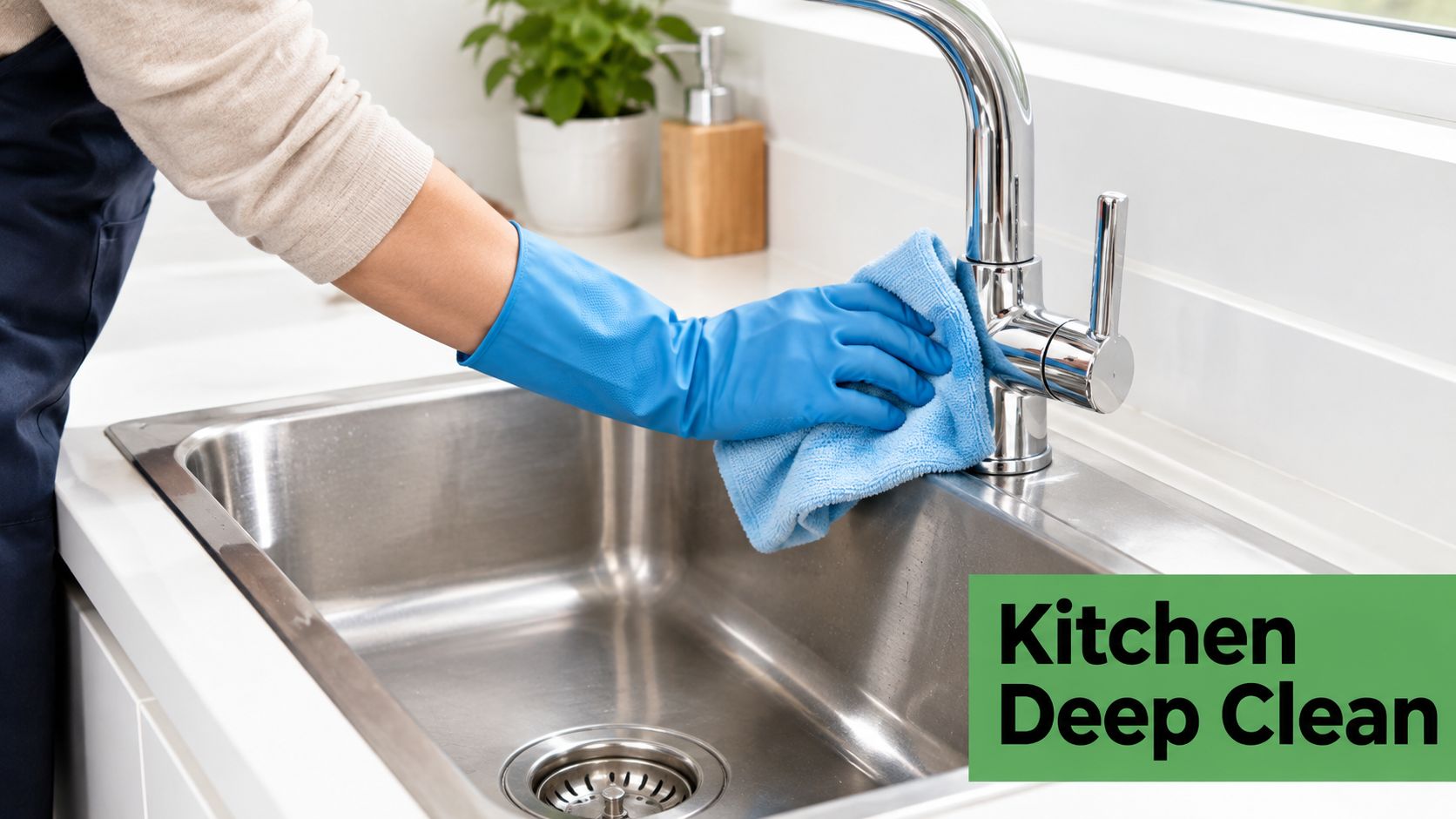
A kitchen can look tidy while grease film, food residue, and dust remain inside appliances, around cabinet edges, and behind small countertop equipment. A thorough kitchen assignment starts by identifying the surfaces that need routine cleaning and the areas that need a deeper reset. That may include stovetops, backsplashes, cabinet fronts and interiors, refrigerator shelves, oven interiors, sinks, faucets, walls, and hard-to-reach corners.
Gmaids teams use fragrance-free, plant-derived and mineral-based products rather than bleach, ammonia, or synthetic fragrance. The cleaner should match the product and tool to the surface, remove soil before applying a disinfectant where sanitizing is needed, and avoid leaving residue on food-contact areas. A polished faucet isn't the only quality marker. Clean shelves, handles, seals, drawer interiors, and the space around appliances matter just as much.
Where this duty fits
A Highland Park family preparing for holiday hosting may choose a full kitchen deep cleaning before guests arrive. In Frisco, a new-construction home may need post-construction kitchen cleaning before the first meal is prepared. A Dallas rental property may need a move-out service that includes the full kitchen before the next tenants arrive.
For a detailed explanation of room-by-room scope, see what deep cleaning includes.
Practical rule: A kitchen deep clean should document which appliance interiors, cabinet areas, and food-contact surfaces are included. “Kitchen cleaned” is too vague for a handoff or training checklist.
Schedule detailed kitchen work before major entertaining or a move. Recurring maid service, whether weekly, biweekly, or monthly, can maintain the result between deep cleans. Pet owners may also want regular attention to areas where dander settles, including appliance exteriors, lower cabinets, and nearby floor edges. A consistent team assignment helps cleaners learn the layout, materials, and appliance requirements in each Dallas home.
2. Bathroom Sanitization and Mold Prevention
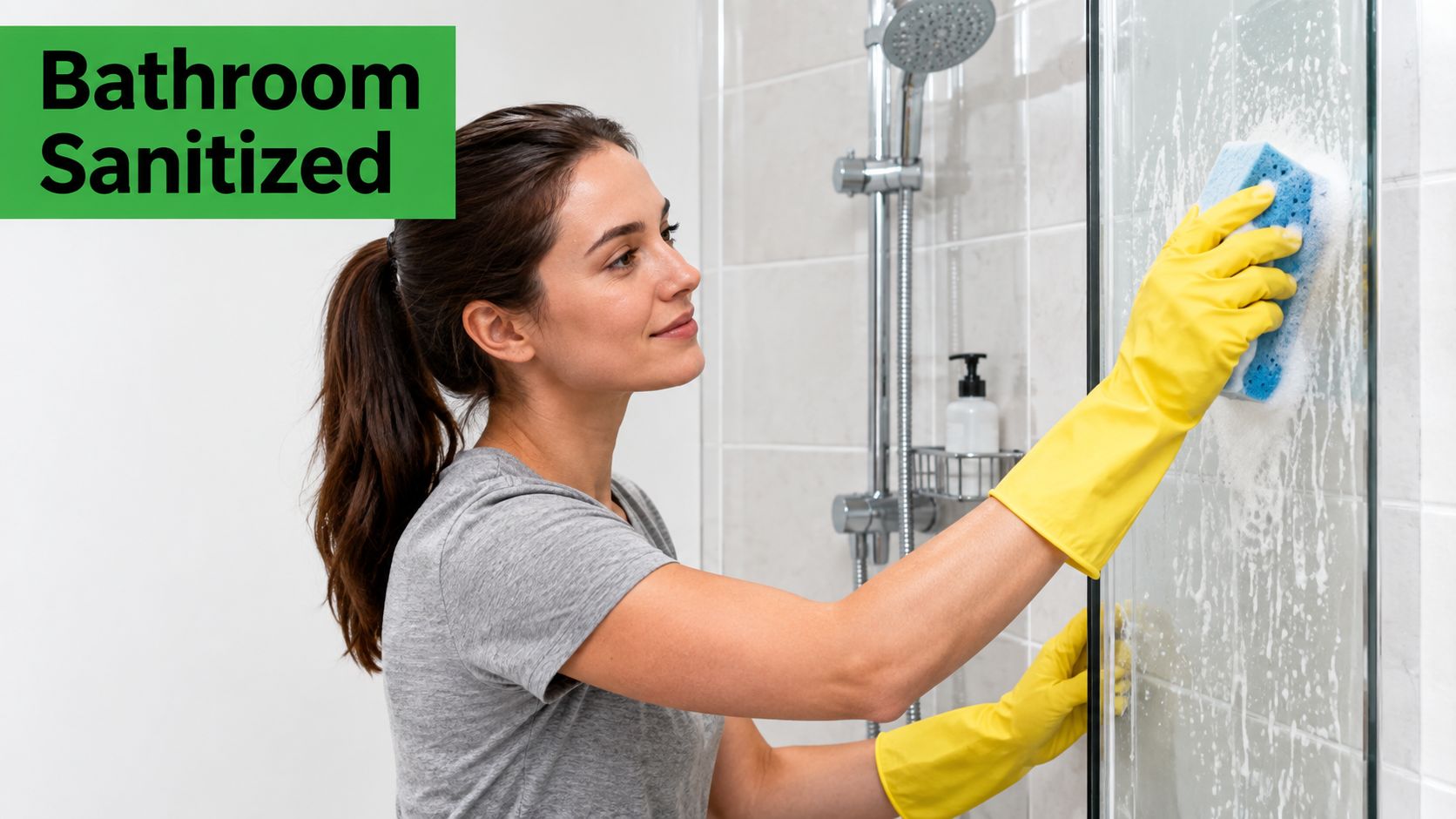
Bathroom work combines soil removal, moisture management, and careful attention to high-touch surfaces. A complete assignment may include toilets, sinks, faucets, mirrors, shower and tub interiors, tile, grout, cabinet fronts, floors, vents, doorknobs, and light switches. The cleaner should work from cleaner areas toward dirtier areas, use fresh tools by zone, and avoid spreading residue from the toilet area to surrounding surfaces.
Sanitizing requires more than spraying and immediately wiping. The EPA defines contact time as the period a disinfectant must remain on a surface to work, and the surface must stay visibly wet for the entire labeled period. If a product label requires 10 minutes for a particular pathogen but the surface dries after 5 minutes, the cleaner must reapply the product to achieve the full labeled contact time, as explained in the EPA guidance on registered disinfectants.
Moisture and high-touch checks
Dallas homes experience changing humidity, long air-conditioning seasons, and bathrooms with very different ventilation. An East Dallas family with a young child and pet may schedule biweekly bathroom sanitization, while a busy household may need more frequent attention in a high-use bathroom. University Park rental turnover, a Lake Highlands pre-sale clean, or a Prosper post-construction service may each require a different scope.
Cleaners should check whether exhaust fans operate properly and report signs of moisture, damaged caulk, or persistent discoloration rather than promising that cleaning alone will solve a building problem. Families can run an exhaust fan for at least 20 minutes after showers and ask for vent checks during service. For shower-specific maintenance, cleaning shower door tracks can prevent overlooked buildup in a narrow, moisture-prone area.
Gmaids uses fragrance-free products without bleach or ammonia. The aim is a clean bathroom with fewer harsh chemicals, not a strong scent that masks an odor. Monthly sanitizing may fit humid homes or heavily used bathrooms, while recurring maid service helps maintain grout and touchpoints between detailed visits.
3. Floor Care, Vacuuming, and Hard-Surface Cleaning
Floor care changes according to the material underfoot. Carpet, hardwood, tile, laminate, and grout each need a suitable vacuum setting, tool, moisture level, and cleaning product. A professional assignment may include vacuuming, sweeping, mopping, baseboard wiping, spot treatment, grout attention, and careful drying.
A Plano family with two dogs may need weekly attention to pet hair on hardwood and tile. A move-in cleaning in McKinney can include vacuuming, mopping, and grout cleaning throughout an empty property. An Addison household may schedule deeper floor care during oak pollen season, while an Irving property manager may request post-move-out service to restore floors before a new occupant arrives.
Match the method to the floor
HEPA-filter vacuuming can capture fine dust and debris instead of merely redistributing it. A pH-balanced, plant-derived floor cleaner can be selected according to the manufacturer's care requirements. Cleaners should avoid oversaturating wood or laminate, change mop water when it becomes dirty, and leave walkways dry enough to reduce slip risk.
Floors don't need a heavy fragrance to feel clean. They need the right amount of soil removal, controlled moisture, and a finish that doesn't leave a sticky film where children crawl or pets nap.
A practical household rhythm might include vacuuming high-traffic areas weekly during allergy seasons and mopping hard floors biweekly, with more frequent care for homes with pets or young children. Doormats and a shoes-off routine can reduce tracked-in dust. During new construction, floor cleaning should happen after the major dusty work is complete and before sensitive finishes or furnishings are installed.
Gmaids teams bring their own tools and fragrance-free products. Families should tell the team which floors are sealed, which areas receive direct sun, where pets sleep, and whether any surface has special care instructions. A consistent team assignment also supports flooring-specific knowledge, especially in homes with several materials.
For complementary plant needs around a property, homeowners can consult The Green Advantage plant care, while keeping interior floor duties with the appropriate cleaning specialist.
4. Dusting, Surface Cleaning, and Allergen Removal
Dusting is a capture task, not a decorative flourish. A cleaner should work systematically across furniture, shelves, baseboards, ceiling fans, light fixtures, décor, vents, and suitable electronics. Microfiber cloths can collect dust more effectively than tools that only flick particles into the air, especially when the cleaner follows dusting with vacuuming.
Dallas-Fort Worth homes may contend with outdoor dust, recirculated air, pet dander, and seasonal oak or cedar pollen. A Highland Park family might request weekly dusting during oak pollen season. A Westlake home with multiple pets may choose biweekly service, while a Bishop Arts client may rely on recurring visits to prevent buildup. A Preston Hollow move-in clean can include detailed dusting before furniture and personal belongings fill the rooms.
Build a room-by-room sequence
The cleaner should start at higher surfaces and move downward, giving settled dust a chance to land before floors are vacuumed. Vents, fan blades, and ledges deserve attention because air movement can distribute accumulated particles across a room. Electronics need suitable dry or lightly damp methods, and cleaners should never apply liquid directly to screens or openings.
A useful surface-care plan can include:
- Capture dust carefully: Use clean microfiber cloths rather than feather dusters that scatter particles.
- Prioritize high-set surfaces: Clean fan blades, tops of shelves, light fixtures, and door frames before lower furniture.
- Coordinate with floors: Vacuum and mop after dusting so loosened particles leave the room.
- Adjust for local conditions: Increase frequency when outdoor construction, landscaping, or pollen brings more dust indoors.
- Support the HVAC routine: Coordinate surface cleaning with filter changes and other HVAC maintenance.
Fragrance-free cleaning also matters in occupied spaces. The U.S. Access Board explains that janitorial products can emit volatile organic compounds and that fragrance exposure may create access barriers for people with asthma, allergies, migraines, or chemical sensitivities. The Access Board's indoor environmental quality guidance supports an ingredient-aware approach that removes soil rather than covering odors with synthetic scent.
5. Trash Removal, Recycling Organization, and Decluttering Support
Trash removal is one of the most visible cleaning job duties, but it also involves safe handling, clear instructions, and property protection. A team may empty full bags, replace liners, consolidate recycling, collect compost where the client has a system, and move approved donation or disposal items to a designated place. In an office, the scope may include desk-side bins, kitchen waste, restroom supplies, and shared break areas.
An Uptown family may include weekly trash removal in recurring maid service. A Lakewood move-in clean may involve removing leftover debris before rooms are furnished. Southlake post-construction work may require removal of packaging and dust-laden materials, while a Carrollton rental move-out may need coordinated trash removal before inspection.
Clarify what leaves the property
Cleaning teams shouldn't guess whether a box, bag, appliance, or personal item is intended for disposal. Clients should identify donation piles, recycling containers, compost rules, and anything that must remain. Batteries, bulbs, electronics, chemicals, sharps, and unknown containers may require special handling rather than placement in ordinary waste.
Handoff standard: Every waste task should answer three questions. What is being removed, where does it go, and who has approved that destination?
Basic decluttering support can make a cleaning visit more efficient, but it isn't the same as a full professional organizing project. A cleaner may consolidate loose items, clear a surface according to client instructions, or place belongings in an assigned basket. The client should provide direction before the visit when privacy, documents, medications, or valuable items are present.
Scheduling trash removal on the same day as full cleaning prevents bags and recyclables from accumulating. Weekly service may suit homes with high waste volumes, busy professional families, or frequent pet-related waste. Office and commercial clients should document building rules for loading areas, recycling, and shared dumpsters so every team member follows the same process.
6. Bedrooms and Living Areas Dusting Vacuuming and Pet-Hair Management
Bedrooms and living rooms require a quieter, detail-focused approach because people sleep, relax, work, and spend time with pets in these spaces. The routine may include dusting furniture and fixtures, vacuuming carpets and rugs, cleaning under accessible furniture, removing pet hair from upholstery, emptying wastebaskets, and making beds when requested. Spot treatment should follow the fabric or surface instructions rather than relying on a one-product-fits-all method.
A Lake Highlands family with a dog may schedule weekly bedroom vacuuming and dusting. A Frisco move-in cleaning can include carpet vacuuming and vent dusting before beds are assembled. A Plano parent may request biweekly service for a child's bedroom, while a Richardson recurring client may include weekly bedroom care in a standing plan.
Prioritize where people and pets spend time
Teams should ask where pets sleep, which furniture they use, and whether any rooms have delicate finishes. HEPA-filter vacuuming can help capture fine debris, while fragrance-free products avoid introducing synthetic scents near sleeping areas. Gmaids uses plant-derived and mineral-based products without bleach, ammonia, or synthetic fragrance, which fits households that want fewer harsh chemicals around children, pets, and sensitive occupants.
A bedroom service can also include optional bed-linen changes, light organization of nightstands, closet tidying within the agreed scope, and cleaning around furniture that can be moved safely. The cleaner should report signs of moisture, unusual staining, pest activity, or damage instead of treating an unknown problem casually. Cleaning removes soil and hair, but it doesn't replace a pest, HVAC, upholstery, or building inspection.
During Dallas allergy seasons, families may increase bedroom cleaning frequency and wash pet bedding according to its care label. Appointment timing matters too. A household can request service when children are at school, adults are working elsewhere, or pets can stay in a separate room. The best plan balances thoroughness with minimal disruption to sleep and daily routines.
7. Post-Construction and Move-In Cleaning Dust Debris and Residue Removal
Post-construction cleaning begins after the major work is finished, but the property still contains fine dust, packaging, adhesive residue, paint spots, and particles that routine maintenance won't address. New-construction homes in Celina, Southlake, and other North Dallas suburbs may need cleaning before families unpack. A Highland Park renovation may require a final reset after contractors leave, while an Addison townhome being resold may need detailed cleaning before a showing or handoff.
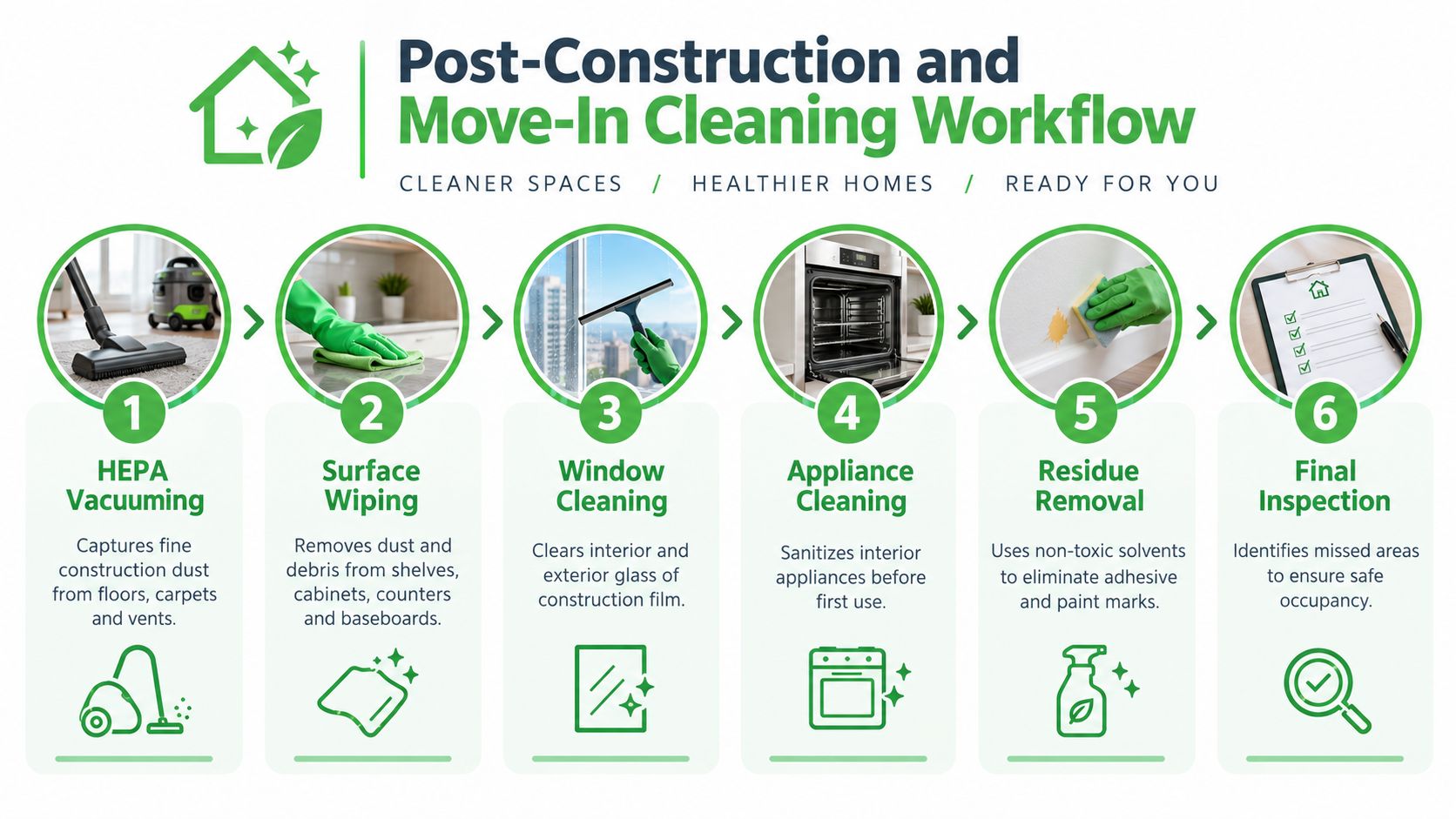
The team should confirm that construction crews have completed their work and that the property is ready for cleaners to enter. The scope may include HEPA vacuuming, careful residue removal, interior and exterior windows, appliance interiors, cabinets, drawers, closets, vents, HVAC intakes, floors, and a final walk-through. Adhesive, paint, and finish residue should be approached with a product and tool that won't damage the underlying surface.
Use a staged inspection
Fine particles can settle again after an initial pass, so cleaners should work from higher surfaces to lower ones, clean ventilation-related areas carefully, and inspect corners, ledges, cabinet interiors, and appliance seals. Homeowners should coordinate HVAC cleaning or filter replacement with the builder before occupancy. This is especially useful when renovation or construction dust has entered return-air areas.
The post-construction cleaning guide can help property owners understand why this service differs from a basic cleaning visit. Gmaids teams use their own tools and non-toxic products, and clients can request a walk-through to identify priority areas. A written completion record can also support a real estate handoff, property-management file, or warranty conversation.
Construction cleaning isn't finished when the counters look shiny. It is finished when the team has checked the dust paths, residue points, appliance interiors, windows, floors, and ventilation-related areas included in the agreed scope.
A move-in or move-out cleaning may also include inside the fridge, oven, cabinets, drawers, and closets. Those areas are easy to miss when furniture is present, so an empty property offers the best opportunity for detailed work. Schedule the service before personal belongings arrive and after all major dusty trades have completed their work.
7-Point Cleaning Duties Comparison
| Service | Complexity 🔄 | Resources & Training ⚡ | Expected Outcomes 📊 ⭐ | Ideal Use Cases | Key Advantages 💡 |
|---|---|---|---|---|---|
| Kitchen Deep Cleaning and Appliance Sanitization | High, detailed appliance interiors; risk to seals/finishes 🔄🔄🔄 | Specialized non-toxic degreasers, appliance-safe tools, trained technicians; longer duration ⚡ (slower) | Deep grease removal, improved indoor air quality, extended appliance lifespan 📊 ⭐⭐⭐ | Holiday hosting, move-in/move-out, post-construction, recurring deep plans | Non-toxic methods; safer for kids/pets; preserves appliances |
| Bathroom Sanitization and Mold Prevention | Moderate–High, moisture control and grout care 🔄🔄 | EPA-approved botanical disinfectants, grout tools, vent access; humidity-aware techniques ⚡ | Reduced mold/mildew, safer surfaces, improved air quality 📊 ⭐⭐⭐ | Humid bathrooms, allergy/asthma households, post-construction, rental turnover | Mold prevention, non-toxic sanitizers, protects grout/finishes |
| Floor Care, Vacuuming, and Hard-Surface Cleaning | Moderate, multiple floor types and drying techniques 🔄🔄 | HEPA vacuums, pH‑balanced cleaners, mops, grout tools; flooring-specific training ⚡ (efficient with teams) | Allergen reduction, preserved finishes, cleaner carpets and hard floors 📊 ⭐⭐⭐ | Weekly maintenance, pet homes, post-move, allergy seasons | HEPA capture, non-toxic cleaners, extends floor life |
| Dusting, Surface Cleaning, and Allergen Removal | Moderate, careful technique to avoid redistributing dust 🔄🔄 | Microfiber cloths, allergen-capture tools, vent cleaning methods; timing for pollen seasons ⚡ (fast for routine) | Lower indoor allergens, protected finishes/electronics 📊 ⭐⭐ | Peak pollen months, pet households, recurring maid service, pre-sale touch-ups | Fragrance-free approach, captures rather than redistributes dust |
| Trash Removal, Recycling Organization, and Decluttering Support | Low, procedurally straightforward but volume-dependent 🔄 | Bins/liners, knowledge of local DFW recycling rules, organization supplies; minimal training ⚡ (quick) | Reduced odor/clutter, correct recycling, streamlined move-ins/outs 📊 ⭐⭐ | Weekly maid service, move-in/move-out, post-construction debris management | Saves time, reduces pests, proper local recycling compliance |
| Bedrooms & Living Areas, Dusting, Vacuuming, Pet-Hair Management | Moderate, privacy/access coordination and pet considerations 🔄🔄 | HEPA vacuums, pet-hair tools, dusting supplies, optional linen change protocols ⚡ (efficient with checklist) | Allergen-reduced sleep/living spaces, pet-hair removal, improved comfort 📊 ⭐⭐⭐ | Homes with pets/allergies, weekly/biweekly routines, move-ins | HEPA filtration, non-toxic treatments, safer sleep environments |
| Post-Construction & Move-In Cleaning, Dust, Debris, Residue Removal | High, fine construction dust and timing coordination 🔄🔄🔄 | HEPA vacuums, non-toxic residue solvents, window tools, post-project inspection; skilled crews ⚡ (multiple passes may be needed) | Safe occupancy, removal of fine dust/adhesives, protected finishes/equipment 📊 ⭐⭐⭐ | New construction, renovations, move-in turnovers, real-estate prep | Thorough dust control, appliance protection, documented completion |
Turn Cleaning Duties Into a Reliable Checklist
A strong cleaning plan begins with scope, not a vague promise to “make it clean.” Hiring managers should identify the rooms, surfaces, appliances, waste streams, high-touch points, and special materials included in the assignment. Families should explain where children crawl, where pets sleep, which rooms receive heavy traffic, and whether anyone needs fragrance-free products. Office and commercial managers should document shared equipment, after-hours access, restroom expectations, supply replenishment, and handoff procedures.
Frequency should match the environment. A pet-friendly home may need more floor and upholstery attention than a lightly occupied guest space. A Dallas home may need more dusting during oak or cedar pollen seasons. A busy office may need recurring restroom, kitchen, touchpoint, and trash duties, while a new Frisco or Celina home may first need post-construction cleaning before routine maintenance begins.
Product requirements deserve their own check. Gmaids uses non-toxic, fragrance-free, plant-derived and mineral-based products, with no bleach, ammonia, or synthetic fragrance. Fragrance-free isn't the same as unscented, and a strong scent isn't proof of better cleaning. The U.S. EPA notes that air fresheners, cleaning products, and pine or citrus fragrances can react with indoor ozone to form particulate matter and formaldehyde. Its indoor particulate matter guidance recommends ventilation, such as opening windows or doors or using an exhaust fan, when these products are used.
A qualified cleaner also needs safety training. The CDC's National Institute for Occupational Safety and Health identifies lifting, repetitive movement, chemical exposure, body fluids, infectious materials, and work outside standard daytime hours among the demands that can shape custodial work. Its cleaning and custodial services safety information supports task-specific training, protective equipment, ventilation, safe lifting, and clear protocols. OSHA's Hazard Communication Standard adds practical duties for employers using hazardous chemicals, including a written program, accessible safety data sheets, labeled containers, and training before first exposure or when a new hazard is introduced.
Quality control should be visible. A checklist can record completed rooms, exceptions, damaged surfaces, items requiring client direction, and tasks that need correction. For high-touch work, the CDC describes fluorescent-marker audits using surfaces such as bed rails, doorknobs, light switches, and bathroom fixtures. In one discharge-cleaning study, approximately half of high-touch surfaces were missed, which shows why visual inspection alone isn't a dependable measure. The CDC environmental cleaning and disinfection resource supports room-specific lists, sequence control, fresh cloths, required wet contact time, and periodic validation.
Gmaids Certified Cleaning Teams® use standardized checklists and regular inspections, bring their own tools and products, and support basic cleaning, deep cleaning, move-in/move-out cleaning, post-construction cleaning, office cleaning, commercial cleaning, sanitizing cleaning, and recurring maid service. Services are available across Dallas-Fort Worth, including Dallas neighborhoods such as Uptown, Preston Hollow, Highland Park, University Park, Lakewood, East Dallas, Lake Highlands, M Streets, Bluffview, Kessler Park, and Bishop Arts/Oak Cliff, as well as Plano, Frisco, McKinney, Allen, Southlake, Grapevine, and Irving.
Gmaids was founded by Juan Chaparro and Karen La Spina and has served DFW since 2004. The company reports serving 7,500+ families, holds a 4.8-star Google rating, and has been featured in Forbes and on NBC 5 DFW. Its promise is “Healthy Homes, Families and Souls. We green clean without toxic chemicals.” That means fewer harsh chemicals and no synthetic fragrance, not a medical promise or a guarantee that every sensitive person will respond the same way. If something isn't right, Gmaids offers a 24-hour satisfaction policy. Let the team know within 24 hours, and it will work to make it right.
For teams evaluating scheduling and operational workflows, compare cleaning software features and ROI, but don't let software replace hands-on inspection. The most reliable service still depends on clear duties, trained people, suitable products, documented exceptions, and a final check against the actual property.
Gmaids offers fragrance-free basic, deep, move-in/move-out, post-construction, office, commercial, sanitizing, and recurring maid service across Dallas-Fort Worth. Get an instant, flat-rate quote online at Gmaids or call 214-997-6918 to match the cleaning job duties to your home, workplace, move, or renovation handoff.


Ready for a healthier, cleaner home?