Deep Cleaning Oven the Non-Toxic Way
You know the smell. The oven door opens the night before guests arrive, and a warm wave of old grease, yesterday's roast, and something slightly burnt drifts out into a Dallas kitchen that's already working overtime. In a home in Plano, Frisco, or anywhere across Dallas, that moment usually means the same thing, this oven hasn't just gotten messy, it's turned into an indoor-air and flavor problem that's been building for months.
Deep cleaning an oven isn't really about making metal shine. It's about removing baked-on grease before it smokes, deciding whether a self-clean cycle is safe for your home, and making sure what's left behind won't end up in your food or your air. For families juggling school nights, holiday hosting, and Texas AC that keeps windows shut for months, that choice matters before anyone starts scrubbing.
If you want a big-picture sense of where appliance-heavy deep cleaning fits into home care, Renue Systems Four Points deep cleaning gives a useful view of how detailed cleaning gets handled in larger properties too. The same principle applies in a house, attention to hidden residue matters more than a quick wipe.
Table of Contents
- Racks need soaking, not brute force
- The glass door needs a separate pass
- The seal, vents, and exterior need restraint
The Oven You Haven't Opened Since Last Thanksgiving
The first clue is usually visual, a dark ring on the oven floor, sticky spots on the door glass, and racks that look fine until you touch them. The second clue is the smell. Open the door and you get a reminder that grease doesn't disappear, it cooks, cools, and hardens into a layer that keeps waiting for the next heat cycle.
In Dallas homes, that buildup often happens because the kitchen stays closed up during long AC seasons. Busy families in Lakewood, Preston Hollow, or Frisco keep cooking, baking, and reheating, but the oven doesn't get the kind of routine attention that counters or stovetops do. By the time the holidays roll around, what looked like “a little residue” has become a deeper cleaning job.
Practical rule: if the oven smells greasy before it's on, it's already past the point where a fast wipe is enough.
For a cleaning company, that's why deep oven work sits in the same category as move-in/move-out service and detailed kitchen cleaning. National appliance data from the U.S. Energy Information Administration shows how common and varied oven setups are, with separate wall ovens in millions of U.S. homes and multiple-wall-oven layouts in a smaller but still significant share of those homes, which means the job isn't one-size-fits-all. That variation is one reason a serious oven cleaning has to account for racks, seals, sidewalls, doors, and hidden grease pockets, not just the floor.
The question is simple. Do you want to use the oven's high-heat cleaning cycle, or do you want a fragrance-free manual clean that gives you more control over fumes and residue? The right answer depends on the household, the model, and what's already baked onto the inside.
Why the Self-Clean Button Is Not the Easy Answer
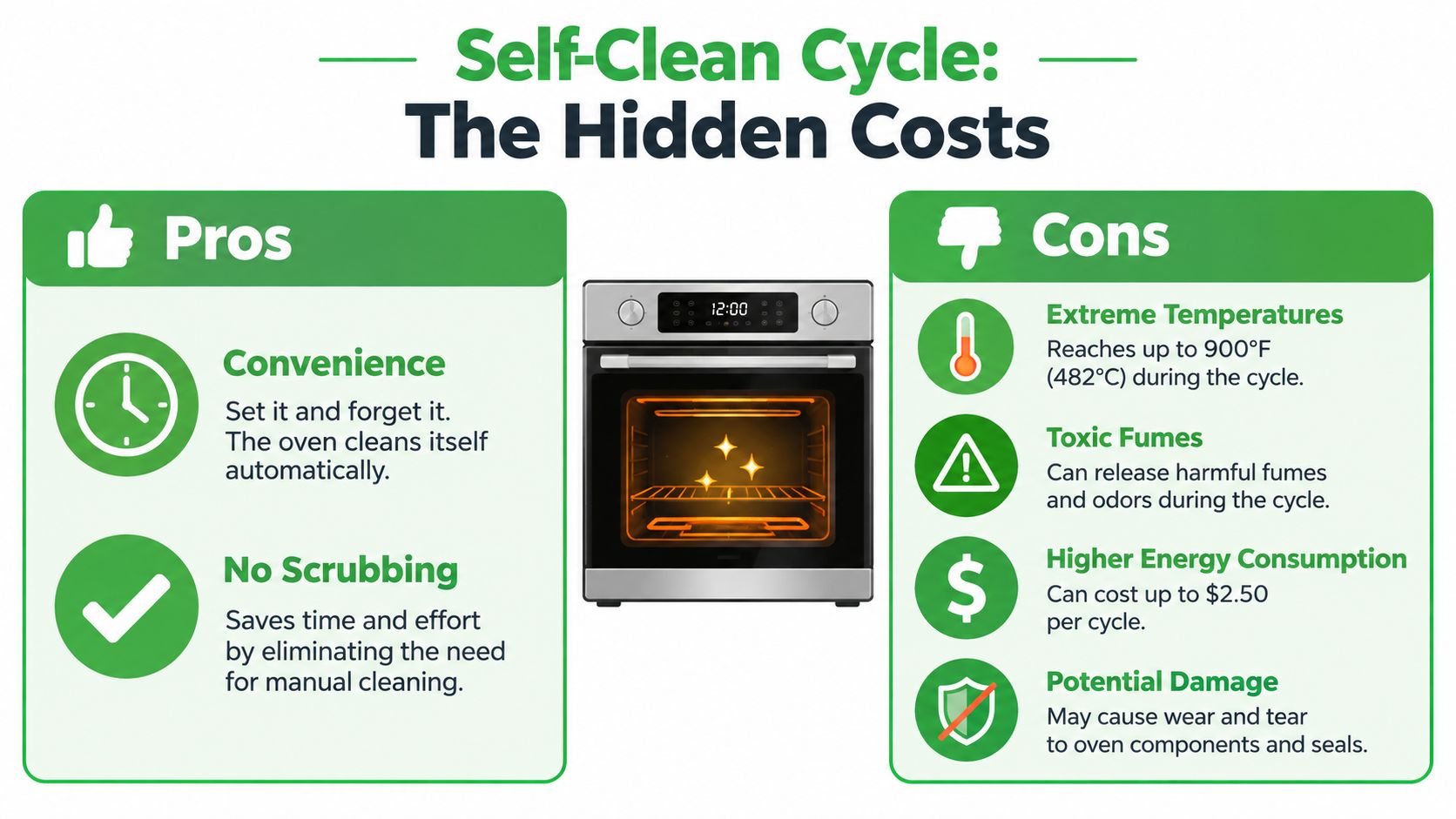
The self-clean button looks convenient because it promises less effort, but the trade-off is heat, smoke, and indoor air. During pyrolytic self-cleaning, manufacturer documentation reports cavity temperatures around 885°F (470°C), and some systems keep the door locked until the interior falls below about 535°F (280°C). That's not normal cooking heat. It's a thermal burn-off process, and it behaves like one.
Independent indoor-air research found oven cleaning could push airborne particle levels as high as 3,600 micrograms per cubic meter, well above California's 50 micrograms per cubic meter 24-hour ambient standard, and gas-oven cleaning generated nitrogen dioxide levels up to 400 parts per billion. The California Air Resources Board says the cycle should be used only when the home is unoccupied and well ventilated, especially during the first one to two hours. In other words, the “easy” button is only easy if the house can safely clear the air.
When the self-clean cycle is the wrong call
A high-heat cycle is a poor fit in homes with birds, children, respiratory sensitivities, or weak ventilation. It's also awkward in apartments and many new-construction homes in Celina or Prosper, where HVAC systems can be tight and the kitchen doesn't clear out quickly.
The manufacturer rules are strict for a reason. GE's safety guidance says the oven should be completely cool before the cycle starts, the gasket shouldn't be rubbed or damaged, and commercial oven cleaner or liner coatings shouldn't be used around the oven. A Costco-use and care guide also warns that heavy grease can ignite and cause smoke or flare-ups, and that the kitchen should be ventilated. One Maytag manual goes further and prohibits oven cleaners around self-clean ovens.
If the oven already has heavy puddled grease, the self-clean cycle can turn a cleaning job into a smoke problem.
For Dallas households that cook a lot during long AC seasons, the key question isn't which method sounds tougher. It's which method leaves the kitchen safer to re-enter and the oven safer to use again. That's why self-cleaning is a specialized tool, not the default answer.
A Fragrance-Free Manual Deep Clean That Actually Works
Start with the manual, not the sponge. Check whether your oven has catalytic liners, exposed heating elements, gas components, or a self-cleaning coating, because chemical cleaners are not universally compatible. Consumer Reports specifically recommends checking the manual first and points to dish soap, baking soda, diluted vinegar, and lemon juice as generally safer household alternatives, while warning against using the self-clean cycle together with cleaning materials.
What to do first
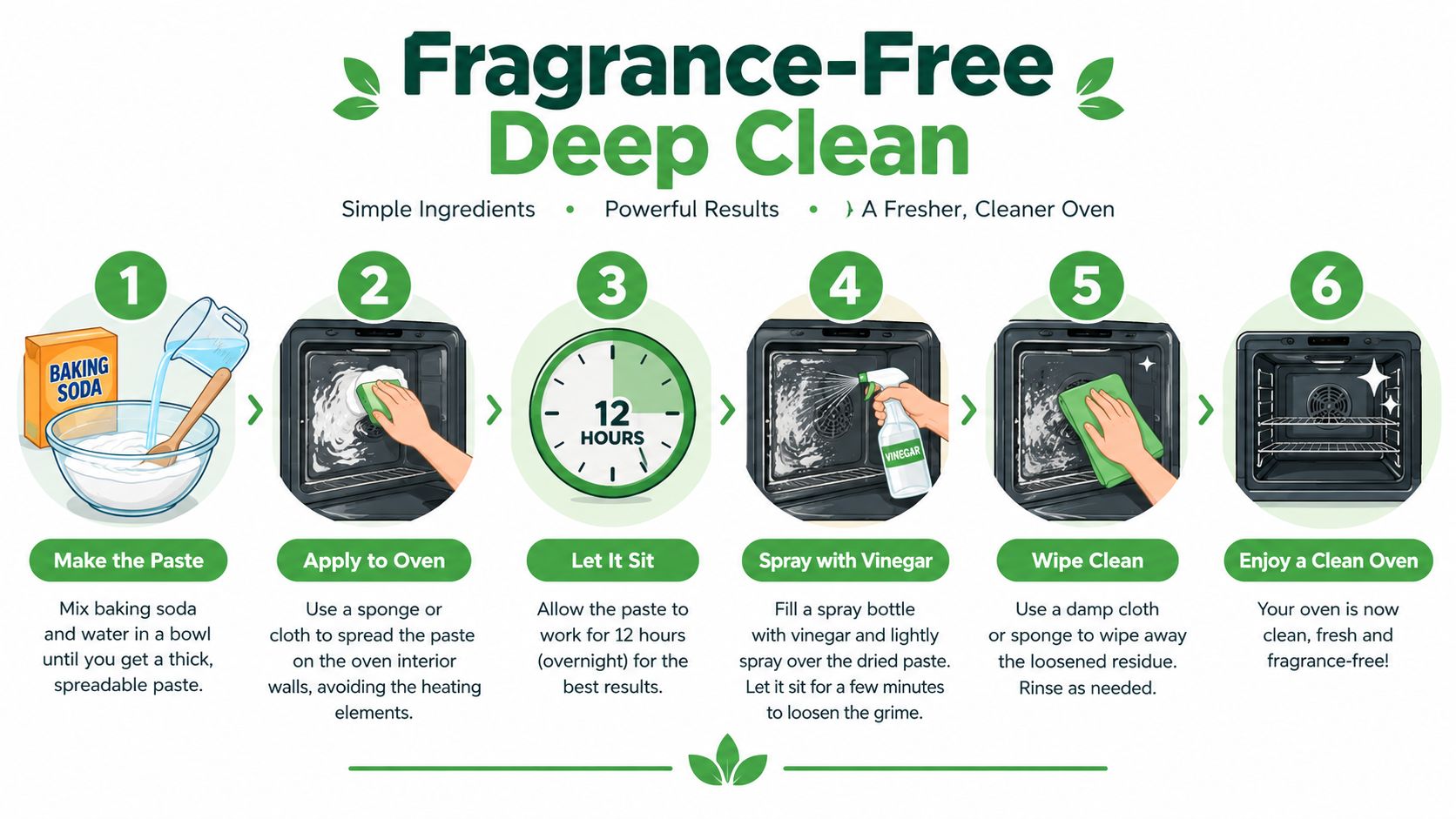
Remove racks, trays, thermometers, and anything loose. Wipe out pooled grease and vacuum or brush out crumbs before you add any paste, because loose debris just turns into sludge once it gets wet. If the cavity is cool and the manual allows it, protect the surrounding area and work in a ventilated kitchen.
For the cavity itself, mix baking soda and water into a spreadable paste and apply it to cooled enamel surfaces. Let it sit for several hours or overnight, then lightly mist with diluted white vinegar or lemon solution and wipe it away with repeated damp-cloth passes. The paste softens carbonized grease, it doesn't magically erase every deposit, so expect a second pass on stubborn spots.
What never gets coated
- Heating elements: leave them clean and dry.
- Door gaskets: don't scrub, soak, or coat them.
- Vents and probes: keep them clear so the oven can breathe and read temperature correctly.
- Unsealed seams: don't force liquid into gaps.
- Gas components: keep all cleaners away unless the manual clearly allows contact.
Here's the part many people skip. Finish only when the rinse cloth comes back clean and the surface no longer feels chalky or sticky. Residual cleaner can smoke or smell when the oven heats back up, and that's the opposite of a food-safe finish.
If you want a plain-language walk-through of a natural approach, clean oven with baking soda is a helpful companion reference. For a fuller picture of what a deeper service can include, the internal guide at what deep cleaning includes helps show where oven work fits into the larger kitchen reset.
Tackling Racks, the Glass Door, and the Seal
The oven cavity is only part of the job. Racks, glass, and seals collect their own kind of mess, and each one needs a slightly different touch. If you try to treat every surface the same way, you usually end up with streaks, residue, or a gasket that's worse than before.
Racks need soaking, not brute force
Oven racks clean up better when they're taken out and soaked in warm water with dish soap and baking soda. A bathtub or large basin works well because baked-on carbon usually needs dwell time before any scrubbing makes a difference. For the last bits, use a non-abrasive pad first, then only move to something more assertive if the rack material allows it.
The glass door needs a separate pass
Door glass often looks cleaner than it is. A thin paste and a soft or non-abrasive pad work better than aggressive scrubbing, especially on the inside pane where residue tends to cling. If your manual clearly allows removing the door or opening the glass assembly, fine, but if it doesn't, don't improvise. Broken glass and misaligned hardware turn a cleaning job into a repair call fast.
The seal, vents, and exterior need restraint
The gasket should be wiped gently, not soaked. Vents should stay open and clear, because trapped residue can interfere with airflow or leave odors behind. On stainless or enamel exteriors, use a fragrance-free cleaner that matches the finish and skip ammonia-based glass sprays and anything scented. That matters in homes with crawlers, pets, or allergy-sensitive family members, where masking fragrance just adds another layer of indoor air you don't want.
In Dallas, that fragrance-free approach fits the same logic people use for floors where babies crawl and pets nap, fewer harsh chemicals in the room means fewer unknowns on the surfaces people touch every day. It's the same reason a careful oven clean should feel calm, not chemical.
Self-Clean or Manual A Side-by-Side Decision
The easiest way to choose is to look at the household first and the oven second. If the house is empty, the ventilation is strong, and nobody in the home is sensitive to smoke, the self-clean cycle can make sense for some models. If the kitchen is occupied, the oven has heavy grease, or the home includes pets, kids, or fragrance-sensitive adults, the manual route is usually the better fit.
| Factor | Self-Clean Cycle | Fragrance-Free Manual |
|---|---|---|
| Best fit | Empty home with strong ventilation | Rentals, occupied homes, sensitive households |
| Indoor-air impact | High heat, smoke, and odor risk | Lower odor when done with ventilation |
| Time required | Hands-off during the cycle, but cooling takes time | More hands-on, but more controlled |
| Residue risk | Ash still needs removal, and some spots may remain | Better for targeted residue removal |
| Ideal household type | Homes that can leave the kitchen unused | Dallas families, renters, pet owners, and people who want fragrance-free cleaning |
The hybrid approach can work too. Some homeowners run a self-clean cycle on a lightly soiled oven, then do a manual spot clean afterward on the glass, racks, or edges the cycle missed. That makes sense only if the manual allows it and the oven isn't already loaded with grease. For a deeper overview of service scope, the internal guide at deep cleaning vs regular cleaning helps show why this job belongs in a deeper-clean category, not routine upkeep.
The safest choice is the one that fits your house, not the one that sounds most powerful.
For Dallas and nearby places like Lakewood, Addison, or Southlake, that usually means choosing the path that protects indoor air first, then deals with the grime second.
The Pre-Cook Safety Check Most People Skip
The cleaning isn't finished when the wipe-down ends. The biggest risk comes from what gets left behind, because oven-cleaner exposures often happen when residue isn't fully removed before the next use. Poison Control classifies oven and grill cleaners as usually highly caustic, and mixing household cleaners can create toxic fumes. That's why “looks clean” is not the same as “ready to cook.”
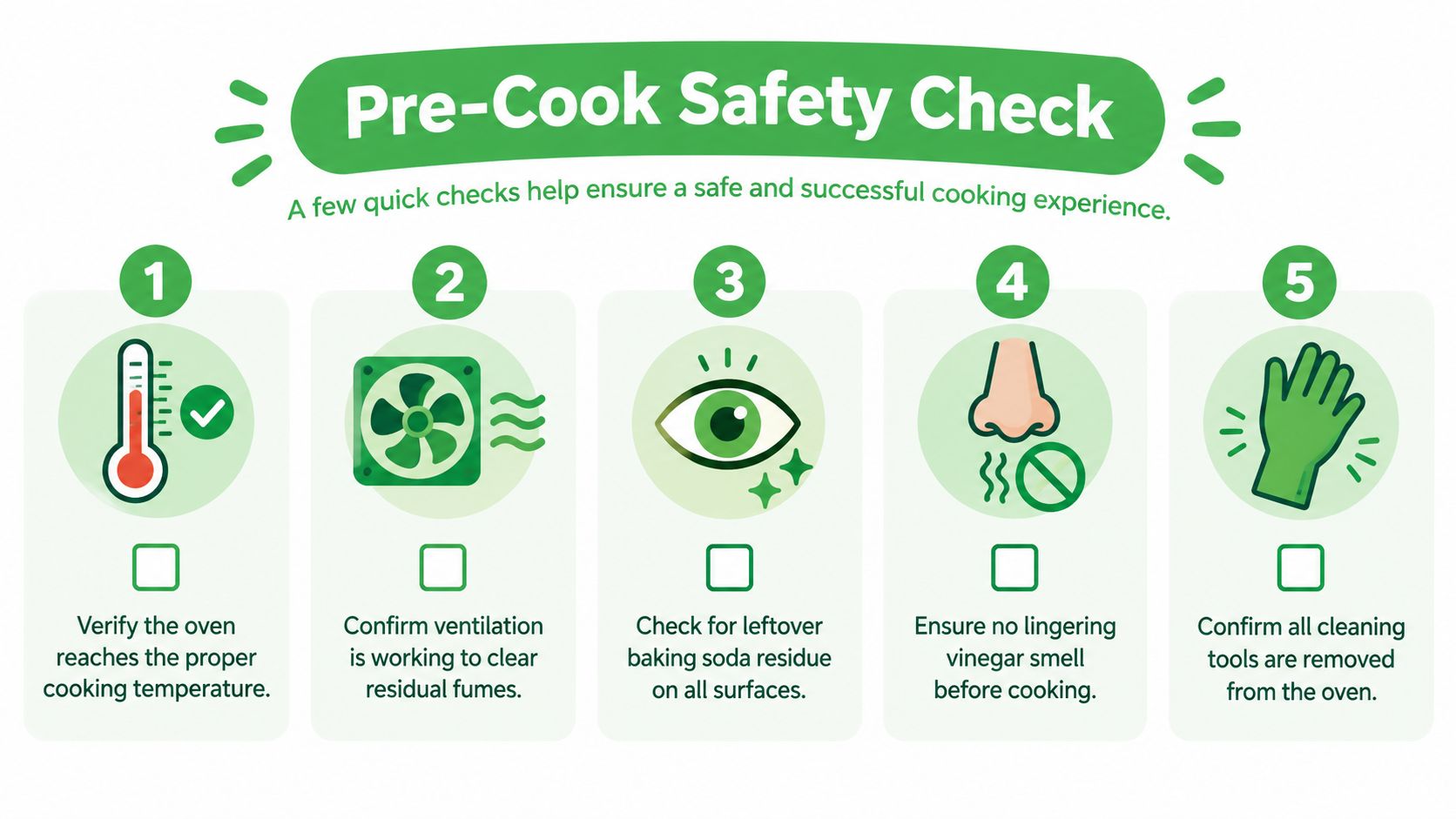
The four checks that matter
- No visible film. Wipe a white cloth along the surface. If it picks up chalky paste or greasy streaks, keep rinsing.
- No chemical odor. A faint vinegar note can fade, but a cleaner smell shouldn't linger.
- No smoke on a controlled warm-up. Heat the oven empty at a low setting with ventilation on. Any smoke means more residue is still there.
- No irritation. If eyes, throat, or skin react, stop and ventilate immediately.
Fragrance-free, odor-free, and residue-free are three different things. An oven can smell neutral and still hold cleaner in a corner seam, and it can look shiny while the gasket still traps residue. That's why the final pass matters as much as the scrubbing.
Never mix bleach, ammonia, acids, or commercial oven cleaners in the same session, and never start a self-clean cycle after applying a chemical product unless the manual explicitly allows it. The safest finishing move is simple: clean, rinse, ventilate, warm it gently, and only cook once the oven stays neutral through all four checks.
When to Hand the Job to a Dallas–Fort Worth Team
Some ovens are fine for a weekend project. Others are the kind of job you start on Saturday and regret by Sunday afternoon. In a Highland Park rental that needs to turn fast, a Bishop Arts move-out, or a new Frisco build still carrying construction dust, it often makes more sense to bring in a team that already knows how to handle the oven without filling the house with fumes.
That's where a non-toxic, fragrance-free service matters. Gmaids has served Dallas–Fort Worth since 2004, and its Certified Cleaning Teams® are trained, background-checked, and insured. For households that care about kids, pets, pregnancy, allergies, or chemical sensitivities, that kind of approach fits the same logic as a careful manual oven clean, fewer harsh chemicals, less masking fragrance, and more attention to what gets left behind. For a broader look at the brand's approach, the internal page on green cleaning and non-toxic maid service in Dallas gives the bigger picture.
If you're comparing options for a busy household, house cleaning for busy families is a useful reminder of how much value comes from taking one big task off the weekend list. In Dallas, Plano, Frisco, Lakewood, and other local neighborhoods, that's often the win, not doing the work yourself, just getting the kitchen ready without losing a day to it.
Gmaids handles deep cleaning, move-in/move-out cleaning, and recurring maid service across Dallas–Fort Worth with a non-toxic, fragrance-free approach that fits kitchens where indoor air matters. If your oven needs a safer reset, visit Gmaids for an instant flat-rate quote online or call 214-997-6918 to get the job on the calendar.


Ready for a healthier, cleaner home?