

What Is Deep House Cleaning and Why It Matters
A Plano family can run the robot vacuum, wipe the counters, and still feel like the house isn't clean. After spring entertaining, the ceiling fan may have a gray streak, the baseboards can hold a dull film, and a sneeze may send settled cedar pollen dust drifting from a vent. Routine upkeep handles what you see most often. It doesn't always reach what collects above, below, behind, and along the edges.
That's the practical answer to what is deep house cleaning. It's a systematic, top-to-bottom reset of buildup, residue, dust, and overlooked surfaces that regular maintenance usually skips. In a Dallas home with long air-conditioning seasons, pets, open doors, and seasonal pollen, the difference is more than a shinier floor. It's the difference between wiping the surface and working through the layers.
Table of Contents
What Deep House Cleaning Actually Means
Deep house cleaning is detail work organized in a deliberate order. A team starts high, works downward, and moves from less soiled areas toward more soiled ones. That way, dust from a ceiling fan or vent falls onto a surface that hasn't been cleaned yet instead of landing on a finished countertop.
The process usually includes places that routine visits may pass over:
- High surfaces: Ceiling fans, light fixtures, upper cabinets, door tops, and vents.
- Edges and transitions: Baseboards, corners, window sills, window tracks, and the line where the wall meets the ceiling.
- Behind and underneath: Areas beneath furniture, behind appliances, and around toilet bases.
- Buildup zones: Grout, soap film, grease, mineral residue, and dust caught in textured surfaces.
The point isn't to mop faster or use a stronger-smelling spray. A deep clean establishes a cleaner baseline, so weekly or biweekly upkeep has less accumulated soil to manage. In a Dallas house that runs the air conditioner for long stretches, dust can settle on vents, trim, upholstery, and electronics even when the main walking paths look tidy.
The top-to-bottom sequence
A useful sequence begins with dry soil removal, then moves to damp cleaning, and finishes with appropriate disinfection where it's needed. The CDC's cleaning and disinfecting guidance distinguishes cleaning, which removes soil with soap, water, or detergent, from disinfection, which uses an EPA-registered product for the required wet-contact time.
That distinction matters. A dusty baseboard needs careful soil removal, not automatically a disinfectant. A frequently touched surface may need more frequent attention than a decorative wall because repeated contact can transfer more contamination.
Use microfiber cloths for damp dusting and a vacuum with effective dust capture rather than waving a dry cloth over every surface. Dry dusting can move particles into the air, while a top-to-bottom workflow keeps the work controlled. If you're comparing products for your own home, a guide to healthier alternatives for cleaning can help you think beyond the familiar assumption that a powerful scent means a powerful clean.
Practical rule: A deep clean should leave you able to maintain the home more easily, not leave a layer of fragrance covering what the cloth didn't remove.
Deep Cleaning Compared to Regular Cleaning
Regular cleaning protects the home's everyday rhythm. It keeps counters, sinks, toilets, floors, and commonly used surfaces presentable between visits. Deep cleaning changes the scope by reaching the surfaces that collect soil slowly and become obvious only after months of routine upkeep.
The distinction is not just that one service takes longer. A deep clean requires different priorities, more detail, and often access to areas that aren't part of a standard maintenance route. Wiping a range hood exterior is routine. Degreasing the filter, cleaning the underside, and addressing the wall behind it is deeper work.
| Category | Regular Cleaning | Deep Cleaning |
|---|---|---|
| Scope | Visible, frequently used surfaces such as counters, sinks, toilets, and open floor areas | Visible surfaces plus baseboards, vents, fixtures, window tracks, grout, and neglected edges |
| Time | Designed to maintain an already managed home | Requires more time because buildup and hard-to-reach areas need detailed attention |
| Frequency | Often scheduled on a recurring weekly, biweekly, or monthly plan | Scheduled when buildup has accumulated, after a transition, or as a seasonal reset |
| Tools | Standard vacuuming, mopping, wiping, and bathroom cleaning | Microfiber dusting, detailed vacuuming, edge work, targeted degreasing, and appropriate disinfecting |
| Results | The home stays orderly and usable | The home returns to a more manageable baseline, including areas routine visits skip |
Why the difference is easy to miss
A regular visit might wipe the kitchen counters while a deep clean works along the cabinet edges, cleans the range hood, scrubs grout, and reaches beneath movable appliances. A maintenance vacuum may cover the center of a living-room rug, while deep work follows the perimeter where dust and pet hair collect beside the baseboards.
The same logic applies upstairs. Routine dusting may clear a nightstand, but deep cleaning addresses the top of the headboard, the underside of furniture, closet shelving, vent covers, and the dust line around the room. These tasks don't always create a dramatic before-and-after from the doorway, yet they affect how quickly the house feels dusty again.
Choosing the right service
Choose regular cleaning when the home is already in reasonable condition and you need help keeping it there. Choose deep cleaning when skipped areas have accumulated, you're preparing for guests, you're returning after construction or a move, or routine visits no longer seem to restore the rooms.
A detailed explanation of deep cleaning versus regular cleaning can help you compare the two services before you book. The most useful question isn't “Which one sounds more thorough?” It's “Which specific areas does this service include, and what will remain outside its scope?”
What a Deep Clean Covers Room by Room
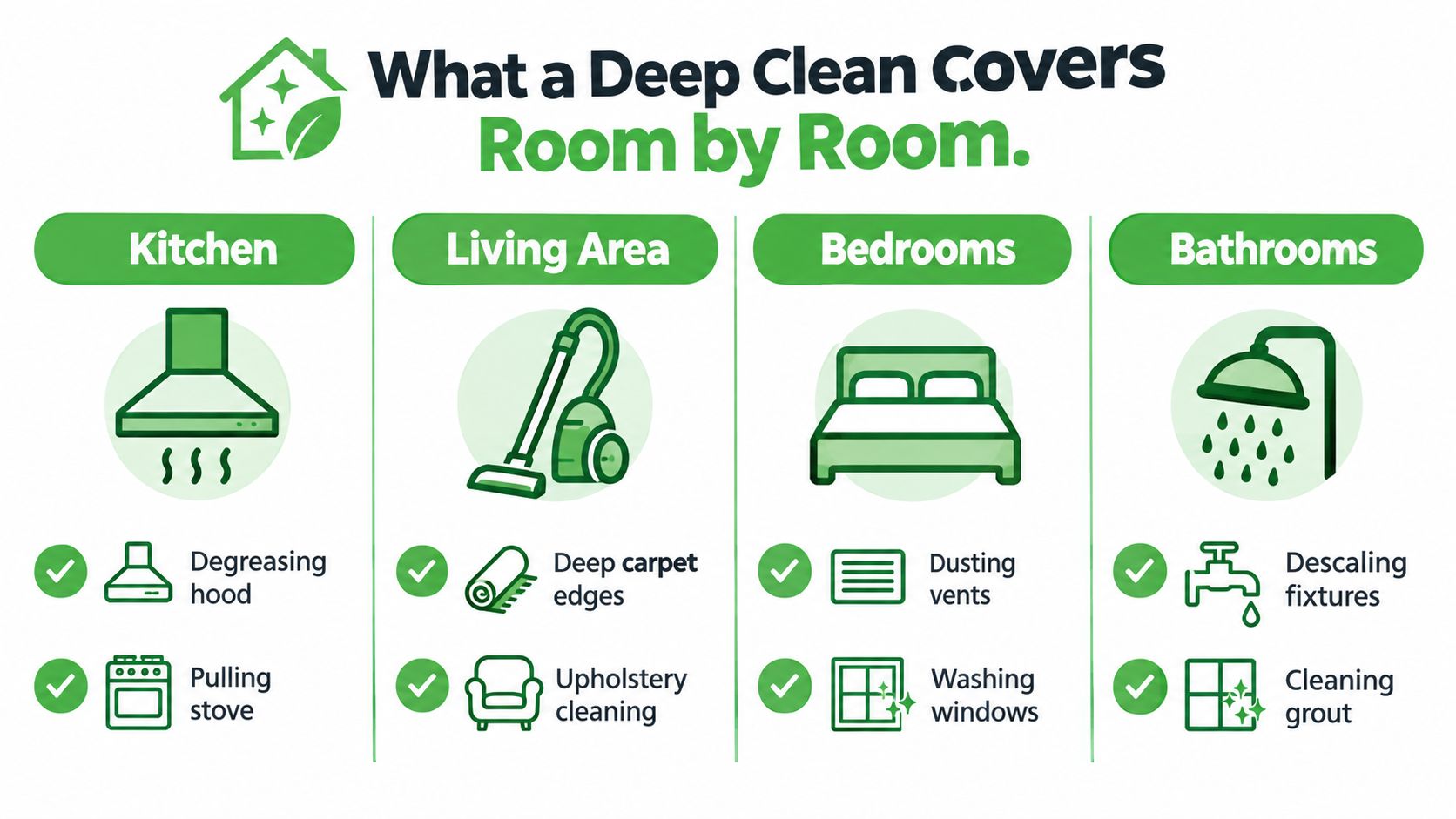
A real deep clean follows the home's structure rather than stopping at the surfaces that are easiest to reach. Room-by-room checklists commonly include the kitchen, bathrooms, bedrooms, and living areas, with special attention to fixtures, appliances, edges, and areas behind or underneath furniture.
Kitchen
Kitchen buildup has a way of hiding in plain sight. A detailed service may degrease the range hood, clean the underside of cabinet edges, pull out the stove when it's safe to do so, and remove residue from the floor beneath it. Faucet aerators can collect mineral deposits, while grout lines darken from moisture and cooking soil.
The refrigerator and oven interiors may be included in some deep-clean packages, but not all. That's one reason to read the checklist before booking rather than assuming every provider defines “deep” the same way. If the inside of the fridge, oven, cabinets, or drawers is essential, confirm it in writing.
Bathrooms
Bathrooms need more than a quick pass over the sink and toilet. Deep work addresses soap scum on shower glass, limescale on showerheads and faucets, grout lines, the area behind the toilet, and the grime that builds around the toilet base.
Use the same behind-and-underneath mindset throughout the room. Clean the lower edges of vanities, the floor perimeter, light switches, vent covers, and the places where hair and dust gather along trim.
Living areas
In living rooms and family rooms, look upward and outward. Ceiling fans, light fixtures, vents, window sills, window tracks, baseboards, switch plates, upholstery seams, and the dust line where the wall meets the ceiling all deserve attention. Vacuuming along sofa seams and beneath furniture matters in pet-friendly Dallas households where dander and hair settle out of sight.
Microfiber cloths, damp dusting, and careful vacuuming help control particles instead of merely redistributing them. Advice about controlling dust in Arizona homes offers a useful reminder that dust management depends on technique and capture, not just the number of times someone wipes a surface.
Bedrooms and floors
Bedrooms often benefit from cleaning under beds, vacuuming the mattress surface, wiping closet shelves, and cleaning windowsills and tracks. Floors need edge work along baseboards and in corners, where a weekly mop or vacuum head may not reach.
For a more detailed checklist, see what deep cleaning includes. The exact scope still depends on the home, furnishings, condition, and service agreement.
Why the Method Matters for Indoor Air and Health
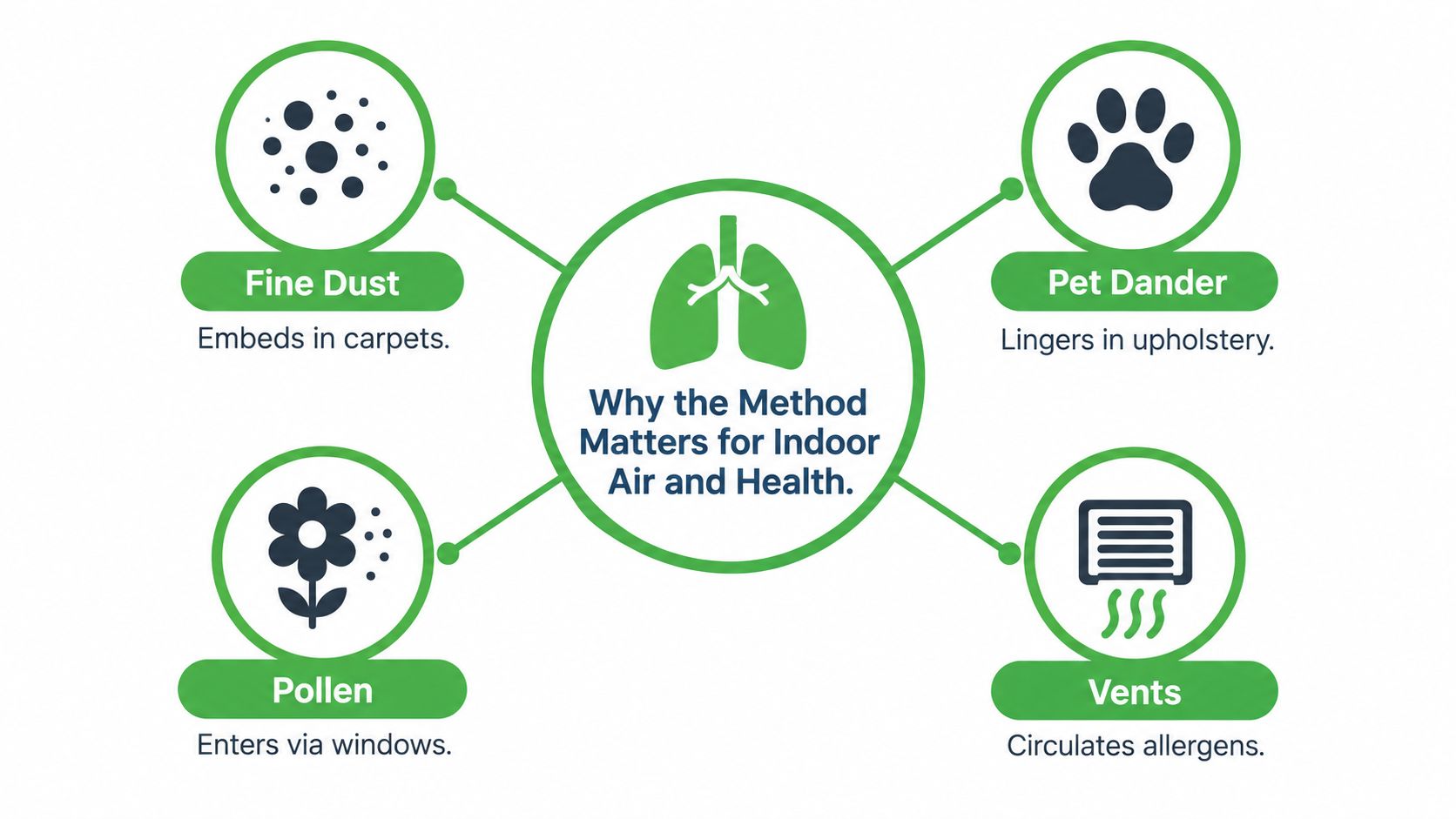
Dust doesn't stay where you first notice it. Fine particles can settle into carpet edges, upholstery seams, window tracks, and vent covers, then move again when people walk through a room or the HVAC system operates. Pet dander and pollen can follow the same paths, especially in homes with shedding animals, open windows, or frequent outdoor activity.
The cleaning method determines whether those particles are captured or scattered. A dry feather duster can lift dust into the air. A damp microfiber cloth holds soil more effectively on suitable surfaces, while a vacuum designed for high-efficiency particle capture can collect what a broom leaves behind. The Wisconsin Department of Health Services explains that HEPA filtration is designed to capture at least 99.97% of particles at 0.3 micrometers, and it recommends approaches such as wet dusting and HEPA-grade capture for indoor dust control. Read the indoor-air-quality guidance on dust removal.
What field research tells us
A double-blind intervention study in Oslo in 1998 followed 114 nonsmokers with irritation complaints. In the intervention group, mean dust concentration fell from 67 micrograms per cubic meter before cleaning to 50 micrograms per cubic meter afterward, while the control group received only superficial cleaning. The study also reported a median 1.0-point reduction on an irritation index from 0 to 8, along with odds ratios of 3.5 for achieving a 2-point symptom reduction and 4.2 for reducing nasal congestion above the 70th percentile. Review the study record in PubMed.
That research doesn't mean a house cleaning service treats a medical condition. It does show why thorough cleaning has long been discussed as an indoor-environment intervention, not merely a cosmetic exercise.
Fragrance isn't proof of cleanliness
A strong scent can make a room feel freshly cleaned, but it doesn't prove that dust or residue was removed. Fragrance can also be a poor fit for people who prefer fewer airborne irritants or who are sensitive to scented products. Fragrance-free means synthetic scents are left out entirely. It isn't the same as unscented, which can sometimes describe a product with masking ingredients, and it isn't the same as low-fragrance.
When to Schedule a Deep Clean in a DFW Home
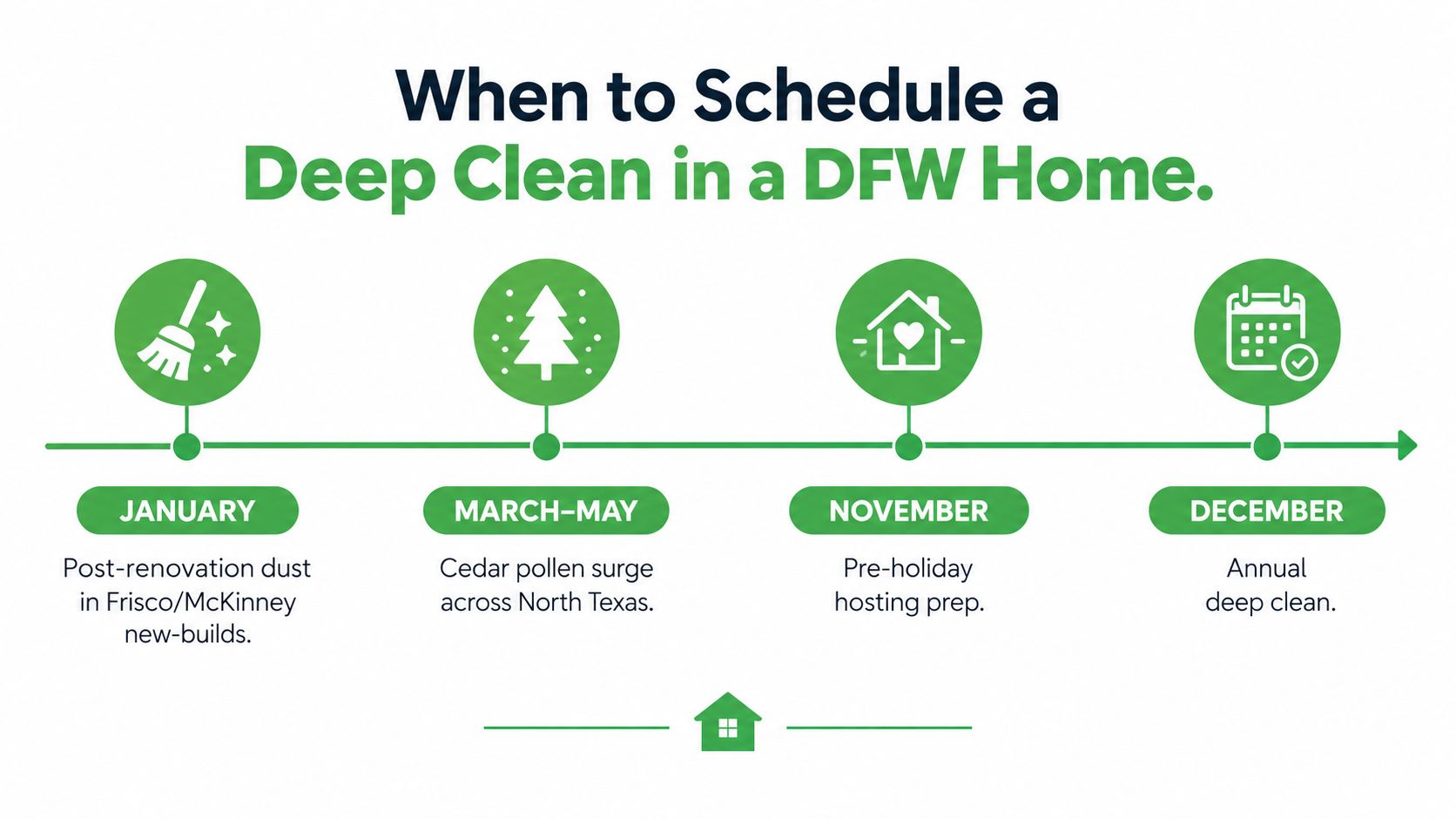
Dallas homes often need a reset when local conditions or household transitions create more soil than routine cleaning can comfortably handle. A new-construction home in Frisco or McKinney may have fine construction dust in trim gaps, cabinets, vents, and floors. That situation calls for post-construction cleaning, which is a different service conversation from ordinary deep cleaning because debris and residue may require specialized handling.
Seasonal reasons
Cedar pollen is a distinct Dallas consideration. One local allergy source describes cedar fever as running from late December through February, while another says Dallas tree pollen season starts in late December and lasts until May, with cedar among the most problematic types. See the Dallas allergy forecast.
That makes a post-winter reset sensible for a home where pollen enters through doors and windows, settles on sills, and circulates through the household's normal activity. Spring can bring another useful reset, especially after open-window days, outdoor play, and heavy entertaining.
Household moments
November is a practical time to schedule a deep clean before holiday hosting. It gives you an opportunity to address neglected trim, bathroom buildup, kitchen grease, and guest-room details before family arrives. A household with pets may also choose a reset when shedding becomes especially noticeable or when upholstery and floor edges need focused attention.
Move-in and move-out periods are another clear trigger. Those services often have a defined empty-home scope, and a move-in or move-out clean may include the inside of the refrigerator, oven, cabinets and drawers, and closets. A new baby, a major decluttering project, or a return from an extended absence can also justify a more detailed reset.
A practical cadence
There isn't one correct calendar for every home. A lightly used guest room needs less frequent attention than a busy Dallas household with pets, children, frequent visitors, and long AC use. Industry summaries report that 40% of cleaning clients use deep cleaning services at least three times a year, while 16% use quarterly deep cleaning and 9% use biweekly services. Review the house-cleaning industry summary.
Use those figures as evidence that recurring deep-clean demand exists, not as a rule for your household. Let dust, pollen, traffic, pets, construction, and upcoming hosting plans determine the timing.
What Deep Cleaning Does Not Include and Why Products Matter
The phrase “deep cleaning” sounds precise, but providers don't always use it the same way. One checklist may include the inside of an oven and refrigerator, while another may treat those as add-ons. Exterior windows, carpet shampooing, wall washing, mold remediation, pest control, hoarding cleanup, and repairs commonly require separate services or special arrangements.
| Typically Included | Usually Not Included |
|---|---|
| Baseboards, vents, ceiling fans, light fixtures, window sills, and tracks | Exterior window washing or high-access glass work |
| Detailed kitchen and bathroom surface cleaning | Mold remediation, pest control, or water-damage restoration |
| Grout, soap residue, grease buildup, and floor edges | Carpet shampooing or upholstery extraction unless specifically added |
| Vacuuming beneath accessible furniture and along upholstery seams | Repairs, painting, maintenance, or appliance servicing |
| High-touch surfaces and appropriate surface disinfection | Hoarding cleanup or hazardous-material removal |
Ask what the checklist means
Before booking, ask whether the quoted service includes the inside of appliances, cabinets, drawers, closets, blinds, walls, and windows. Home size, condition, furniture, and access can change the workload. A written scope prevents disappointment and makes it easier to compare services fairly.
Disinfection also deserves careful wording. Cleaning removes soil first. Disinfecting is a targeted step for appropriate surfaces, using an EPA-registered product and its required contact time. If a home needs a specialized hygiene response, compare the scope with professional disinfecting services rather than assuming every deep clean includes that level of work.
Read the label, not the scent
For a non-toxic approach, look for transparent ingredient information, pH-appropriate products, and meaningful third-party standards. The EPA's Safer Choice program has a separate fragrance-free label, and a product can qualify only after EPA review confirms that it contains no fragrance materials. Learn how the Safer Choice label works.
A fragrance-free product isn't automatically right for every surface, but it gives families a clearer starting point. Gmaids' guide to pet-safe cleaning products is also useful for households thinking about residues on floors where babies crawl and pets nap. The aim is fewer harsh chemicals, not fear of every ingredient.
Booking a Deep Clean in Dallas Fort Worth
Start with a short walkthrough before contacting a service. Note the rooms that routine cleaning skips, the areas where pets sleep, the bedrooms used by allergy-sensitive family members, and any post-renovation zones. Write down whether you need a one-time reset, a move-in or move-out clean, post-construction cleaning, or a recurring plan afterward.
Questions worth asking
A trustworthy Dallas Fort Worth service should answer specific questions without making you chase the details:
- What does the checklist include? Ask about baseboards, vents, window tracks, appliances, grout, upholstery seams, closets, and areas beneath furniture.
- What is excluded? Confirm whether exterior windows, carpet extraction, wall washing, mold remediation, and interior appliances require an add-on.
- Who will do the work? Ask about crew size, training, background checks, insurance, and whether the same team can return for recurring visits.
- What equipment is used? Ask whether the team brings microfiber cloths and vacuums with HEPA-grade filtration or another method for controlling fine dust.
- Which products are used? Tell the provider if you need fragrance-free products, especially in nurseries, pet areas, bedrooms, or homes with chemical sensitivities.
- How is the quote calculated? Look for transparent pricing tied to the home's size, condition, scope, or estimated labor rather than a vague promise of “everything.”
You don't need to empty the house before the team arrives. Clear countertops, pick up loose clothing and toys, secure pets, and identify delicate surfaces or areas that need special care. If a room contains valuable items, move them or explain what should not be touched.
What good service looks like afterward
A defined scope, clear product information, proof of insurance, and a practical arrival plan are signs of a professional operation. After the work, inspect the areas you identified at booking. Check baseboards in a naturally lit room, the edges of floors, vent covers, shower glass, kitchen buildup zones, and the spaces beneath accessible furniture.
Share feedback the same day while the visit is still fresh. A company that offers a 24-hour satisfaction policy should give you a clear way to report anything that isn't right and make it right. After the reset, recurring maid service on a weekly, biweekly, or monthly schedule can keep the home from returning to the same level of buildup.
Since 2004, Gmaids has served Dallas Fort Worth with non-toxic, fragrance-free cleaning through trained, background-checked, insured Gmaids Certified Cleaning Teams®. Its service options include basic cleaning, deep cleaning, move-in and move-out cleaning, post-construction cleaning, office cleaning, commercial cleaning, and sanitizing cleaning. The company's promise is “Healthy Homes, Families and Souls. We green clean without toxic chemicals.” It serves Dallas neighborhoods including Uptown, Preston Hollow, Highland Park, University Park, Lakewood, East Dallas, Lake Highlands, M Streets, Bluffview, Kessler Park, and Bishop Arts/Oak Cliff, along with Plano, Frisco, McKinney, Allen, Prosper, Celina, Richardson, Addison, Carrollton, Farmers Branch, Coppell, Southlake, Grapevine, Colleyville, Westlake, Flower Mound, Highland Village, and Irving.
If your Dallas Fort Worth home needs a detailed reset without bleach, ammonia, or synthetic fragrance, visit Gmaids for an instant, flat-rate quote online. You can also call 214-997-6918 to discuss deep cleaning, seasonal dust, pet areas, or a recurring plan that keeps the work manageable.


Ready for a healthier, cleaner home?

Gmaids is Dallas's original non-toxic house cleaning and maid service green since 2004. We deliver consistent, reliable, eco-friendly cleaning across Dallas–Fort Worth using fragrance-free products that are safe for kids, pets, and allergies, performed by our Certified Cleaning Teams®.
support@gmaids.com